
Title
Public Choice Interpretations of American Economic History,Used
Sold by Ergodebooks, an authorized reseller.
Returns accepted within 30 days | support@ergodebooks.com
Shipping Information
- Free Standard Shipping — United States only
- Processing Time: 3–5 business days
- Estimated Delivery: 6–10 business days after dispatch
- Double-boxed, fully insured & discreetly packaged
- Tracking number sent via email once dispatched
Returns & Refund
Returns accepted within 30 days of delivery.
Damaged or Defective Item
Free return shipping + replacement or full refund
Wrong Item Received
Free return shipping + replacement or full refund
Change of Mind
Return shipping at customer's expense · 25% restocking fee applies
Payment Option

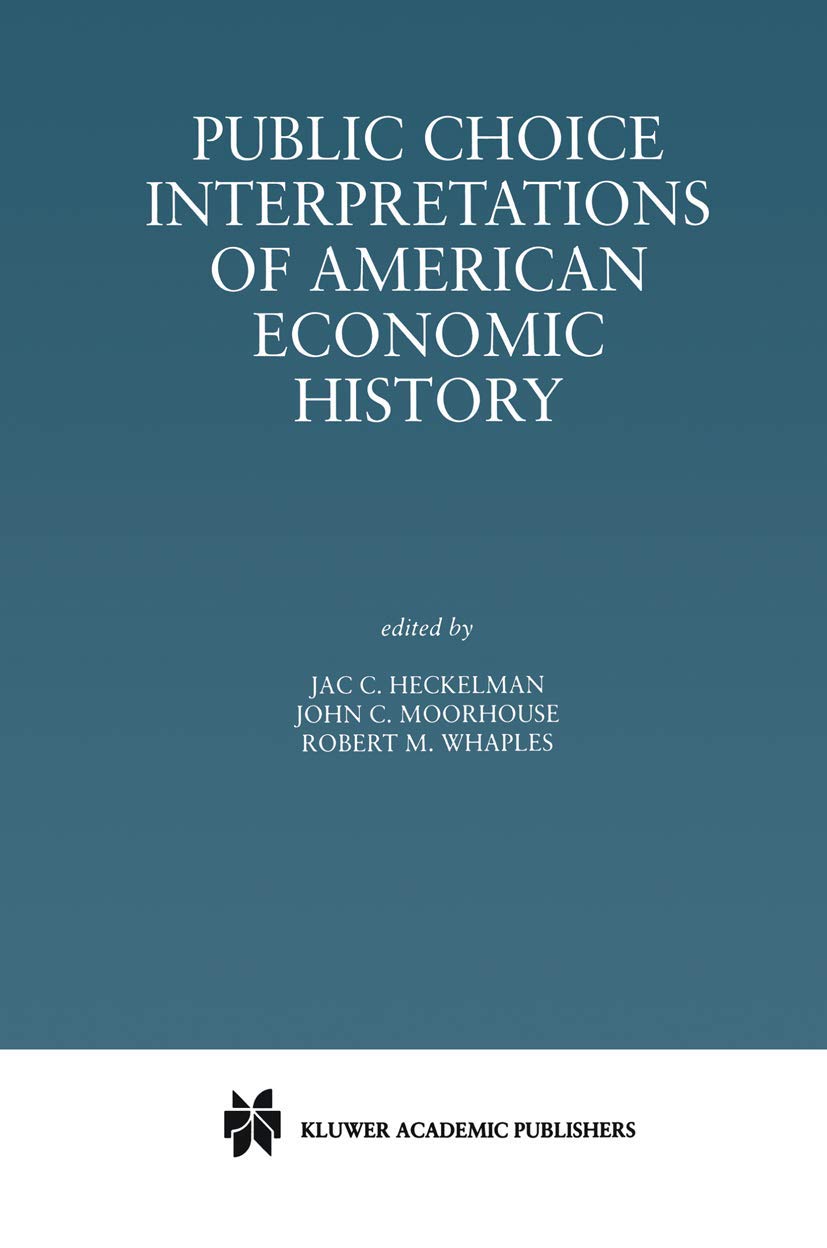
Jac C. Heckelman, John C. Moorhouse and Robert Whaples The eight chapters of this volume are revised versions of papers originally presented at the "Applications of Public Choice Theory to Economic History" conference held at Wake Forest University, April 910, 1999. They all apply the tools of public choice theory to the types of questions which economic historians have traditionally addressed. By adding the insights of public choice economics to the traditional tools used to understand economic actors and institutions, the authors are able to provide fresh insights about many important issues of American history. 1. DEVELOPMENTS IN PUBLIC CHOICE THEORY Economists have historically sought to develop policies to improve social welfare by correcting perceived market failures due to monopoly power, externalities, and other departures from the textbook case of the purely competitive model. An underlying assumption is that the public sector, upon recognizing the market failure, will act to correct it. Applied work often develops the conditions under which these policies will be optimal. The public choice movement has questioned the false dichotomy established by welfare economists. Economists of all persuasions assume traditional private market actors, such as entrepreneurs, managers, and consumers, are selfinterested rational maximizers. Why should this not hold for all economic agents? The innovation of public choice analysis is to show what happens when public sector actors, such as politicians, bureaucrats, and voters, also behave as rational selfinterested maximizers.
⚠️ WARNING (California Proposition 65):
This product may contain chemicals known to the State of California to cause cancer, birth defects, or other reproductive harm.
For more information, please visit www.P65Warnings.ca.gov.