
Title
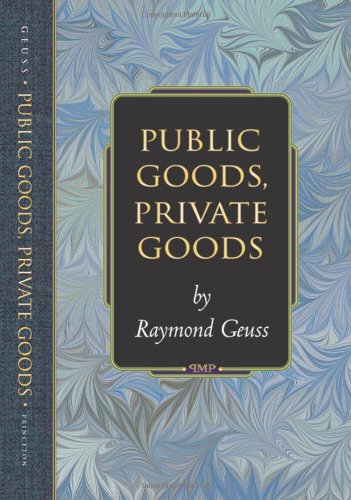
Public Goods, Private Goods.,Used
Sold by Ergodebooks, an authorized reseller.
Returns accepted within 30 days | support@ergodebooks.com
Shipping Information
- Free Standard Shipping — United States only
- Processing Time: 3–5 business days
- Estimated Delivery: 6–10 business days after dispatch
- Double-boxed, fully insured & discreetly packaged
- Tracking number sent via email once dispatched
Returns & Refund
Returns accepted within 30 days of delivery.
Damaged or Defective Item
Free return shipping + replacement or full refund
Wrong Item Received
Free return shipping + replacement or full refund
Change of Mind
Return shipping at customer's expense · 25% restocking fee applies
Payment Option

Much political thinking today, particularly that influenced by liberalism, assumes a clear distinction between the public and the private, and holds that the correct understanding of this should weigh heavily in our attitude to human goods. It is, for instance, widely held that the state may address human action in the ''public'' realm but not in the ''private.'' In Public Goods, Private Goods Raymond Geuss exposes the profound flaws of such thinking and calls for a more nuanced approach. Drawing on a series of colorful examples from the ancient world, he illustrates some of the many ways in which actions can in fact be understood as public or private.The first chapter discusses Diogenes the Cynic, who flouted conventions about what should be public and what should be private by, among other things, masturbating in the Athenian marketplace. Next comes an analysis of Julius Caesar's decision to defy the Senate by crossing the Rubicon with his army; in doing so, Caesar asserted his dignity as a private person while acting in a public capacity. The third chapter considers St. Augustine's retreat from public life to contemplate his own, private spiritual condition. In the fourth, Geuss goes on to examine recent liberal views, questioning, in particular, common assumptions about the importance of public dialogue and the purportedly unlimited possibilities humans have for reaching consensus. He suggests that the liberal concern to maintain and protect, even at a very high cost, an inviolable ''private sphere'' for each individual is confused.Geuss concludes that a view of politics and morality derived from Hobbes and Nietzsche is a more realistic and enlightening way than modern liberalism to think about human goods. Ultimately, he cautions, a simplistic understanding of privacy leads to simplistic ideas about what the state is and is not justified in doing.
⚠️ WARNING (California Proposition 65):
This product may contain chemicals known to the State of California to cause cancer, birth defects, or other reproductive harm.
For more information, please visit www.P65Warnings.ca.gov.