
Title
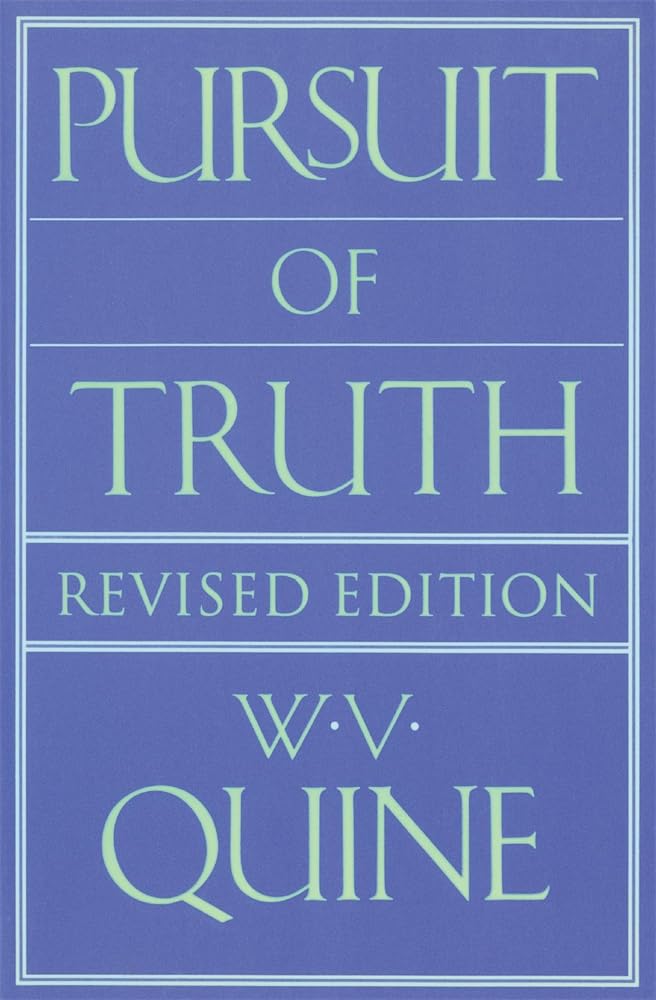
Pursuit Of Truth: Revised Edition,New
Sold by Ergodebooks, an authorized reseller.
Returns accepted within 30 days | support@ergodebooks.com
Shipping Information
- Free Standard Shipping — United States only
- Processing Time: 3–5 business days
- Estimated Delivery: 6–10 business days after dispatch
- Double-boxed, fully insured & discreetly packaged
- Tracking number sent via email once dispatched
Returns & Refund
Returns accepted within 30 days of delivery.
Damaged or Defective Item
Free return shipping + replacement or full refund
Wrong Item Received
Free return shipping + replacement or full refund
Change of Mind
Return shipping at customer's expense · 25% restocking fee applies
Payment Option

In Pursuit of Truth W. V. Quine gives us his latest word on issues to which he has devoted many years. As he says in the preface: 'In these pages I have undertaken to update, sum up, and clarify my variously intersecting views on cognitive meaning, objective reference, and the grounds of knowledge' The pursuit of truth is a quest that links observation, theory, and the world. Various faulty efforts to forge such links have led to much intellectual confusion. Quine's efforts to get beyond the confusion begin by rejecting the very idea of binding together word and thing, rejecting the focus on the isolated word. For him, observation sentences and theoretical sentences are the alpha and omega ofthe scientific enterprise. Notions like 'idea' and 'meaning' are vague, but a sentencenow there's something you can sink your teeth into. Starting thus with sentences, Quine sketches an epistemological setting for the pursuit of truth. He proceeds to show how reification and reference contribute to the elaborate structure that can indeed relate science to its sensory evidence. In this book Quine both summarizes and moves ahead. Rich, lively chapters dissect his major concernsevidence, reference, meaning, intension, and truth. 'Some points' he writes, 'have become clearer in my mind in the eight years since Theories and Things. Some that were already clear in my mind have become clearer on paper. And there are some that have meanwhile undergone substantive change for the better' This is a key book for understanding the effort that a major philosopher has made a large part of his life's work: to naturalize epistemology in the twentieth century. The book is concise and elegantly written, as one would expect, and does not assume the reader's previous acquaintance with Quine's writings. Throughout, it is marked by Quine's wit and economy of style.
⚠️ WARNING (California Proposition 65):
This product may contain chemicals known to the State of California to cause cancer, birth defects, or other reproductive harm.
For more information, please visit www.P65Warnings.ca.gov.
- Q: How many pages does this book have? A: This book has one hundred twenty-six pages. It provides an in-depth exploration of epistemology and cognitive meaning.
- Q: What is the binding type of this book? A: The binding type is paperback. This makes it lightweight and easy to handle for reading.
- Q: What are the dimensions of this book? A: The dimensions are five point nine eight inches in length, zero point three one inches in width, and nine point zero two inches in height. These dimensions make it a convenient size for reading.
- Q: Who is the author of this book? A: The author is W. V. Quine. He is a prominent philosopher known for his work in epistemology and logic.
- Q: What topics does this book cover? A: The book covers topics such as cognitive meaning, objective reference, and the grounds of knowledge. It aims to clarify Quine's views on these subjects.
- Q: Is this book suitable for beginners in philosophy? A: Yes, this book is suitable for beginners. It does not assume previous acquaintance with Quine's writings, making it accessible.
- Q: How should I read this book for best understanding? A: To best understand this book, read it actively and take notes on the key concepts discussed. Engaging with the material will enhance comprehension.
- Q: What age group is this book appropriate for? A: This book is appropriate for adults and mature teens interested in philosophy. It deals with complex ideas that require critical thinking.
- Q: Can I use this book for academic purposes? A: Yes, this book is suitable for academic purposes. It is a key resource for studying epistemology and Quine's philosophical contributions.
- Q: What are the best practices for storing this book? A: Store this book in a cool, dry place, away from direct sunlight. This will help preserve its condition over time.
- Q: How do I clean this book if it gets dirty? A: To clean this book, gently wipe the cover with a soft, dry cloth. Avoid using water or cleaning solutions that could damage the pages.
- Q: What should I do if the book arrives damaged? A: If the book arrives damaged, contact the seller for a return or exchange. Most sellers have policies in place to handle such issues.
- Q: Can I return this book if I'm not satisfied? A: Yes, you can usually return the book if you are not satisfied. Check the seller's return policy for specific details.
- Q: Is there a warranty for this book? A: No, there is typically no warranty for books. However, you can inquire about return policies.
- Q: What if I have questions about the content after reading? A: If you have questions about the content, consider joining a philosophy discussion group or seeking out online forums. Engaging with others can provide further insights.
- Q: Is this book considered a classic in philosophy? A: Yes, this book is considered a classic in philosophy, particularly in the field of epistemology. Quine's work has had a significant impact on contemporary thought.