
Title
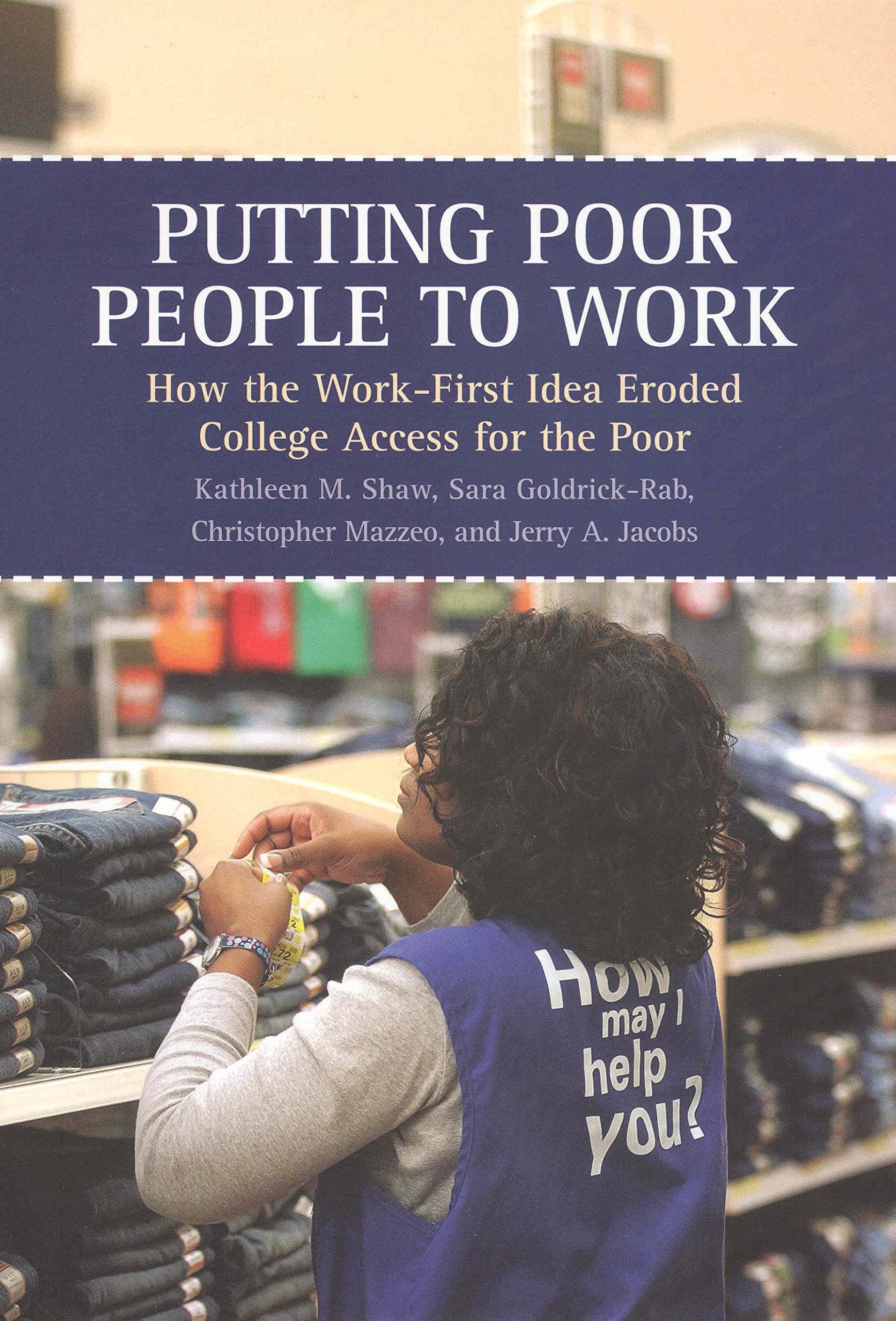
Putting Poor People To Work: How The Workfirst Idea Eroded College Access For The Poor,Used
Sold by Ergodebooks, an authorized reseller.
Returns accepted within 30 days | support@ergodebooks.com
Shipping Information
- Free Standard Shipping — United States only
- Processing Time: 3–5 business days
- Estimated Delivery: 6–10 business days after dispatch
- Double-boxed, fully insured & discreetly packaged
- Tracking number sent via email once dispatched
Returns & Refund
Returns accepted within 30 days of delivery.
Damaged or Defective Item
Free return shipping + replacement or full refund
Wrong Item Received
Free return shipping + replacement or full refund
Change of Mind
Return shipping at customer's expense · 25% restocking fee applies
Payment Option

Today, a college education is increasingly viewed as the gateway to the American Dreama necessary prerequisite for social mobility. Yet recent policy reforms in the United States effectively steer former welfare recipients away from an education that could further their career prospects, forcing them directly into the workforce where they often find only lowpaying jobs with little opportunity for growth. In Putting Poor People to Work, Kathleen Shaw, Sara GoldrickRab, Christopher Mazzeo, and Jerry A. Jacobs explore this troubling disconnect between the principles of 'workfirst' and 'college for all.' Using comprehensive interviews with government officials and sophisticated data from six states over a four year period, Putting Poor People to Work shows how recent changes in public policy have reduced the quantity and quality of education and training available to adults with low incomes. The authors analyze how two policies encouraging workthe federal welfare reform law of 1996 and the Workforce Investment Act of 1998have made moving people off of public assistance as soon as possible, with little regard to their longterm career prospects, a government priority. Putting Poor People to Work shows that since the passage of these 'workfirst' laws, not only are fewer lowincome individuals pursuing postsecondary education, but when they do, they are increasingly directed towards the most ineffective, shortterm forms of training, rather than higherquality collegelevel education. Moreover, the schools most able and ready to serve poor adultsthe community collegesare deterred by these policies from doing so. Having a competitive, agile workforce that can compete with any in the world is a national priority. In a global economy where skills are paramount, that goal requires broad popular access to education and training. Putting Poor People to Work shows how current U.S. policy discourages poor Americans from seeking out a college education, stranding them in jobs with little potential for growth. This important new book makes a powerful argument for a shift in national priorities that would encourage the poor to embrace both work and education, rather than having to choose between the two. Institute for Research on Poverty Affiliated Books on Poverty and Public Policy'>An Institute for Research on Poverty Affiliated Book on Poverty and Public Policy
⚠️ WARNING (California Proposition 65):
This product may contain chemicals known to the State of California to cause cancer, birth defects, or other reproductive harm.
For more information, please visit www.P65Warnings.ca.gov.