
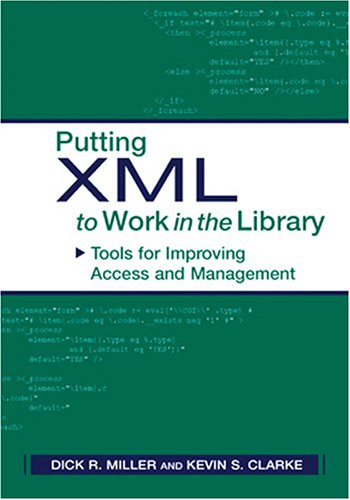
Title
Putting XML to Work in the Library: Tools for Improving Access and Management,Used
Sold by Ergodebooks, an authorized reseller.
Returns accepted within 30 days | support@ergodebooks.com
Shipping Information
- Free Standard Shipping — United States only
- Processing Time: 3–5 business days
- Estimated Delivery: 6–10 business days after dispatch
- Double-boxed, fully insured & discreetly packaged
- Tracking number sent via email once dispatched
Returns & Refund
Returns accepted within 30 days of delivery.
Damaged or Defective Item
Free return shipping + replacement or full refund
Wrong Item Received
Free return shipping + replacement or full refund
Change of Mind
Return shipping at customer's expense · 25% restocking fee applies
Payment Option

Optimize information access across platforms, vendors, andthroughout your library! Offering the advantages of both control and flexibility, the authors show how librarians using XML can begin to selectively impose control in the haphazard digital environment.XML, the language of the Web, is becoming the tool of choice to modernize the technical infrastructure in the information profession. XML champions Miller and Clarke argue that for dealing with content, metadata, and access issues, XML provides an elegant and useful solution. Offering a universal format for data and document exchange, XML addresses many shortcomings of Web access, but how and where should you start?Putting XML to Work in the Library offers complete answers to these questions, as the authors outline small proactive steps for libraries, illustrated with specific examples. This userfriendly roadmap outlines basic, practical applications of XMLExtensible Markup Language, derived from SGML.It addresses such technical questions as: What is XML and why is it important? How can XML address libraries' technical challenges? When and how are style sheets and schemas used? Where does XML come into play to strategically integrate with MARC and AACR data? What makes for a "wellformed" XML document that conforms to XML rules of syntax?Embrace XML standards and extend bibliographic control into new areas.For librarians working in systems, technical services, cataloging, and as webmasters, these are the tools you need to create more integrated solutions to organize and create access to information.
⚠️ WARNING (California Proposition 65):
This product may contain chemicals known to the State of California to cause cancer, birth defects, or other reproductive harm.
For more information, please visit www.P65Warnings.ca.gov.