
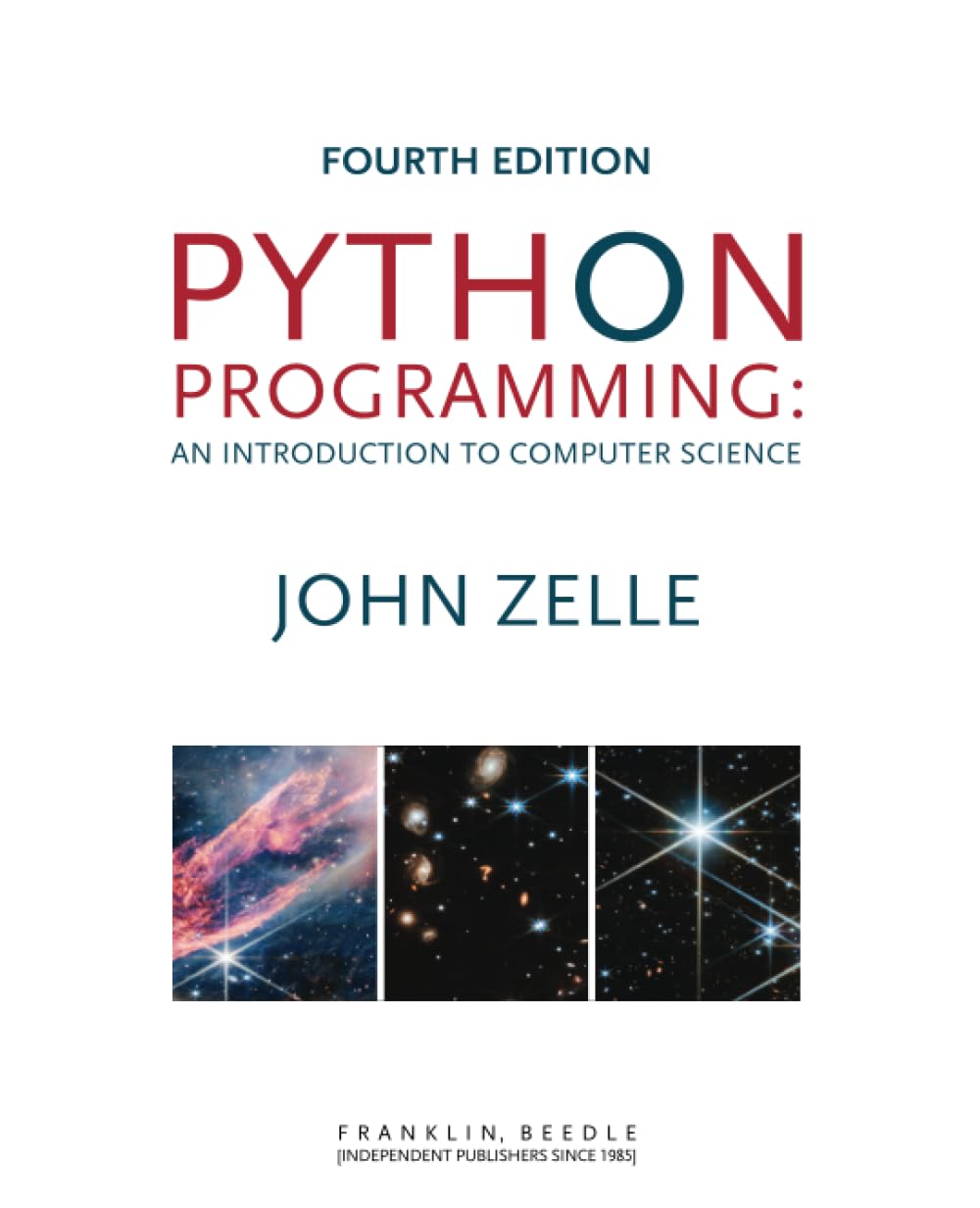
Title
Python Programming: An Introduction To Computer Science, Fourth Edition
Sold by Ergodebooks, an authorized reseller.
Returns accepted within 30 days | support@ergodebooks.com
Shipping Information
- Free Standard Shipping — United States only
- Processing Time: 3–5 business days
- Estimated Delivery: 6–10 business days after dispatch
- Double-boxed, fully insured & discreetly packaged
- Tracking number sent via email once dispatched
Returns & Refund
Returns accepted within 30 days of delivery.
Damaged or Defective Item
Free return shipping + replacement or full refund
Wrong Item Received
Free return shipping + replacement or full refund
Change of Mind
Return shipping at customer's expense · 25% restocking fee applies
Payment Option

This New Edition Has All The Familiar Elements That Made Previous Editions A Leading Intro Textbook, Including:Extensive Use Of Computer Graphics. Coverage Includes A Simpletouse Graphics Package (Provided As A Python Module) That Allows Students Both To Learn The Principles Of Computer Graphics And To Practice Objectoriented Concepts Without The Complexity Inherent In A Fullblown Graphics Library And Eventdriven Programming.Interesting Examples. This Book Is Packed With Complete Programming Examples To Solve Real Problems. Readable Prose. Key Computer Science Concepts Are Introduced In A Natural Way As An Outgrowth Of A Developing Discussion.Flexible Spiral Coverage. Each Chapter Is Organized So That New Ideas Are Introduced Gradually, Giving Students Time To Assimilate An Increasing Level Of Detail. Ideas That Take More Time To Master Are Introduced In Early Chapters And Reinforced In Later Chapters.Justintime Object Coverage. This Book Gradually Introduces Object Concepts After A Brief Initial Grounding In The Basics Of Imperative Programming. Students Learn Multiple Design Techniques, Including Topdown (Functional Decomposition), Spiral (Prototyping), And Objectoriented Methods.Extensive Endofchapter Problems. Exercises At The End Of Every Chapter Provide Ample Opportunity For Students To Reinforce Their Mastery Of The Chapter Material And To Practice New Programming Skills.New To The Fourth Editionthe Focus Of This Edition Continues To Be On Providing A Solid Foundation In Computer Science Appropriate For A First Computing Course For Cs Majors (Cs1). At The Same Time, Many Learners Outside Of Cs Are Also Keen To Develop Programming Skills. All Budding Programmers Are Best Served By A Firm Grounding In Computer Science And Software Design, So The Material Here Has Been Streamlined And Reorganized To Make It More Useful As A Reference For Learners In Csadjacent Fields Such As The Natural And Social Sciences, Data Science, And Intelligent Systems. Special Attention Is Paid To Essential Idioms That Students Are Likely To See In Python Code That They Encounter In The Wild. In Addition To Technology Updates Throughout, Those Familiar With The Previous Edition Will Notice These Changes:Addition Of New Material On Operating Systems And An Extended Discussion Of Persistent Data Including File Systems, Binary Files, And Data Serialization Over Networks.Inclusion Of New And Additional Python Features: Fstrings For String Formatting, Context Managers, List Comprehensions, Sequence Functions, And The Pathlib And Pickle Libraries.Streamlining Of Early Chapters Including Covering All Control Structures Before Going Into Depth On Sequence Types Such As Strings And Lists.Consolidation Of Objectedoriented Design Case Studies In A Dedicated Chapter.Additional Programming Exercises.
⚠️ WARNING (California Proposition 65):
This product may contain chemicals known to the State of California to cause cancer, birth defects, or other reproductive harm.
For more information, please visit www.P65Warnings.ca.gov.
- Q: How many pages does this book have? A: This book has five hundred seventy-four pages. It provides an extensive exploration of computer science concepts for beginners.
- Q: What is the size of the book? A: The book measures seven point five two inches in length, one point three inches in width, and nine point two five inches in height. This size makes it portable and easy to read.
- Q: What is the binding type of this book? A: This book is paperback bound. This type of binding is flexible and lightweight, making it ideal for students.
- Q: What programming language does this book focus on? A: This book focuses on Python programming. It is tailored to help students grasp computer science concepts through Python.
- Q: Who is the author of this book? A: The author of this book is John M. Zelle. He is known for his clear writing style and effective teaching methods.
- Q: What is the main audience for this book? A: This book is primarily aimed at introductory and beginning students. It serves as an ideal resource for first computing courses.
- Q: What topics are covered in this book? A: The book covers topics such as computer graphics, object-oriented programming, and essential Python features. It provides a solid foundation in computer science.
- Q: Is this book suitable for beginners? A: Yes, this book is suitable for beginners. It gradually introduces complex concepts, making it accessible to those new to programming.
- Q: Can this book be used for self-study? A: Yes, this book can be used for self-study. It includes exercises at the end of each chapter to reinforce learning.
- Q: Does this book include programming exercises? A: Yes, this book includes extensive end-of-chapter programming exercises. These exercises help students practice and master the material.
- Q: What updates are included in the fourth edition? A: The fourth edition includes updates on operating systems and new Python features like f-strings and context managers. It has streamlined content for better understanding.
- Q: How does this book differ from previous editions? A: This edition has reorganized material and includes additional topics for a broader audience. It emphasizes essential idioms and practical applications in Python.
- Q: Is there a focus on real-world applications in this book? A: Yes, the book focuses on real-world applications of programming. It contains interesting examples that relate to practical problems.
- Q: What kind of graphics does this book cover? A: This book covers basic computer graphics using a simple-to-use graphics package. It allows students to learn and practice without complexity.
- Q: Are there additional resources available with this book? A: Yes, the book may come with supplementary resources like online materials or a companion website. Check the publisher's site for details.
- Q: What design techniques are taught in this book? A: The book teaches several design techniques, including top-down, spiral, and object-oriented methods. These approaches help students understand programming logic.