If you have any questions, you are always welcome to contact us. We'll get back to you as soon as possible, withing 24 hours on weekdays.
Customer service
All questions about your order, return and delivery must be sent to our customer service team by e-mail at yourstore@yourdomain.com
Sale & Press
If you are interested in selling our products, need more information about our brand or wish to make a collaboration, please contact us at press@yourdomain.com
Help
If you have any questions, you are always welcome to contact us. We'll get back to you as soon as possible, withing 24 hours on weekdays.
Customer service
All questions about your order, return and delivery must be sent to our customer service team by e-mail at yourstore@yourdomain.com
Sale & Press
If you are interested in selling our products, need more information about our brand or wish to make a collaboration, please contact us at press@yourdomain.com
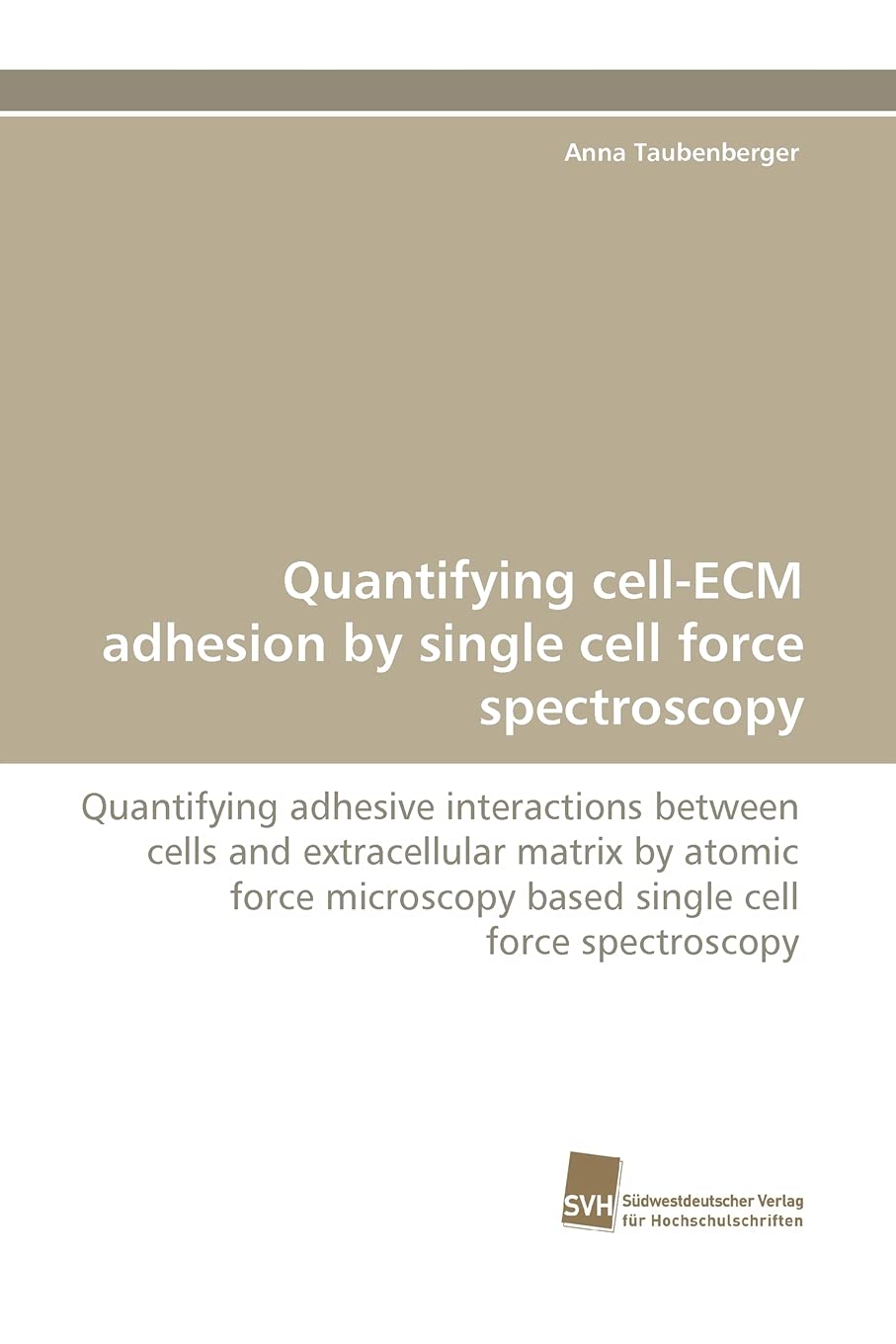
Integrinmediated adhesive interactions of cells with the extracellular matrix (ECM) regulate important cellular functions and play a critical role in disease. Therefore, studying the mechanisms underlying integrinbinding and regulation is of great interest. In the presented work three respective biological questions have been addressed using Atomic Force Microscopy based Single Cell Force Spectroscopy (AFMSCFS). The work is split into six chapters. The first chapter provides an introduction into cellECM interactions. Thereafter different adhesion assays are compared and contrasted, and the theoretical BellEvans model is discussed. In chapter four, alpha2beta1integrin mediated cell adhesion to collagen I is quantified. Thereafter the effects of the exposure of cryptic integrin binding sites within collagen I on preosteoblasts are analysed. At last, the role of BCR/ABL in modulating myeloid progenitor cell adhesion to stromal cells and ECMcoated substrates is studied. Taken together, the work demonstrates that AFMSCFS is a versatile tool that permits monitoring of cell adhesion from singlemolecule recognition events to the formation of more complex adhesion sites.
⚠️ WARNING (California Proposition 65):
This product may contain chemicals known to the State of California to cause cancer,
birth defects, or other reproductive harm.
For MAP (Minimum Advertised Price) violations and Intellectual Property (IP) or Trademark concerns, please contact:
support@ergodebooks.com
⚠️ California Proposition 65 Warning: Some products sold on this website may expose you to chemicals known to the State of California to cause cancer, birth defects, or other reproductive harm. For more information, visit www.P65Warnings.ca.gov.