If you have any questions, you are always welcome to contact us. We'll get back to you as soon as possible, withing 24 hours on weekdays.
Customer service
All questions about your order, return and delivery must be sent to our customer service team by e-mail at yourstore@yourdomain.com
Sale & Press
If you are interested in selling our products, need more information about our brand or wish to make a collaboration, please contact us at press@yourdomain.com
Help
If you have any questions, you are always welcome to contact us. We'll get back to you as soon as possible, withing 24 hours on weekdays.
Customer service
All questions about your order, return and delivery must be sent to our customer service team by e-mail at yourstore@yourdomain.com
Sale & Press
If you are interested in selling our products, need more information about our brand or wish to make a collaboration, please contact us at press@yourdomain.com
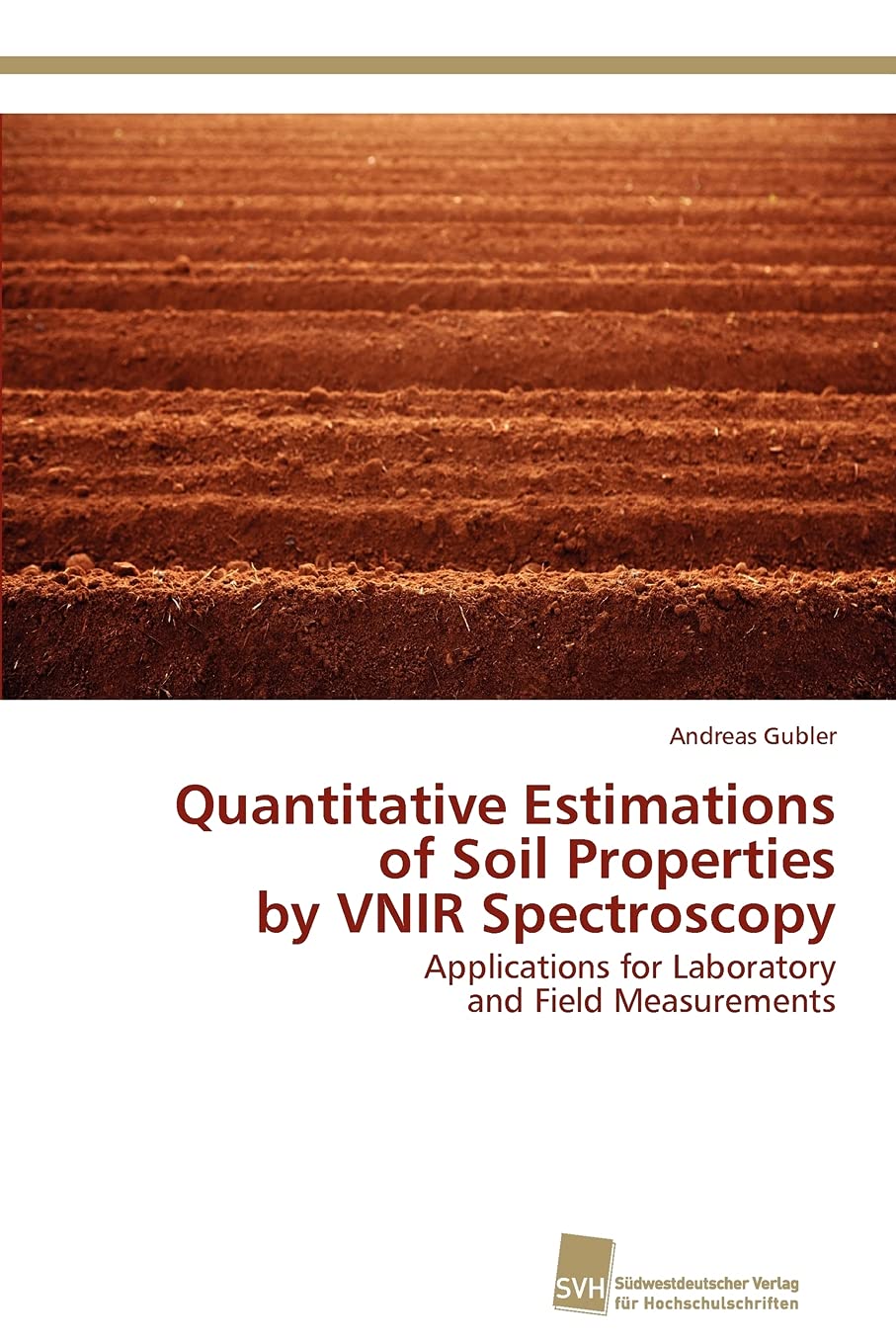
Soils are a limited resource. Information about soils is needed to assess and monitor its quality and to ensure a sustainable soil management. The acquisition of soil data is limited by the available amounts of time and money. Visible and Near Infrared Spectroscopy (VNIRS) measures the portion of reflected energy at wavelengths between 300 and 2500 nm and represents a novel, nondestructive technique allowing for fast and inexpensive soil analyses. In the present work, VNIRS was used to estimate organic carbon and total nitrogen contents of soil (samples) in the laboratory as well as directly (in situ) in the field. In addition, the effect of soil moisture on VNIR soil reflectance was addressed. The presented results confirm the ability of VNIRS to replace classical laboratory analyses of soils. Furthermore, the potential and the pitfalls of in situ measurements are illustrated. Besides, this text also provides an extensive and comprehensible introduction into the principles and the state of the art of Near Infrared Spectroscopy as well as the used statistical calibration and validation procedures.
⚠️ WARNING (California Proposition 65):
This product may contain chemicals known to the State of California to cause cancer,
birth defects, or other reproductive harm.
For MAP (Minimum Advertised Price) violations and Intellectual Property (IP) or Trademark concerns, please contact:
support@ergodebooks.com
⚠️ California Proposition 65 Warning: Some products sold on this website may expose you to chemicals known to the State of California to cause cancer, birth defects, or other reproductive harm. For more information, visit www.P65Warnings.ca.gov.