
Title
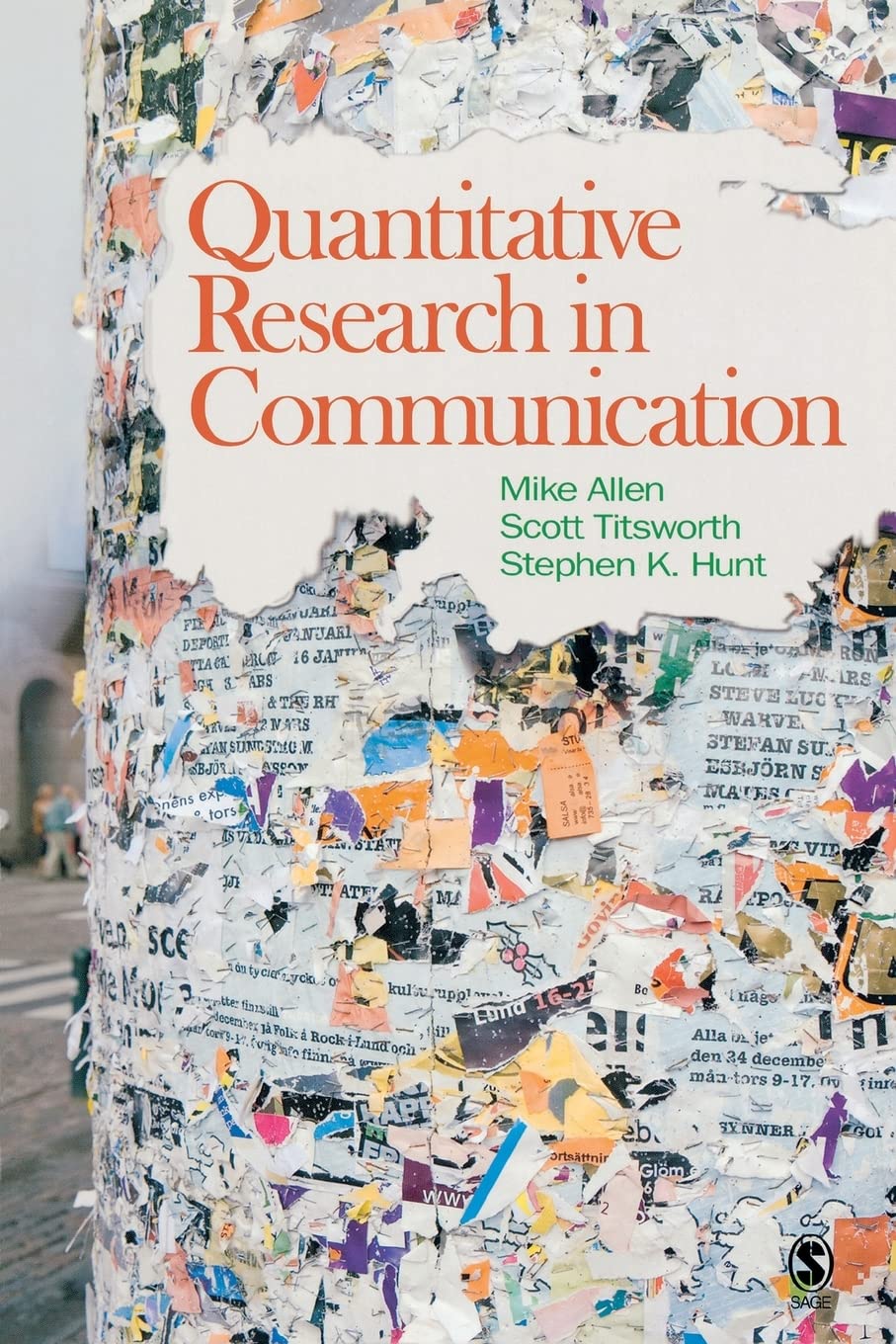
Quantitative Research in Communication,Used
Sold by Ergodebooks, an authorized reseller.
Returns accepted within 30 days | support@ergodebooks.com
Shipping Information
- Free Standard Shipping — United States only
- Processing Time: 3–5 business days
- Estimated Delivery: 6–10 business days after dispatch
- Double-boxed, fully insured & discreetly packaged
- Tracking number sent via email once dispatched
Returns & Refund
Returns accepted within 30 days of delivery.
Damaged or Defective Item
Free return shipping + replacement or full refund
Wrong Item Received
Free return shipping + replacement or full refund
Change of Mind
Return shipping at customer's expense · 25% restocking fee applies
Payment Option

Written for communication students, Quantitative Research in Communication provides practical, userfriendly coverage of how to use statistics, how to interpret SPSS printouts, how to write results, and how to assess whether the assumptions of various procedures have been met. Providing a strong conceptual orientation to techniques and procedures that range from the 'moderately basic' to 'highly advanced,' the book provides practical tips and suggestions for quantitative communication scholars of all experience levels.In addition to important foundational information, each chapter that covers a specific statistical procedure includes suggestions for interpreting, explaining, and presenting results; realistic examples of how the procedure can be used to answer substantive questions in communication; sample SPSS printouts; and a detailed summary of a published communication journal article using that procedure.Features Engaged Research application boxes stimulate thought and discussion, illustrating how particular research methods can be used to answer very practical, civicminded questions. Realistic examples at the beginning of each chapter show how the chapter's procedure could be used to answer a substantive research question. Examples and application activities geared toward the emerging trend of service learning encourage students to do projects oriented toward their community or campus. Summaries of journal articles demonstrate how to write statistical results in APA style and illustrate how real researchers use statistical procedures in a wide variety of contexts, such as tsunami warnings, date requests, and antidrug public service announcements. How to Decipher Figures show students how to 'read' the statistical shorthand presented in the quantitative results of an article and also, by implication, show them how to write up results .Quantitative Research in Communication is ideal for courses in Quantitative Methods in Communication, Statistical Methods in Communication, Advanced Research Methods (undergraduate), and Introduction to Research Methods (Graduate) in departments of communication, educational psychology, psychology, and mass communication.
⚠️ WARNING (California Proposition 65):
This product may contain chemicals known to the State of California to cause cancer, birth defects, or other reproductive harm.
For more information, please visit www.P65Warnings.ca.gov.
- Q: How many pages are in 'Quantitative Research in Communication'? A: There are two hundred fifty-six pages in 'Quantitative Research in Communication.' This offers a comprehensive resource for students and scholars.
- Q: What is the binding type of this book? A: The book is available in paperback binding. This makes it lightweight and easy to handle for reading and note-taking.
- Q: Who is the author of 'Quantitative Research in Communication'? A: The author is Mike Allen. He provides insights and guidance on quantitative methods in communication.
- Q: What is the size of 'Quantitative Research in Communication'? A: The book measures six inches in length, zero point fifty-nine inches in width, and nine point zero two inches in height. This size is standard for academic texts.
- Q: Is 'Quantitative Research in Communication' suitable for beginners? A: Yes, this book is suitable for beginners. It covers basic to advanced statistical procedures, making it accessible for all levels of learners.
- Q: Can I use this book for graduate-level courses? A: Yes, it is ideal for graduate-level courses. The content is designed to support advanced research methods in various communication studies.
- Q: How do I interpret SPSS printouts using this book? A: The book provides practical tips and detailed guidance on interpreting SPSS printouts. Each statistical procedure chapter includes examples to help understand the results.
- Q: Does this book include real-world examples? A: Yes, it includes realistic examples throughout. These examples illustrate how statistical procedures apply to substantive questions in communication.
- Q: What topics are covered in the book? A: The book covers a range of topics, including statistical techniques and procedures, data interpretation, and writing results in APA style.
- Q: How should I care for this paperback book? A: To care for the paperback book, keep it in a dry place away from direct sunlight. Avoid bending the spine to maintain its condition.
- Q: Is there a recommended reading order for the chapters? A: Yes, it is advisable to read the chapters in order as they build upon foundational concepts before progressing to more advanced techniques.
- Q: What if the book arrives damaged? A: If the book arrives damaged, you should contact the seller for return instructions or a replacement. Most sellers have policies for such issues.
- Q: Are there exercises included in the book? A: Yes, the book includes application activities and exercises. These are designed to help students apply the concepts learned to real-world scenarios.
- Q: Does the book explain how to write statistical results? A: Yes, it provides guidance on writing statistical results in APA style. This is crucial for students in communication research.
- Q: Is 'Quantitative Research in Communication' suitable for service learning projects? A: Yes, it encourages projects oriented towards community service. The book includes examples that motivate civic engagement through research.
- Q: What are the book's key features? A: Key features include Engaged Research application boxes, realistic examples, summaries of journal articles, and tips for deciphering statistical figures.