If you have any questions, you are always welcome to contact us. We'll get back to you as soon as possible, withing 24 hours on weekdays.
Customer service
All questions about your order, return and delivery must be sent to our customer service team by e-mail at yourstore@yourdomain.com
Sale & Press
If you are interested in selling our products, need more information about our brand or wish to make a collaboration, please contact us at press@yourdomain.com
Help
If you have any questions, you are always welcome to contact us. We'll get back to you as soon as possible, withing 24 hours on weekdays.
Customer service
All questions about your order, return and delivery must be sent to our customer service team by e-mail at yourstore@yourdomain.com
Sale & Press
If you are interested in selling our products, need more information about our brand or wish to make a collaboration, please contact us at press@yourdomain.com
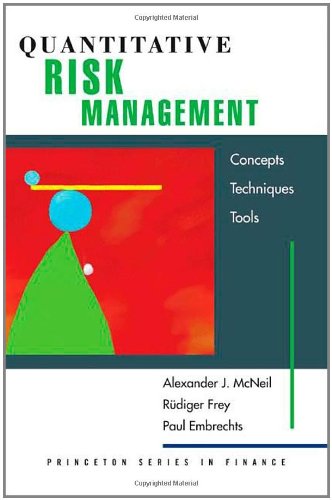
The implementation of sound quantitative risk models is a vital concern for all financial institutions, and this trend has accelerated in recent years with regulatory processes such as Basel II. This book provides a comprehensive treatment of the theoretical concepts and modelling techniques of quantitative risk management and equips readerswhether financial risk analysts, actuaries, regulators, or students of quantitative financewith practical tools to solve realworld problems. The authors cover methods for market, credit, and operational risk modelling; place standard industry approaches on a more formal footing; and describe recent developments that go beyond, and address main deficiencies of, current practice.The book's methodology draws on diverse quantitative disciplines, from mathematical finance through statistics and econometrics to actuarial mathematics. Main concepts discussed include loss distributions, risk measures, and risk aggregation and allocation principles. A main theme is the need to satisfactorily address extreme outcomes and the dependence of key risk drivers. The techniques required derive from multivariate statistical analysis, financial time series modelling, copulas, and extreme value theory. A more technical chapter addresses credit derivatives. Based on courses taught to masters students and professionals, this book is a unique and fundamental reference that is set to become a standard in the field.
⚠️ WARNING (California Proposition 65):
This product may contain chemicals known to the State of California to cause cancer,
birth defects, or other reproductive harm.
For MAP (Minimum Advertised Price) violations and Intellectual Property (IP) or Trademark concerns, please contact:
support@ergodebooks.com
⚠️ California Proposition 65 Warning: Some products sold on this website may expose you to chemicals known to the State of California to cause cancer, birth defects, or other reproductive harm. For more information, visit www.P65Warnings.ca.gov.