If you have any questions, you are always welcome to contact us. We'll get back to you as soon as possible, withing 24 hours on weekdays.
Customer service
All questions about your order, return and delivery must be sent to our customer service team by e-mail at yourstore@yourdomain.com
Sale & Press
If you are interested in selling our products, need more information about our brand or wish to make a collaboration, please contact us at press@yourdomain.com
Help
If you have any questions, you are always welcome to contact us. We'll get back to you as soon as possible, withing 24 hours on weekdays.
Customer service
All questions about your order, return and delivery must be sent to our customer service team by e-mail at yourstore@yourdomain.com
Sale & Press
If you are interested in selling our products, need more information about our brand or wish to make a collaboration, please contact us at press@yourdomain.com
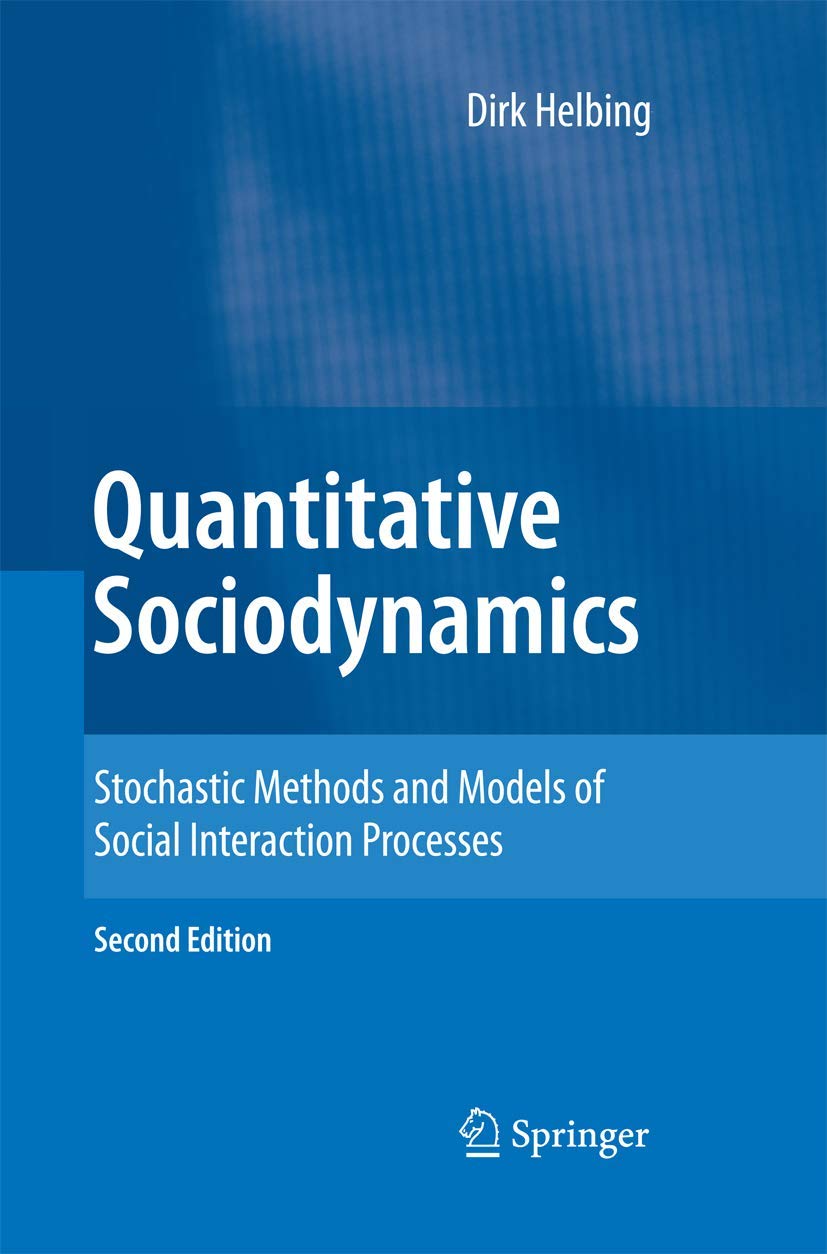
When I wrote the book Quantitative Sociodynamics, it was an early attempt to make methods from statistical physics and complex systems theory fruitful for the modeling and understanding of social phenomena. Unfortunately, the ?rst edition appeared at a quite prohibitive price. This was one reason to make these chapters available again by a new edition. The other reason is that, in the meantime, many of the methods discussed in this book are more and more used in a variety of different ?elds. Among the ideas worked out in this book are: 1 a statistical theory of binary social interactions, a mathematical formulation of social ?eld theory, which is the basis of social 2 force models, a microscopic foundation of evolutionary game theory, based on what is known today as proportional imitation rule, a stochastic treatment of interactions in evolutionary game theory, and a model for the selforganization of behavioral 3 conventions in a coordination game. It, therefore, appeared reasonable to make this book available again, but at a more affordable price. To keep its original character, the translation of this book, which 1 D. Helbing, Interrelations between stochastic equations for systems with pair interactions. Ph icaA 181, 2952 (1992); D. Helbing, Boltzmannlike and BoltzmannFokkerPlanck equations as a foundation of behavioral models. PhysicaA 196, 546573 (1993). 2 D. Helbing, Boltzmannlike and BoltzmannFokkerPlanck equations as a foundation of beh ioral models. PhysicaA 196, 546573 (1993); D.
⚠️ WARNING (California Proposition 65):
This product may contain chemicals known to the State of California to cause cancer,
birth defects, or other reproductive harm.
For MAP (Minimum Advertised Price) violations and Intellectual Property (IP) or Trademark concerns, please contact:
support@ergodebooks.com
⚠️ California Proposition 65 Warning: Some products sold on this website may expose you to chemicals known to the State of California to cause cancer, birth defects, or other reproductive harm. For more information, visit www.P65Warnings.ca.gov.