If you have any questions, you are always welcome to contact us. We'll get back to you as soon as possible, withing 24 hours on weekdays.
Customer service
All questions about your order, return and delivery must be sent to our customer service team by e-mail at yourstore@yourdomain.com
Sale & Press
If you are interested in selling our products, need more information about our brand or wish to make a collaboration, please contact us at press@yourdomain.com
Help
If you have any questions, you are always welcome to contact us. We'll get back to you as soon as possible, withing 24 hours on weekdays.
Customer service
All questions about your order, return and delivery must be sent to our customer service team by e-mail at yourstore@yourdomain.com
Sale & Press
If you are interested in selling our products, need more information about our brand or wish to make a collaboration, please contact us at press@yourdomain.com
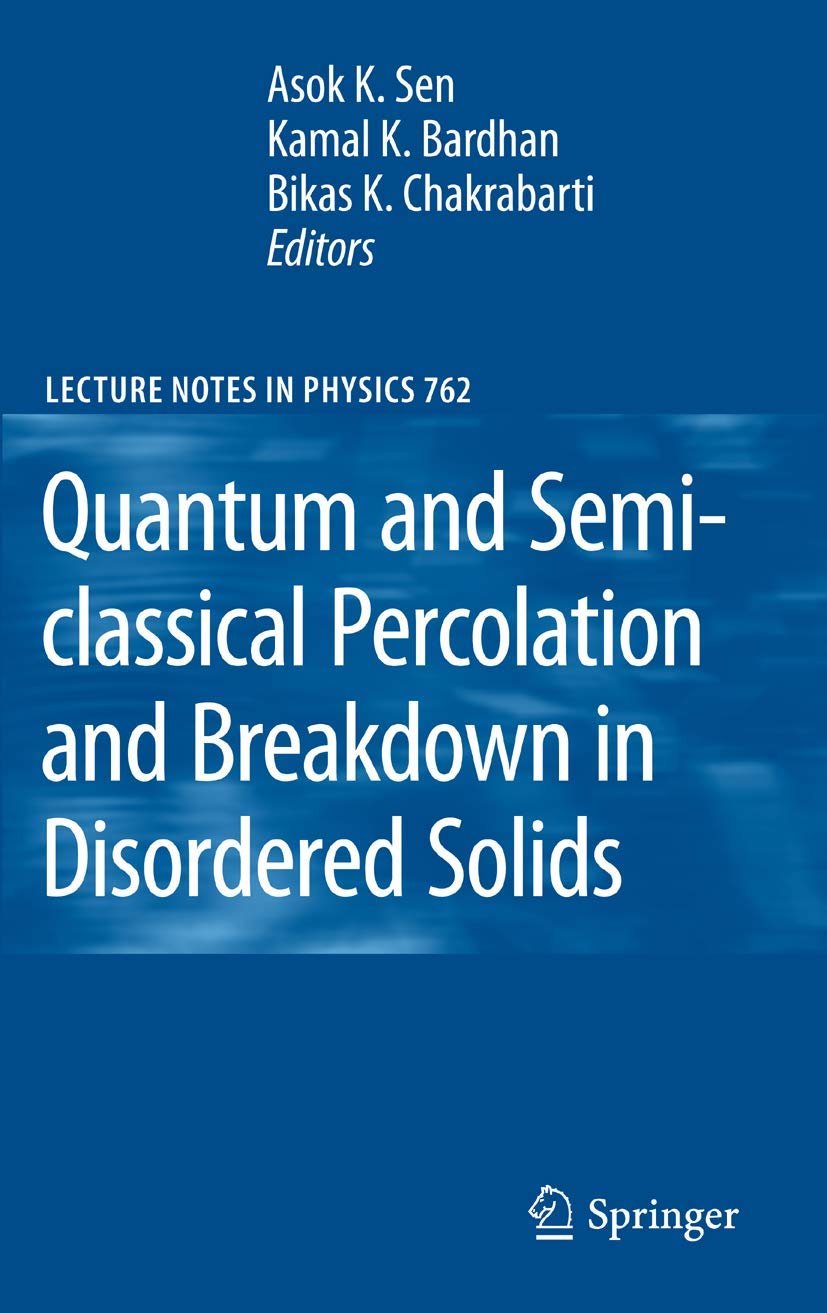
This lecture notes in physics volume mainly focuses on the semi classical and qu tum aspects of percolation and breakdown in disordered, composite or granular s tems. The main reason for this undertaking has been the fact that, of late, there have been a lot of (theoretical) work on quantum percolation, but there is not even a (single) published review on the topic (and, of course, no book). Also, there are many theoretical and experimental studies on the nonlinear currentvoltage characteristics both away from, as well as one approaches, an electrical breakdown in composite materials. Some of the results are quite intriguing and may broadly be explained utilising a semi classical (if not, fully quantum mechanical) tunnelling between cron or nanosized metallic islands dispersed separated by thin insulating layers, or in other words, between the dangling ends of small percolation clusters. There have also been several (theoretical) studies of Zener breakdown in Mott or Anderson in lators. Again, there is no review available, connecting them in any coherent fashion. A compendium volume connecting these experimental and theoretical studies should be unique and very timely, and hence this volume. The book is organised as follows. For completeness, we have started with a short and concise introduction on classical percolation. In the ?rst chapter, D. Stauffer reviews the scaling theory of classical percolation emphasizing (biased) diffusion, without any quantum effects. The next chapter by A. K.
⚠️ WARNING (California Proposition 65):
This product may contain chemicals known to the State of California to cause cancer,
birth defects, or other reproductive harm.
For MAP (Minimum Advertised Price) violations and Intellectual Property (IP) or Trademark concerns, please contact:
support@ergodebooks.com
⚠️ California Proposition 65 Warning: Some products sold on this website may expose you to chemicals known to the State of California to cause cancer, birth defects, or other reproductive harm. For more information, visit www.P65Warnings.ca.gov.