
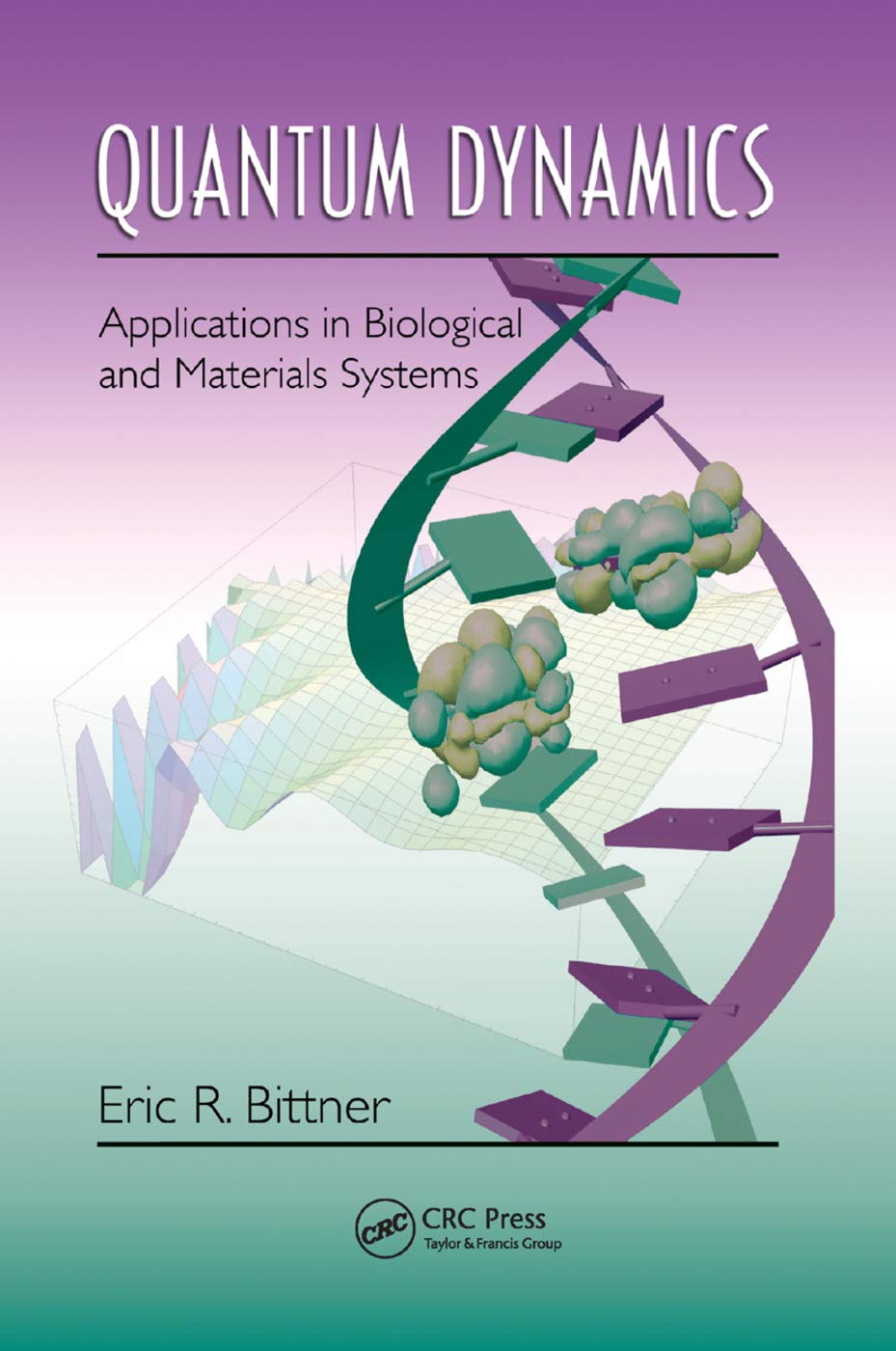
Title
Quantum Dynamics: Applications in Biological and Materials Systems,New
Sold by Ergodebooks, an authorized reseller.
Returns accepted within 30 days | support@ergodebooks.com
Shipping Information
- Free Standard Shipping — United States only
- Processing Time: 3–5 business days
- Estimated Delivery: 6–10 business days after dispatch
- Double-boxed, fully insured & discreetly packaged
- Tracking number sent via email once dispatched
Returns & Refund
Returns accepted within 30 days of delivery.
Damaged or Defective Item
Free return shipping + replacement or full refund
Wrong Item Received
Free return shipping + replacement or full refund
Change of Mind
Return shipping at customer's expense · 25% restocking fee applies
Payment Option

Even though timedependent spectroscopic techniques continue to push the frontier of chemical physics, they receive scant mention in introductory courses and are poorly covered in standard texts. Quantum Dynamics: Applications in Biological and Materials Systems bridges the gap between what is traditionally taught in a onesemester quantum chemistry course and the modern field of chemical dynamics, presenting the quantum theory of charge and energy transport in biological systems and opticalelectronic materials from a dynamic perspective.Reviews the basicsTaking a pedagogical approach, the book begins by reviewing the concepts of classical mechanics that are necessary for studying quantum mechanics. It discusses waves and wave functions and then moves on to an exploration of semiclassical quantum mechanics methods, an important part of the development and utilization of quantum theory.Timeindependent and timedependent perspectivesThe main focus of the book is the chapter on quantum dynamics, which begins with a brief review of the bound states of a coupled twolevel system. This is discussed with a timeindependent as well as a timedependent perspective. The book also explores what happens when the twolevel system has an additional harmonic degree of freedom that couples the transitions between the two states.The book reviews different ways in which one can represent the evolution of a quantum state, explores the quantum density matrix, and examines the basis for excitation energy transfer between molecules. Later chapters describe the pi electronic structure of conjugated organic systems and discuss electronphonon coupling in conjugated systems and transport and dynamics in extended systems.Includes Mathematica downloadsOn an accompanying website, Mathem
⚠️ WARNING (California Proposition 65):
This product may contain chemicals known to the State of California to cause cancer, birth defects, or other reproductive harm.
For more information, please visit www.P65Warnings.ca.gov.