
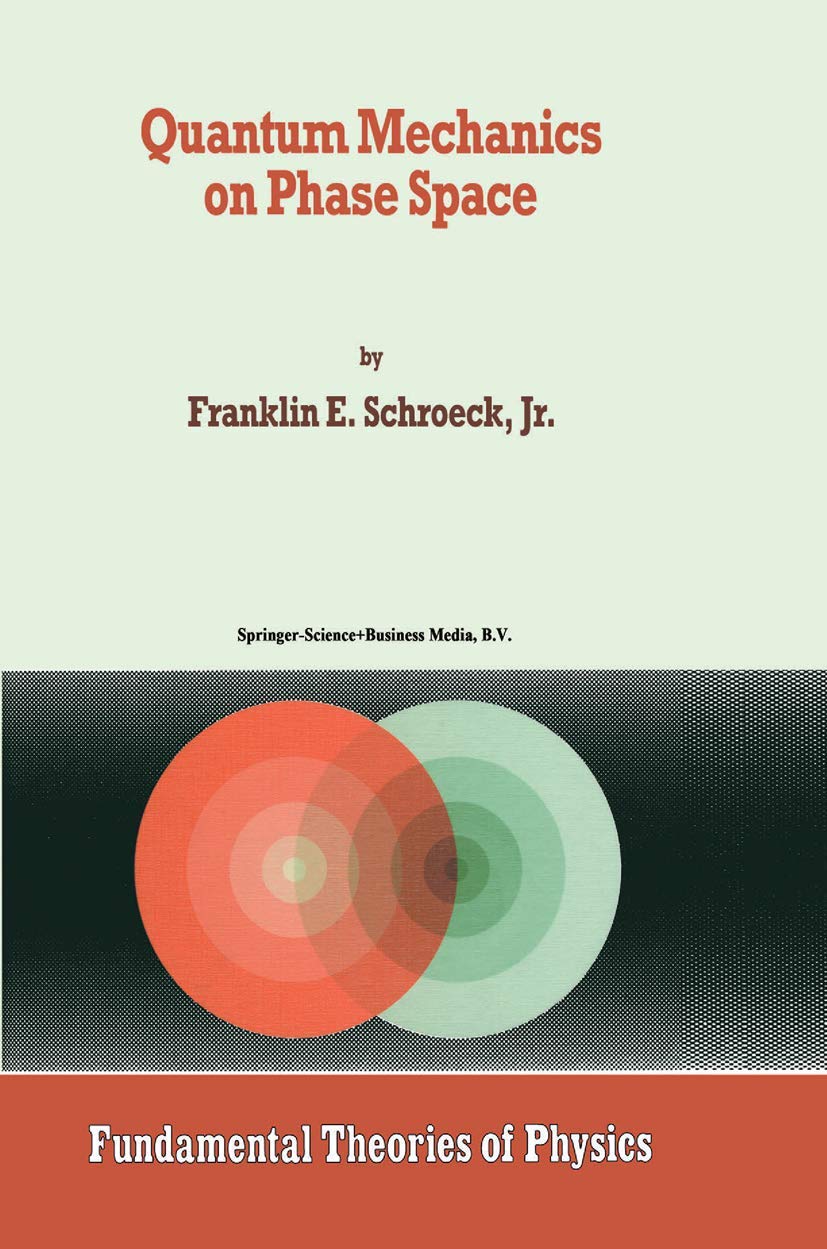
Title
Quantum Mechanics on Phase Space (Fundamental Theories of Physics, 74),New
Sold by Ergodebooks, an authorized reseller.
Returns accepted within 30 days | support@ergodebooks.com
Shipping Information
- Free Standard Shipping — United States only
- Processing Time: 3–5 business days
- Estimated Delivery: 6–10 business days after dispatch
- Double-boxed, fully insured & discreetly packaged
- Tracking number sent via email once dispatched
Returns & Refund
Returns accepted within 30 days of delivery.
Damaged or Defective Item
Free return shipping + replacement or full refund
Wrong Item Received
Free return shipping + replacement or full refund
Change of Mind
Return shipping at customer's expense · 25% restocking fee applies
Payment Option

In this monograph, we shall present a new mathematical formulation of quantum theory, clarify a number of discrepancies within the prior formulation of quantum theory, give new applications to experiments in physics, and extend the realm of application of quantum theory well beyond physics. Here, we motivate this new formulation and sketch how it developed. Since the publication of Dirac's famous book on quantum mechanics [Dirac, 1930] and von Neumann's classic text on the mathematical foundations of quantum mechanics two years later [von Neumann, 1932], there have appeared a number of lines of development, the intent of each being to enrich quantum theory by extra polating or even modifying the original basic structure. These lines of development have seemed to go in different directions, the major directions of which are identified here: First is the introduction of group theoretical methods [Weyl, 1928; Wigner, 1931] with the natural extension to coherent state theory [Klauder and Sudarshan, 1968; Peremolov, 1971]. The call for an axiomatic approach to physics [Hilbert, 1900; Sixth Problem] led to the development of quantum logic [Mackey, 1963; Jauch, 1968; Varadarajan, 1968, 1970; Piron, 1976; Beltrametti & Cassinelli, 1981], to the creation of the operational approach [Ludwig, 198385, 1985; Davies, 1976] with its application to quantum communication theory [Helstrom, 1976; Holevo, 1982), and to the development of the C* approach [Emch, 1972]. An approach through stochastic differential equations ('stochastic mechanics') was developed [Nelson, 1964, 1966, 1967].
⚠️ WARNING (California Proposition 65):
This product may contain chemicals known to the State of California to cause cancer, birth defects, or other reproductive harm.
For more information, please visit www.P65Warnings.ca.gov.