If you have any questions, you are always welcome to contact us. We'll get back to you as soon as possible, withing 24 hours on weekdays.
Customer service
All questions about your order, return and delivery must be sent to our customer service team by e-mail at yourstore@yourdomain.com
Sale & Press
If you are interested in selling our products, need more information about our brand or wish to make a collaboration, please contact us at press@yourdomain.com
Help
If you have any questions, you are always welcome to contact us. We'll get back to you as soon as possible, withing 24 hours on weekdays.
Customer service
All questions about your order, return and delivery must be sent to our customer service team by e-mail at yourstore@yourdomain.com
Sale & Press
If you are interested in selling our products, need more information about our brand or wish to make a collaboration, please contact us at press@yourdomain.com
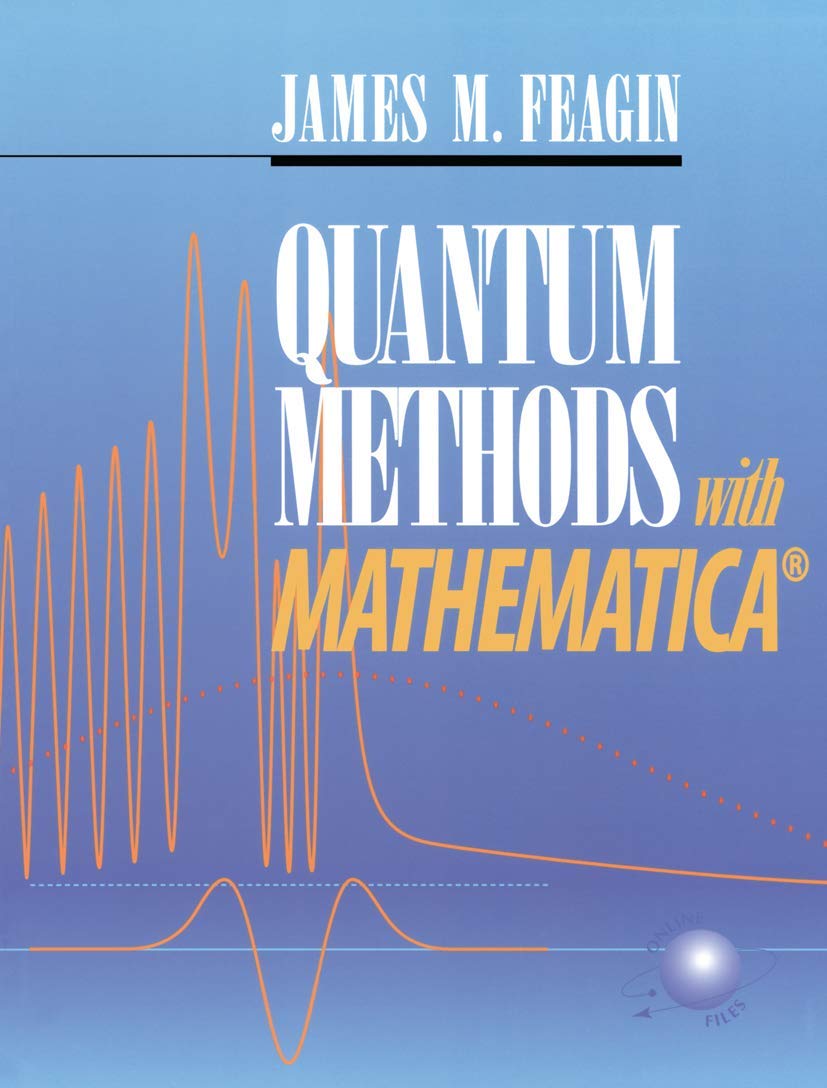
The first quantum mechanics text published that ties directly into a computer algebra system, this book exploits Mathematica(r) throughout for symbolic, numeric, and graphical computing. It is a work designed for computer interaction in an upperdivision undergraduate or firstyear graduate quantum mechanics course. It is also a toolbox for the practicing physicist seeking to automate a variety of algebraic and numerical tasks with the computer. The book is divided into two parts: "Systems in One Dimension" and "Quantum Dynamics." Part I emphasizes topics from a firstyear course on quantum mechanics, while Part II includes more advanced topics. Although the text requires some familiarity with Mathematica, appendices are provided for gaining experience with the software and are referenced throughout the book. The text is taskoriented and integrated with numerous problems and exercises, with hints for working on the computer.James M. Feagin is a Professor of Physics at California State University, Fullerton. He was educated at Georgia Tech and the University of North Carolina, Chapel Hill, where he received a Ph.D. in theoretical physics in 1980. He is a Fellow of the Alexander von Humboldt Foundation and has served as visiting Professor at the University of Freiburg, Germany. Feagin is the author of numerous articles on collision physics and the dynamics of fewbody systems. He has given a number of invited talks and hosted workshops on incorporating computers into the physics curriculum and is presently helping to introduce computing into the Introductory University Physics Project (IUPP) sponsored by the American Institute of Physics.
⚠️ WARNING (California Proposition 65):
This product may contain chemicals known to the State of California to cause cancer,
birth defects, or other reproductive harm.
For MAP (Minimum Advertised Price) violations and Intellectual Property (IP) or Trademark concerns, please contact:
support@ergodebooks.com
⚠️ California Proposition 65 Warning: Some products sold on this website may expose you to chemicals known to the State of California to cause cancer, birth defects, or other reproductive harm. For more information, visit www.P65Warnings.ca.gov.