If you have any questions, you are always welcome to contact us. We'll get back to you as soon as possible, withing 24 hours on weekdays.
Customer service
All questions about your order, return and delivery must be sent to our customer service team by e-mail at yourstore@yourdomain.com
Sale & Press
If you are interested in selling our products, need more information about our brand or wish to make a collaboration, please contact us at press@yourdomain.com
Help
If you have any questions, you are always welcome to contact us. We'll get back to you as soon as possible, withing 24 hours on weekdays.
Customer service
All questions about your order, return and delivery must be sent to our customer service team by e-mail at yourstore@yourdomain.com
Sale & Press
If you are interested in selling our products, need more information about our brand or wish to make a collaboration, please contact us at press@yourdomain.com
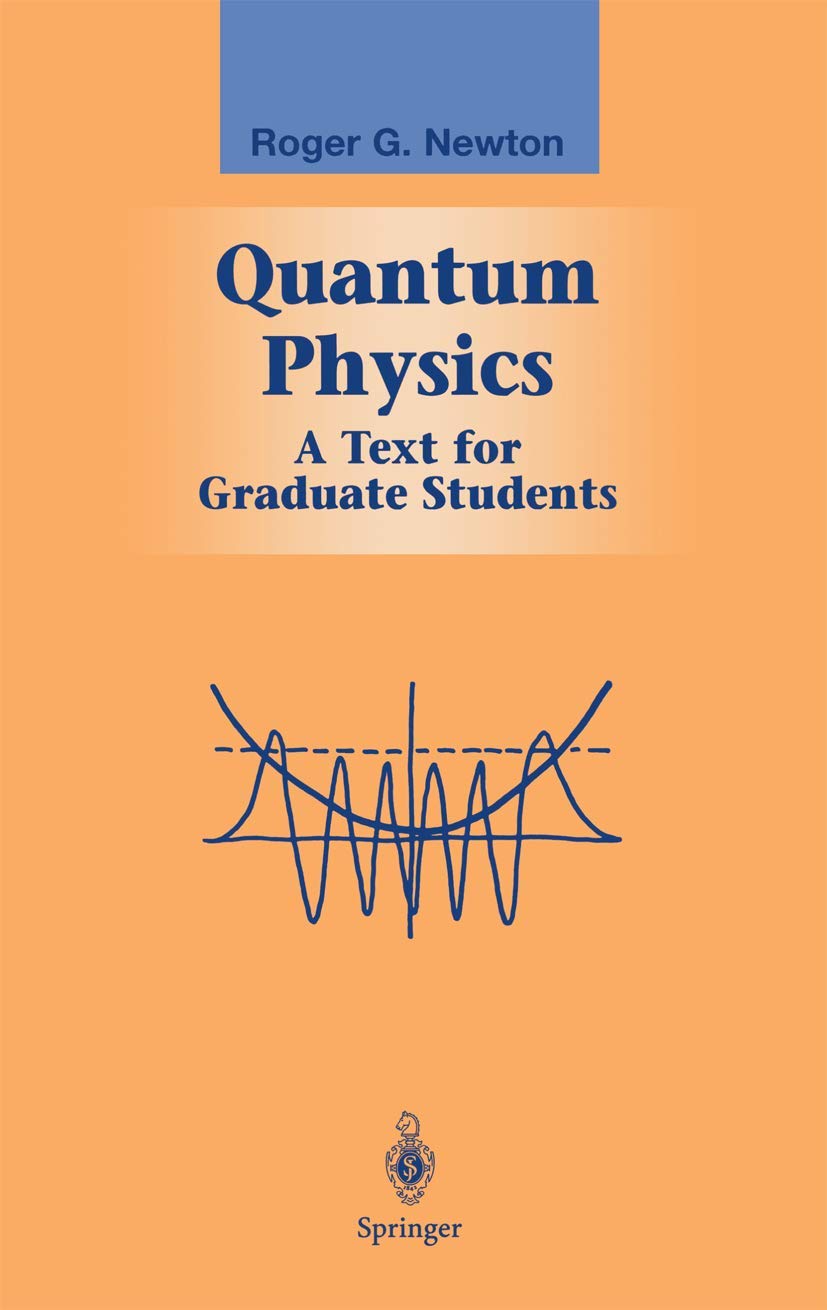
The combination of quantum mechanics and quantum ?eld theory cons tutesthemostrevolutionaryandin?uentialphysicaltheoryofthetwentieth century. Itsimpactisfeltnotonlyinalmostallothersciences,butthefruits of its application are ubiquitous in everyday life. This textbook is designed to teach graduate students the underlying quantumphysical ideas, their mathematical formulations, and the basic problemsolving techniques of the discipline. It assumes they have taken at least one introductory course in quantum mechanics as undergraduates and are familiar with the history of the subject and the basic experimental evidence that led to its adoption, as well as with many of its fundamental notions. In contrast to most other authors, I am therefore not introducing the quantum theory via an hist ical survey of its early successes. Instead, following the models of books on classsical mechanics or electromagnetism, I develop the theory from its basic assumptions, beginning with statics, followed by the dynamics and details of its speci?c areas of use as well as the needed mathematical te niques. Although this book, inevitably, deals largely with the behavior of point particles under various conditions, I do not regard particles as the fun mental entities of the universe: the most basic object is the quantum ?eld, with theobserved particlesarising from the?eld asitsquanta. For thisr son I introduce quantum ?elds right from the beginning and demonstrate, in the ?rst chapter, how particles originate.
⚠️ WARNING (California Proposition 65):
This product may contain chemicals known to the State of California to cause cancer,
birth defects, or other reproductive harm.
For MAP (Minimum Advertised Price) violations and Intellectual Property (IP) or Trademark concerns, please contact:
support@ergodebooks.com
⚠️ California Proposition 65 Warning: Some products sold on this website may expose you to chemicals known to the State of California to cause cancer, birth defects, or other reproductive harm. For more information, visit www.P65Warnings.ca.gov.