If you have any questions, you are always welcome to contact us. We'll get back to you as soon as possible, withing 24 hours on weekdays.
Customer service
All questions about your order, return and delivery must be sent to our customer service team by e-mail at yourstore@yourdomain.com
Sale & Press
If you are interested in selling our products, need more information about our brand or wish to make a collaboration, please contact us at press@yourdomain.com
Help
If you have any questions, you are always welcome to contact us. We'll get back to you as soon as possible, withing 24 hours on weekdays.
Customer service
All questions about your order, return and delivery must be sent to our customer service team by e-mail at yourstore@yourdomain.com
Sale & Press
If you are interested in selling our products, need more information about our brand or wish to make a collaboration, please contact us at press@yourdomain.com
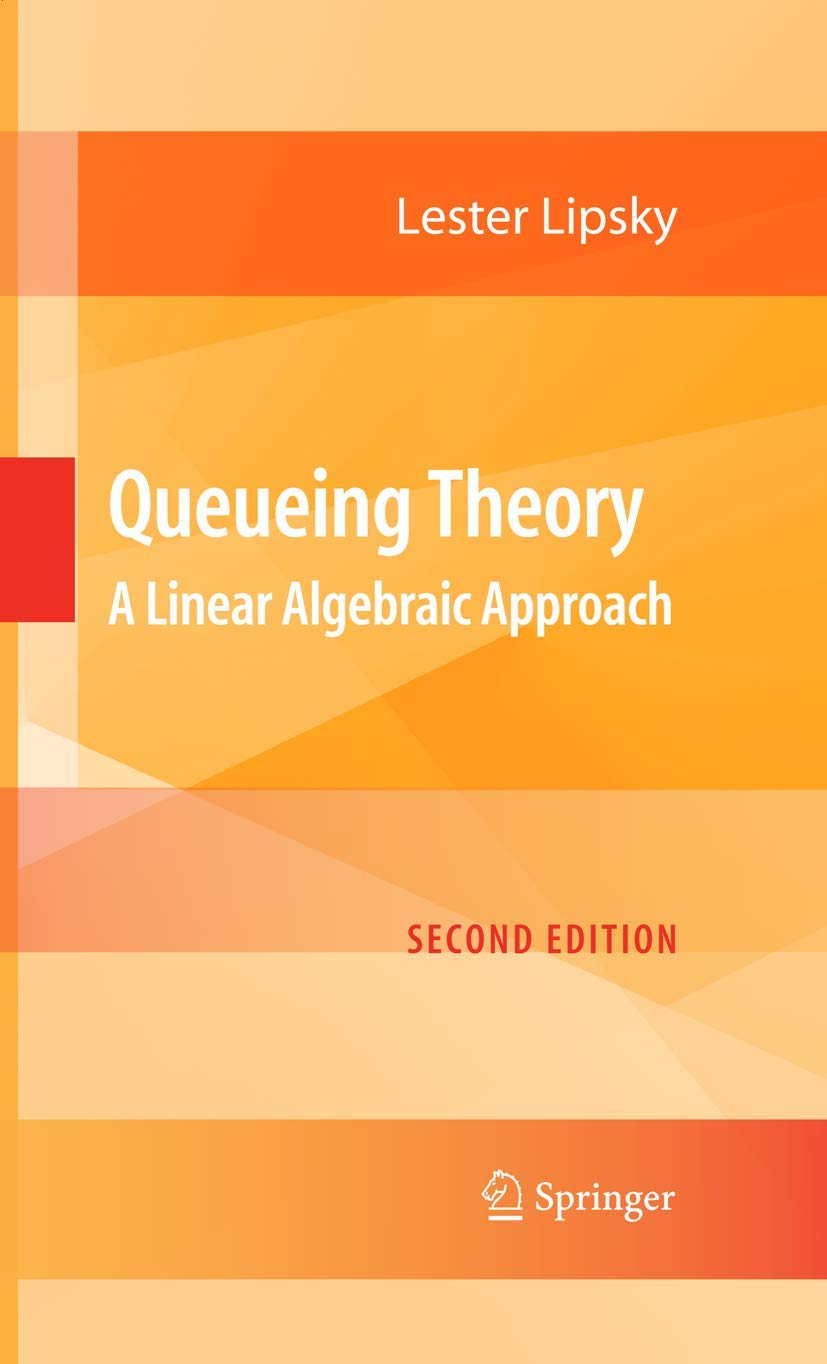
Queueing Theory deals with systems where there is contention for resources, but the demands are only known probabilistically.This book can be considered to be a monograph or a textbook, and thus is aimed at two audiences: those who already know Queueing Theory but would like to know more of the Linear Algebraic Approach; and as a rst course for students who don't already have a strong background in probability, and feel more comfortable with algebraic arguments. Also, the equations are well suited to easy computation. In fact, there is much discussion on how various properties can be easily computed in any language that has automatic matrix operations (e.g., MATLAB). To help with physical insight, there are over 80 gures, numerous examples and exercises distributed throughout the book. There are, perhaps 50 books on QT that are available today, and most practitioners have several of them on their shelves. This book would be a good addition, as well as a good supplement to another text.This second edition has been updated throughout including a new chapter on Semi Markov Processes and new material on matrix representations of distributions and Powertailed distribution.Lester Lipsky is a Professor in the Department of Computer Science and Engineering at the University of Connecticut.
⚠️ WARNING (California Proposition 65):
This product may contain chemicals known to the State of California to cause cancer,
birth defects, or other reproductive harm.
For MAP (Minimum Advertised Price) violations and Intellectual Property (IP) or Trademark concerns, please contact:
support@ergodebooks.com
⚠️ California Proposition 65 Warning: Some products sold on this website may expose you to chemicals known to the State of California to cause cancer, birth defects, or other reproductive harm. For more information, visit www.P65Warnings.ca.gov.