
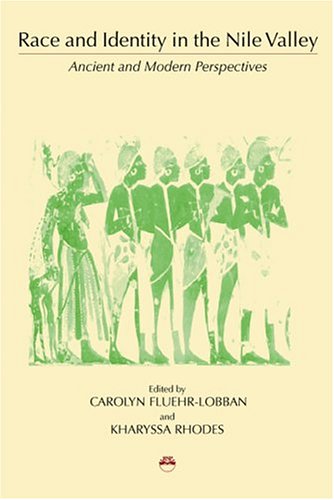
Title
Race and Identity in the Nile Valley: Ancient and Modern Perspectives,Used
Sold by Ergodebooks, an authorized reseller.
Returns accepted within 30 days | support@ergodebooks.com
Shipping Information
- Free Standard Shipping — United States only
- Processing Time: 3–5 business days
- Estimated Delivery: 6–10 business days after dispatch
- Double-boxed, fully insured & discreetly packaged
- Tracking number sent via email once dispatched
Returns & Refund
Returns accepted within 30 days of delivery.
Damaged or Defective Item
Free return shipping + replacement or full refund
Wrong Item Received
Free return shipping + replacement or full refund
Change of Mind
Return shipping at customer's expense · 25% restocking fee applies
Payment Option

This volume pioneers the examination of issues of race and racism, ethnicity and identity in the major Nile Valley countries of Sudan and Egypt from ancient times to the present. Two major events have forced the issue. The study of the ancient Nile Valley was challenged to confront the issue of race in antiquity with the publication of Martin Bernals twovolume work, Black Athena (1987; 1991) asserting the AfroAsiatic roots of Western civilization, and its most famous rebuttal Not Out of Africa (1996). In the aftermath of these earlier works, the question of whether ancient Egypt was black or white became the most simplistic rendering of this not so collegial debate. In this tome, a new generation of critical archaeologists and anthropologists, freed from old Orientalist and Egyptological racialist and racist ideas, have written with greater objectivity about race and representation than their predecessors. The first part of this book contains eight original articles dedicated to an exploration of the dynamics of race in the ancient Nile Valley. These include multiple new perspectives from textual and archaeological sources, as well as reprinting Antnor Firmins chapter on Egypt and Civilization from his 1885 pioneering work of critical race thinking in anthropology The Equality of the Human Races (2000), only recently rediscovered . The chronic civil war in Sudan between the Arabs of the north and the Blacks of the south has also been an event that has forced the issue of race into the discourse on the Nile Valley. Indeed, among the myriad complex issues that have fuelled this warincluding a history of slavery and the unequal distribution of political and economic resourcesa major one has been that of race, as well as religion and ethnicity. The identity of northern Sudanese by indigenous scholars has been subjected to more critical discourse in this period than in any previous one. Western scholars of Sudan and Egypt have noted the heavy hand of both Ottoman and European colonialism as providing the necessary background to the present, while critical southern and northern scholars call for urgent rethinking of these racialhierarchical paradigms.
⚠️ WARNING (California Proposition 65):
This product may contain chemicals known to the State of California to cause cancer, birth defects, or other reproductive harm.
For more information, please visit www.P65Warnings.ca.gov.
- Q: What is the main focus of 'Race and Identity in the Nile Valley'? A: The book examines issues of race, racism, ethnicity, and identity in Sudan and Egypt, exploring the historical and contemporary implications of these themes in the Nile Valley.
- Q: Who is the author of this book? A: The author of 'Race and Identity in the Nile Valley' is Carolyn Fluehr-Lobban.
- Q: When was 'Race and Identity in the Nile Valley' published? A: The book was published on January 15, 2004.
- Q: What are the key themes explored in the book? A: Key themes include the dynamics of race in the ancient Nile Valley, critical perspectives on race and representation, and the impact of colonialism on racial identity.
- Q: How many pages does the book have? A: The book contains 292 pages.
- Q: What type of binding does this book have? A: The book is available in paperback binding.
- Q: Is the book new or used? A: The book is listed as a new item.
- Q: What kind of features does this book include? A: It includes original articles, new perspectives from textual and archaeological sources, and a reprinting of Anténor Firmin’s chapter on race.
- Q: In what category does this book fall? A: This book falls under the category of Social Sciences.
- Q: Are there any specific events discussed in relation to race in the Nile Valley? A: Yes, the book discusses the civil war in Sudan and the historical context of slavery and political resource distribution as significant events influencing racial discourse.