
Title
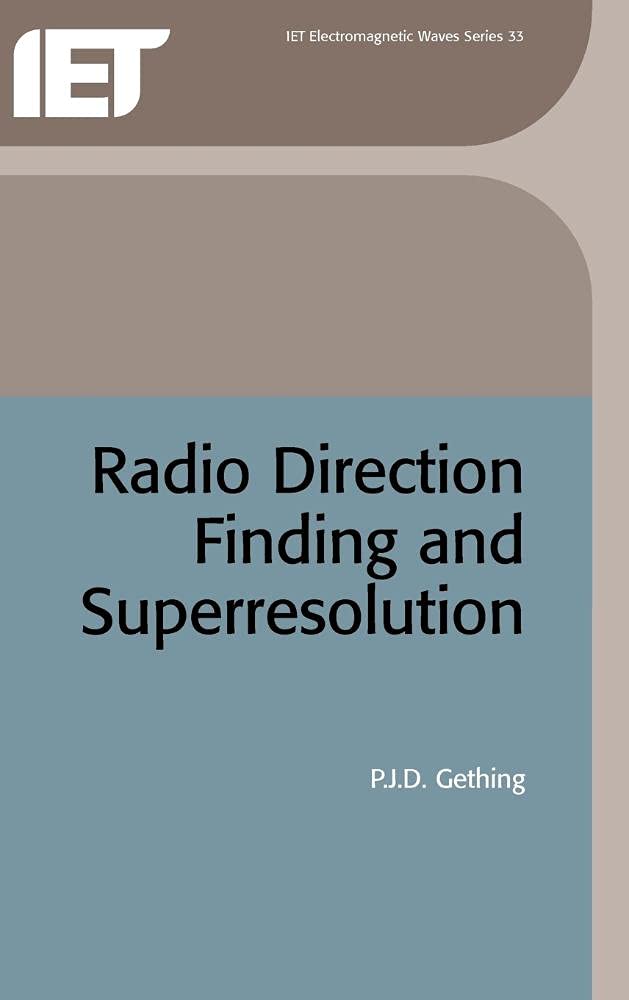
Radio Direction Finding and Superresolution (Electromagnetic Waves),Used
Sold by Ergodebooks, an authorized reseller.
Returns accepted within 30 days | support@ergodebooks.com
Shipping Information
- Free Standard Shipping — United States only
- Processing Time: 3–5 business days
- Estimated Delivery: 6–10 business days after dispatch
- Double-boxed, fully insured & discreetly packaged
- Tracking number sent via email once dispatched
Returns & Refund
Returns accepted within 30 days of delivery.
Damaged or Defective Item
Free return shipping + replacement or full refund
Wrong Item Received
Free return shipping + replacement or full refund
Change of Mind
Return shipping at customer's expense · 25% restocking fee applies
Payment Option

This is an enlarged and revised second edition of a book first published in 1978 and reprinted twice since then. The new edition includes updates to all the original chapters, plus two new chapters on developments in superresolution techniques and their application to directionfinding arrays.Modern direction finders, capable of measuring elevation angles as well as azimuth angles on the components of multiray wavefields, have become powerful tools for research in ionospheric physics and HF radio propagation. The complexity of the problem of resolving closelyspaced rays requires the combined use of wide aperture antenna arrays, multichannel receiving systems and sophisticated digital processing techniques.Published research papers over the last 12 years provide a rich source of information on the development of superresolution algorithms for use in radar, sonar, geophysics and spectral analysis, as well as radio direction finding. Dr Gething reviews the important methods and results, showing how some of the new techniques are related to the wavefront analysis methods described in the first edition. The text is illustrated with computer plots of model wavefields and contain important results on the loci of constant phase and amplitude, and on the statistical properties of bearingerror distributions for specified models. The collection and interpretation of ionospheric data for the purpose of mode identification, and the statistical theory of DF plotting algorithms, are also discussed.Wavefront analysis and superresolution may be regarded as extensions to classical array theory. The basic principles are widely applicable and should therefore be of interest to research workers in radar, sonar, radioastronomy and adaptive array theory, as well as HF radio direction finding.
⚠️ WARNING (California Proposition 65):
This product may contain chemicals known to the State of California to cause cancer, birth defects, or other reproductive harm.
For more information, please visit www.P65Warnings.ca.gov.