
Title
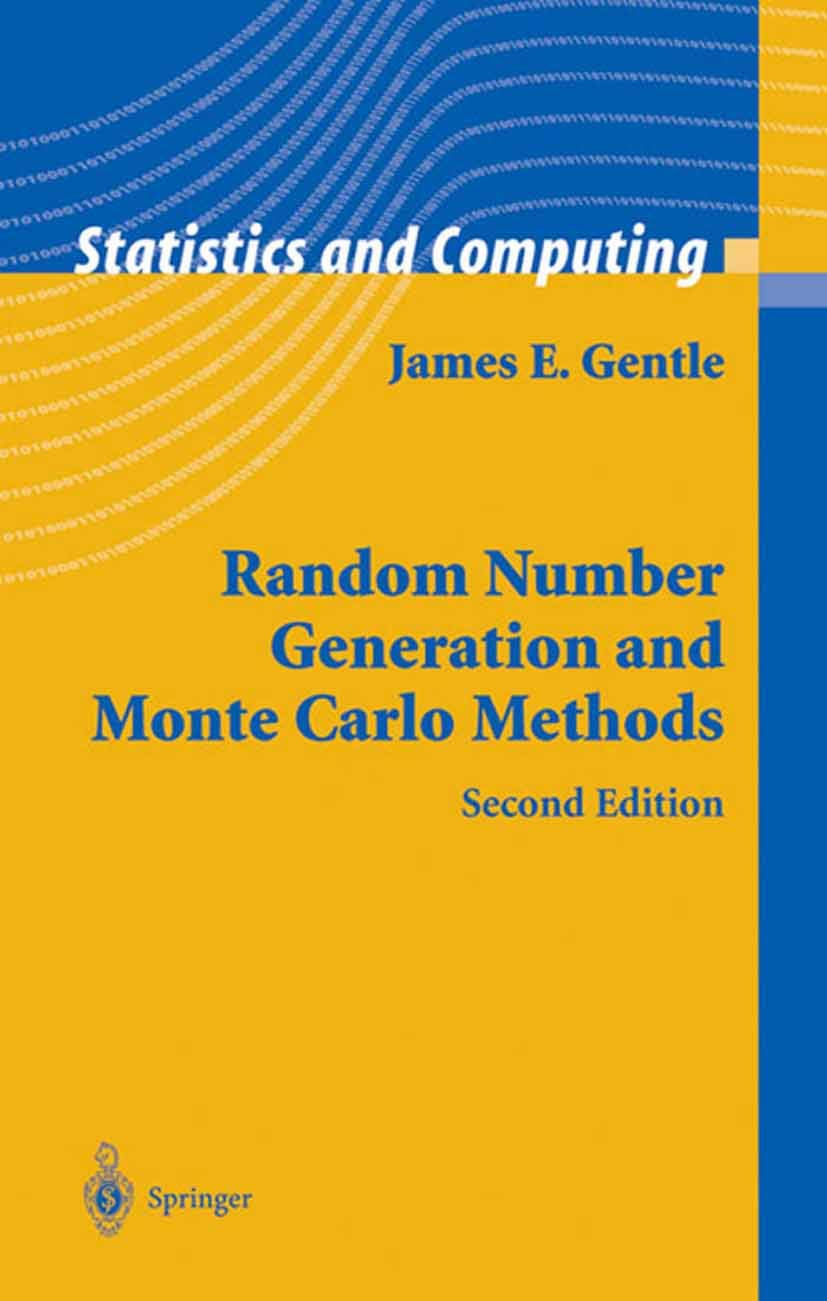
Random Number Generation and Monte Carlo Methods (Statistics and Computing),Used
Sold by Ergodebooks, an authorized reseller.
Returns accepted within 30 days | support@ergodebooks.com
Shipping Information
- Free Standard Shipping — United States only
- Processing Time: 3–5 business days
- Estimated Delivery: 6–10 business days after dispatch
- Double-boxed, fully insured & discreetly packaged
- Tracking number sent via email once dispatched
Returns & Refund
Returns accepted within 30 days of delivery.
Damaged or Defective Item
Free return shipping + replacement or full refund
Wrong Item Received
Free return shipping + replacement or full refund
Change of Mind
Return shipping at customer's expense · 25% restocking fee applies
Payment Option

Monte Carlo simulation has become one of the most important tools in all fields of science. Simulation methodology relies on a good source of numbers that appear to be random. These "pseudorandom" numbers must pass statistical tests just as random samples would. Methods for producing pseudorandom numbers and transforming those numbers to simulate samples from various distributions are among the most important topics in statistical computing.This book surveys techniques of random number generation and the use of random numbers in Monte Carlo simulation. The book covers basic principles, as well as newer methods such as parallel random number generation, nonlinear congruential generators, quasi Monte Carlo methods, and Markov chain Monte Carlo. The best methods for generating random variates from the standard distributions are presented, but also general techniques useful in more complicated models and in novel settings are described. The emphasis throughout the book is on practical methods that work well in current computing environments.The book includes exercises and can be used as a test or supplementary text for various courses in modern statistics. It could serve as the primary test for a specialized course in statistical computing, or as a supplementary text for a course in computational statistics and other areas of modern statistics that rely on simulation. The book, which covers recent developments in the field, could also serve as a useful reference for practitioners. Although some familiarity with probability and statistics is assumed, the book is accessible to a broad audience.The second edition is approximately 50% longer than the first edition. It includes advances in methods for parallel random number generation, universal methods for generation of nonuniform variates, perfect sampling, and software for random number generation.
⚠️ WARNING (California Proposition 65):
This product may contain chemicals known to the State of California to cause cancer, birth defects, or other reproductive harm.
For more information, please visit www.P65Warnings.ca.gov.