
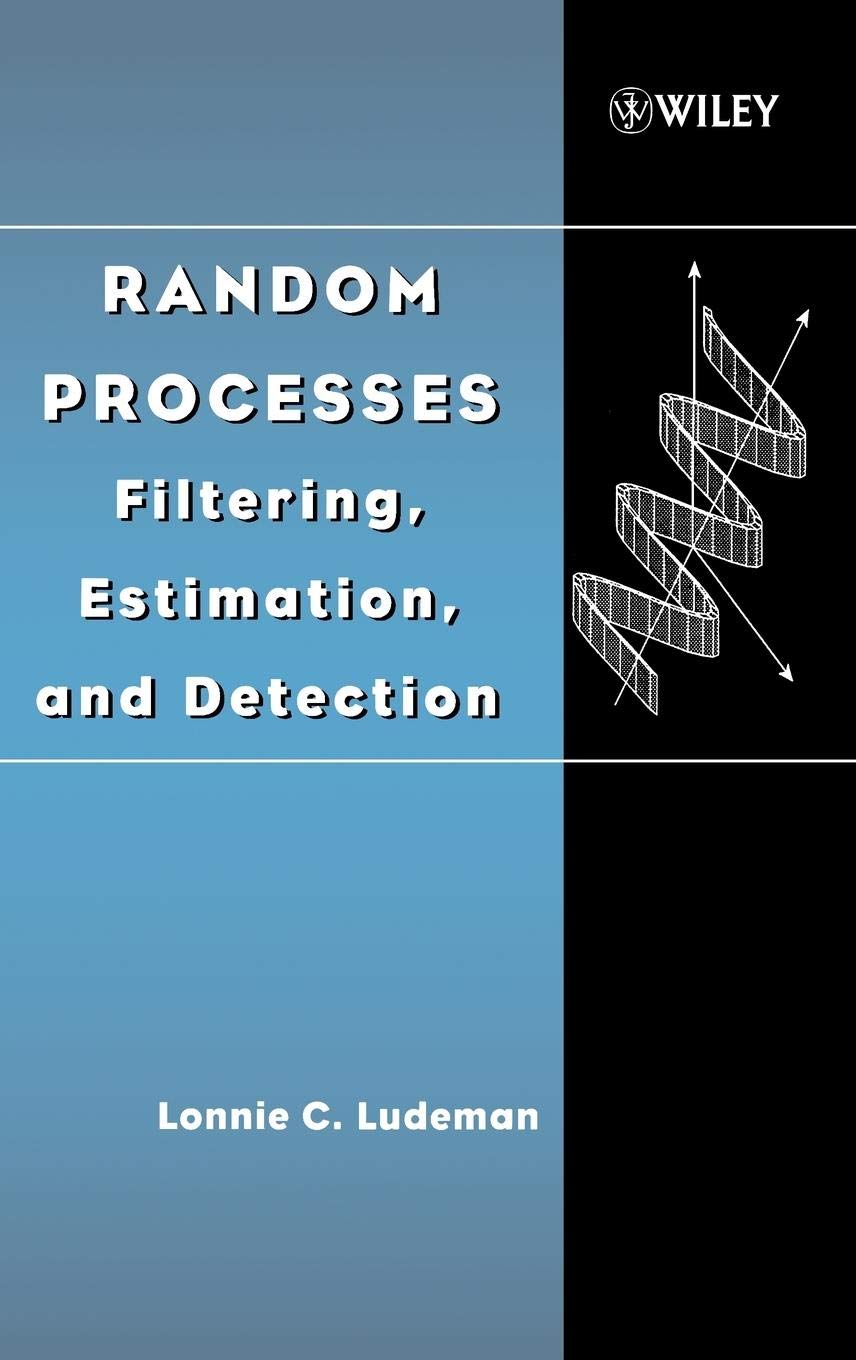
Title
Random Processes: Filtering, Estimation, and Detection (IEEE Press),Used
Sold by Ergodebooks, an authorized reseller.
Returns accepted within 30 days | support@ergodebooks.com
Shipping Information
- Free Standard Shipping — United States only
- Processing Time: 3–5 business days
- Estimated Delivery: 6–10 business days after dispatch
- Double-boxed, fully insured & discreetly packaged
- Tracking number sent via email once dispatched
Returns & Refund
Returns accepted within 30 days of delivery.
Damaged or Defective Item
Free return shipping + replacement or full refund
Wrong Item Received
Free return shipping + replacement or full refund
Change of Mind
Return shipping at customer's expense · 25% restocking fee applies
Payment Option

An understanding of random processes is crucial to many engineering fieldsincluding communication theory, computer vision, and digital signal processing in electrical and computer engineering, and vibrational theory and stress analysis in mechanical engineering. The filtering, estimation, and detection of random processes in noisy environments are critical tasks necessary in the analysis and design of new communications systems and useful signal processing algorithms. Random Processes: Filtering, Estimation, and Detection clearly explains the basics of probability and random processes and details modern detection and estimation theory to accomplish these tasks.In this book, Lonnie Ludeman, an awardwinning authority in digital signal processing, joins the fundamentals of random processes with the standard techniques of linear and nonlinear systems analysis and hypothesis testing to give signal estimation techniques, specify optimum estimation procedures, provide optimum decision rules for classification purposes, and describe performance evaluation definitions and procedures for the resulting methods. The text covers four main, interrelated topics:* Probability and characterizations of random variables and random processes* Linear and nonlinear systems with random excitations* Optimum estimation theory including both the Wiener and Kalman Filters* Detection theory for both discrete and continuous time measurementsLucid, thorough, and wellstocked with numerous examples and practice problems that emphasize the concepts discussed, Random Processes: Filtering, Estimation, and Detection is an understandable and useful text ideal as both a selfstudy guide for professionals in the field and as a core text for graduate students.
⚠️ WARNING (California Proposition 65):
This product may contain chemicals known to the State of California to cause cancer, birth defects, or other reproductive harm.
For more information, please visit www.P65Warnings.ca.gov.