
Title
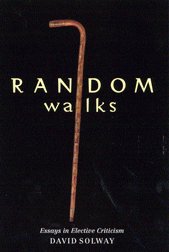
Random Walks: Essays in Elective Criticism,Used
Sold by Ergodebooks, an authorized reseller.
Returns accepted within 30 days | support@ergodebooks.com
Shipping Information
- Free Standard Shipping — United States only
- Processing Time: 3–5 business days
- Estimated Delivery: 6–10 business days after dispatch
- Double-boxed, fully insured & discreetly packaged
- Tracking number sent via email once dispatched
Returns & Refund
Returns accepted within 30 days of delivery.
Damaged or Defective Item
Free return shipping + replacement or full refund
Wrong Item Received
Free return shipping + replacement or full refund
Change of Mind
Return shipping at customer's expense · 25% restocking fee applies
Payment Option

Product Description The first section of the book develops Solway's approach to literature, starting from the assumption that genuine criticism requires the intellectual freedom to range at will across the literary landscape rather than restricting one's direction based on what is current, fashionable, or politically correct. Solway argues that advocating a theoretical school postmodernism, poststructuralism, semiotics, new historicism, Marxist revisionism, or queer theory generally involves abandoning the real critical project, which is the discovery of one's own undetermined motives, dispositions, and interests as reflected in the secret mirrors embedded in literary texts. Instead Solway pursues what he calls elective criticism, writing that enables the critical writer to freely discover his or her own identity a concept that he claims cannot reasonably be diluted, relinquished, or deconstructed. In the second section Solway practices what he preaches, exploring a wide range of authors and subjects. His essays include an analysis of Franz Kafka's The Trial as a Jewish joke, a personal memoir of Irving Layton, an interpretation of Erin Moure's 'Pronouns on the Main,' an examination of language in William Shakespeare's romances, a reading of Robert Browning's 'My Last Duchess' that is sympathetic to the Duke, an assertion that James Joyce has more in common with the traditional novelist than with the professional, (post)modern alienator, and an exploration of Jonathan Swift's sartorial imagery that contends that form is the source of substantive identity. Review 'A brilliant work. Solway takes the theorists on their own terms and, while acknowledging the stimulating contributions of some of the original leaders in literary theory, uses broadsword and rapier whenever needed to expose the inadequacy of what one might well call 'Theory in Practice.' These essays will delight many, infuriate many. Solway is wonderfully amusing even while he is making a deeply serious point, and his love of words is obvious on every page. He is fresh, challenging, dazzling, exhilarating. As a document in literarycritical and literarytheoretical taste in the late twentieth century, Random Walks will prove central.' W.J. Keith, University College, University of Toronto 'Solway is an engaging writer with a distinctive style and a gift for pithy, arresting, and memorable turns of phrase. Random Walks belongs to the distinguished genre of a writer's collected criticism. As a record of thought, a collection of reactions, an attempt at clarification and provocation, it compares favourably with other works in this genre. It is committed, impassioned, opinionated, and insightful, and writes across the grain of prevailing attitudes and ideas.' Iain Higgins, Department of English, University of British Columbia About the Author CA
⚠️ WARNING (California Proposition 65):
This product may contain chemicals known to the State of California to cause cancer, birth defects, or other reproductive harm.
For more information, please visit www.P65Warnings.ca.gov.
- Q: What is the main theme of 'Random Walks: Essays in Elective Criticism'? A: The main theme of 'Random Walks' revolves around the concept of elective criticism, which emphasizes the importance of intellectual freedom in literary criticism. David Solway argues against adhering strictly to theoretical schools and advocates for a personal exploration of literature that reveals one's own identity and motives.
- Q: Who is the author of 'Random Walks' and what is his background? A: The author of 'Random Walks' is David Solway, a noted writer and critic known for his engaging style and insightful commentary on literature. He has a background in literary criticism and has contributed significantly to discussions on various literary theories and practices.
- Q: What type of readers would benefit from this book? A: Readers interested in literary criticism, theory, and the exploration of identity within literature will benefit from this book. It is especially suitable for those who appreciate a blend of personal reflection and critical analysis.
- Q: What is the publication date and edition of 'Random Walks'? A: The book 'Random Walks: Essays in Elective Criticism' was published on July 4, 1997, and is available in its first edition.
- Q: How many pages does 'Random Walks' have? A: The book 'Random Walks' has a total of 256 pages.
- Q: What is the condition of the book, and how can I expect it to be? A: The book is listed as a used book in good condition, which generally means it may show some signs of wear but is still fully functional and readable.
- Q: What subjects does Solway explore in his essays? A: Solway explores a wide range of subjects, including analyses of works by authors such as Franz Kafka, Irving Layton, Erin Moure, William Shakespeare, Robert Browning, and Jonathan Swift, among others.
- Q: Is 'Random Walks' suitable for academic study? A: Yes, 'Random Walks' is suitable for academic study as it offers critical insights and analyses that can support discussions in literary theory and criticism courses.
- Q: What is the binding type of 'Random Walks'? A: The book is available in paperback binding, making it easy to handle and read.
- Q: Are there any notable reviews or endorsements for 'Random Walks'? A: Yes, the book has received positive reviews from academics such as W.J. Keith from the University College, University of Toronto, and Iain Higgins from the University of British Columbia, praising Solway's engaging writing style and critical insights.