
Title
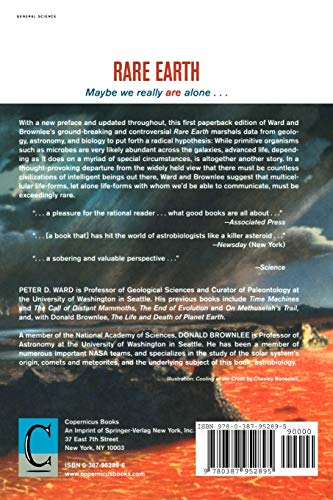
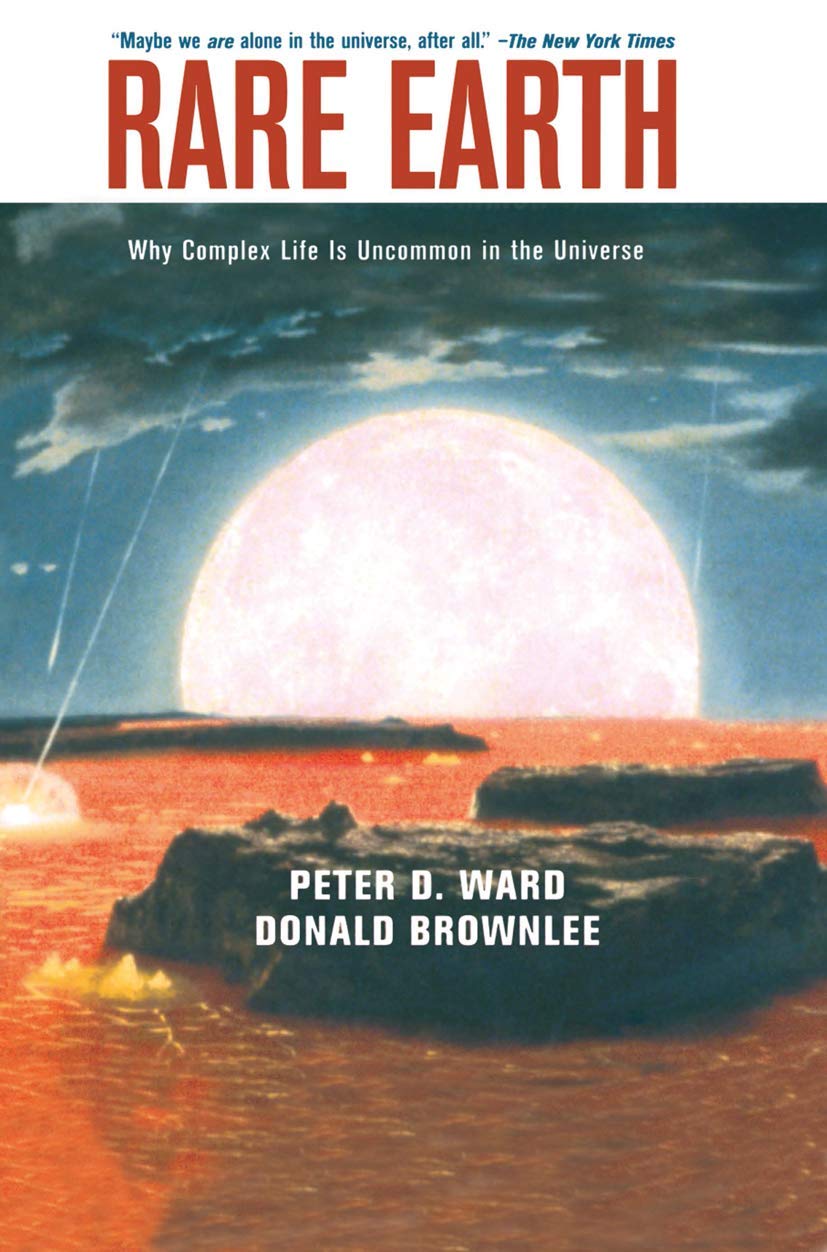
Rare Earth: Why Complex Life is Uncommon in the Universe,Used
Sold by Ergodebooks, an authorized reseller.
Returns accepted within 30 days | support@ergodebooks.com
Shipping Information
- Free Standard Shipping — United States only
- Processing Time: 3–5 business days
- Estimated Delivery: 6–10 business days after dispatch
- Double-boxed, fully insured & discreetly packaged
- Tracking number sent via email once dispatched
Returns & Refund
Returns accepted within 30 days of delivery.
Damaged or Defective Item
Free return shipping + replacement or full refund
Wrong Item Received
Free return shipping + replacement or full refund
Change of Mind
Return shipping at customer's expense · 25% restocking fee applies
Payment Option

In November 12, 2002, Dr. John Chambers of the NASA Ames Research Center gave a seminar to the Astrobiology Group at the University of Washington. The audience of about 100 listened with rapt attention as Chambers described results from a computer study of how planetary systems form. The goal of his research was to answer a deceptively simple question: How often would newly forming planetary systems produce Earthlike planets, given a star the size of our own sun? By Earthlike Chambers meant a rocky planet with water on its surface, orbiting within a stars habitable zone. This nottoohot and nottoocold inner region, relatively close to the star, supports the presence of liquid water on a planet surface for hundreds of million of yearsthe timespan probably necessary for the evolution of life. To answer the question of just how many Earthlike planets might be spawned in such a planetary system, Chambers had spent thousands of hours running highly sophisticated modeling programs through arrays of powerful computers. The results presented at the meeting were startling. The simulations showed that rocky planets orbiting at the right distances from the central star are easily formed, but they can end up with a wide range of water content. Earth seems to be quite a gema rocky planet where not only can liquid water exist for long periods of time, but where water can be found as a heathy oceanfulnot too little and not too much. Our planet seems to reside in a benign region of the Galaxy, where comet and asteroid bombardment is tolerable and habitablezone planets can commonly grow to Earth size. Such real estate in our galaxyperhaps in any galaxyis prime for life. And rare as well.
⚠️ WARNING (California Proposition 65):
This product may contain chemicals known to the State of California to cause cancer, birth defects, or other reproductive harm.
For more information, please visit www.P65Warnings.ca.gov.
- Q: How many pages does this book have? A: This book contains three hundred seventy-two pages. It provides an in-depth exploration of complex life and its rarity in the universe.
- Q: What are the dimensions of this book? A: The book measures six point one inches in length, zero point eight three inches in width, and nine point two five inches in height. These dimensions make it a convenient size for reading.
- Q: What is the binding type of this book? A: This book is a paperback. The binding allows for easy handling and portability.
- Q: Who is the author of this book? A: The author is Peter D. Ward. He is known for his work in paleontology and astrobiology.
- Q: What is the main topic of this book? A: The main topic is the rarity of complex life in the universe. It explores the conditions needed for Earth-like planets to form.
- Q: Is this book suitable for beginners in astronomy? A: Yes, this book is suitable for beginners. It presents complex concepts in a way that is accessible to general readers.
- Q: How does this book explore the concept of habitability? A: The book discusses how planets must be in the 'habitable zone' to support life. It explains the criteria needed for liquid water to exist.
- Q: Can this book be used for academic purposes? A: Yes, this book can be used for academic purposes. It provides research-based insights valuable for students and educators in astrobiology.
- Q: What is the intended audience for this book? A: The intended audience includes astronomy enthusiasts, students, and anyone interested in the origins of life in the universe.
- Q: How should I care for this book? A: To care for this book, keep it in a dry place and avoid exposure to direct sunlight. This helps preserve its condition.
- Q: Is this book safe for children? A: Yes, this book is generally safe for children. It is educational and encourages curiosity about life beyond Earth.
- Q: What if my book arrives damaged? A: If your book arrives damaged, you should contact the seller for a return or replacement. Most sellers have policies in place for such issues.
- Q: Does this book come with a warranty? A: No, this book does not come with a warranty. However, it may be eligible for returns under the seller's policy.
- Q: What makes this book unique compared to others in its category? A: This book is unique because it combines scientific research with accessible writing. It addresses a profound question about life's rarity.
- Q: Are there any common issues with this book? A: Common issues may include printing errors or binding problems. If you notice any, contact the seller for assistance.
- Q: Can I find more works by the same author? A: Yes, Peter D. Ward has written several other books on related topics. You can find more of his works in the same genre.