
Title
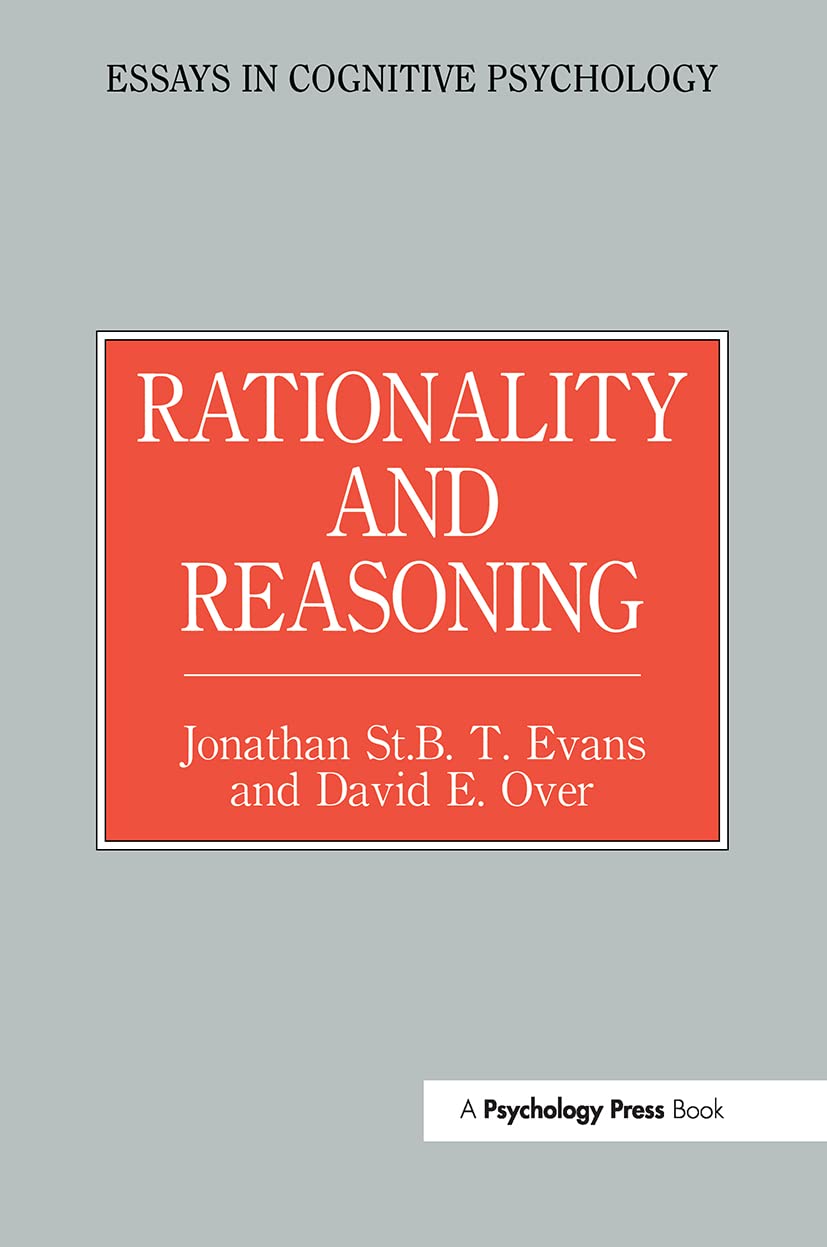
Rationality and Reasoning (Essays in Cognitive Psychology),Used
Sold by Ergodebooks, an authorized reseller.
Returns accepted within 30 days | support@ergodebooks.com
Shipping Information
- Free Standard Shipping — United States only
- Processing Time: 3–5 business days
- Estimated Delivery: 6–10 business days after dispatch
- Double-boxed, fully insured & discreetly packaged
- Tracking number sent via email once dispatched
Returns & Refund
Returns accepted within 30 days of delivery.
Damaged or Defective Item
Free return shipping + replacement or full refund
Wrong Item Received
Free return shipping + replacement or full refund
Change of Mind
Return shipping at customer's expense · 25% restocking fee applies
Payment Option

This book addresses an apparent paradox in the psychology of thinking. On the one hand, human beings are a highly successful species. On the other, intelligent adults are known to exhibit numerous errors and biases in laboratory studies of reasoning and decision making. There has been much debate among both philosophers and psychologists about the implications of such studies for human rationality. The authors argue that this debate is marked by a confusion between two distinct notions: (a) personal rationality (rationality1Evans and Over argue that people have a high degree of rationality1 but only a limited capacity for rationality2. The book reinterprets the psychological literature on reasoning and decision making, showing that many normative errors, by abstract standards, reflect the operation of processes that would normally help to achieve ordinary goals. Topics discussed include relevance effects in reasoning and decision making, the influence of prior beliefs on thinking, and the argument that apparently nonlogical reasoning can reflect efficient decision making. The authors also discuss the problem of deductive competence whether people have it, and what mechanism can account for it.As the book progresses, increasing emphasis is given to the authors' dual process theory of thinking, in which a distinction between tacit and explicit cognitive systems is developed. It is argued that much of human capacity for rationality1 is invested in tacit cognitive processes, which reflect both innate mechanisms and biologically constrained learning. However, the authors go on to argue that human beings also possess an explicit thinking system, which underlies their unique if limited capacity to be rational.
⚠️ WARNING (California Proposition 65):
This product may contain chemicals known to the State of California to cause cancer, birth defects, or other reproductive harm.
For more information, please visit www.P65Warnings.ca.gov.