If you have any questions, you are always welcome to contact us. We'll get back to you as soon as possible, withing 24 hours on weekdays.
Customer service
All questions about your order, return and delivery must be sent to our customer service team by e-mail at yourstore@yourdomain.com
Sale & Press
If you are interested in selling our products, need more information about our brand or wish to make a collaboration, please contact us at press@yourdomain.com
Help
If you have any questions, you are always welcome to contact us. We'll get back to you as soon as possible, withing 24 hours on weekdays.
Customer service
All questions about your order, return and delivery must be sent to our customer service team by e-mail at yourstore@yourdomain.com
Sale & Press
If you are interested in selling our products, need more information about our brand or wish to make a collaboration, please contact us at press@yourdomain.com
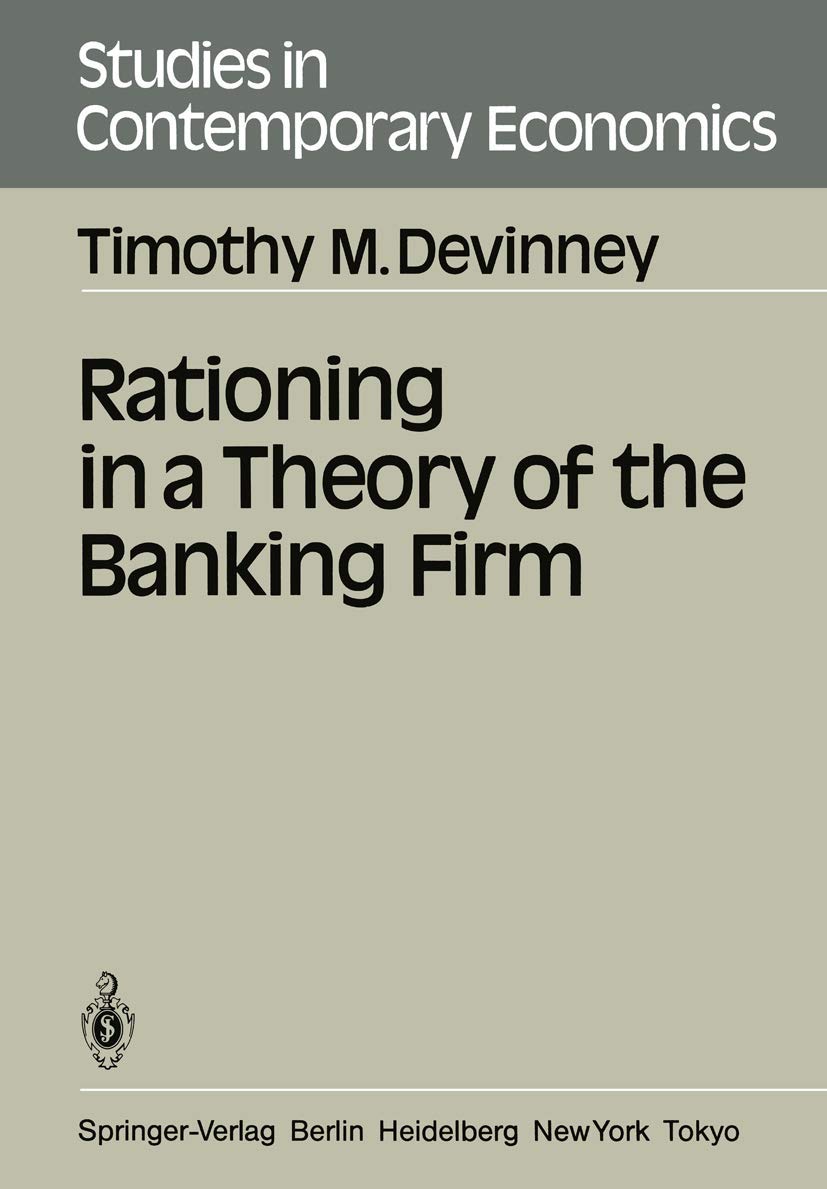
The existence of nonprice rationing in credit markets is a subj ect, not only of paramount importance, but of considerable controversy, which is ultimately linked with our understanding, or lack thereof, of the basic nature of the banking firm. A recognition of this phenomenon is critical to the understanding of the banking firm in its major role as a financial intermediary. The banking firm serves as an intermediary in two important spheres, between borrower and lender, and between spenders and the monetary authorities. The basic economic formulation of borrowerlender behavior, the simple Fisherian consumption loan model, while beautiful in its simplicity, fail s to acknowledge any role for a nonneutral financial intermediary. The bank, in its second intermediary role, leads one to question the assumption of both neoclassical and Keynsian monetary theories that monetary changes are diffused across the economy (the proverbial monetary helicopter). Monetary policy effects on spending and investment will clearly be biased by the policies of the banks. The major focus of the present work is the development of a theory of credit rationing based upon the existence of risk reducing information technologies. Implicit in the analysis is a discussion of the role of the banking firm as something more than a traditional financial intermediary. The present analysis will focus on the bank as an intermediary between borrower and lender. It will be shown that in .
⚠️ WARNING (California Proposition 65):
This product may contain chemicals known to the State of California to cause cancer,
birth defects, or other reproductive harm.
For MAP (Minimum Advertised Price) violations and Intellectual Property (IP) or Trademark concerns, please contact:
support@ergodebooks.com
⚠️ California Proposition 65 Warning: Some products sold on this website may expose you to chemicals known to the State of California to cause cancer, birth defects, or other reproductive harm. For more information, visit www.P65Warnings.ca.gov.