
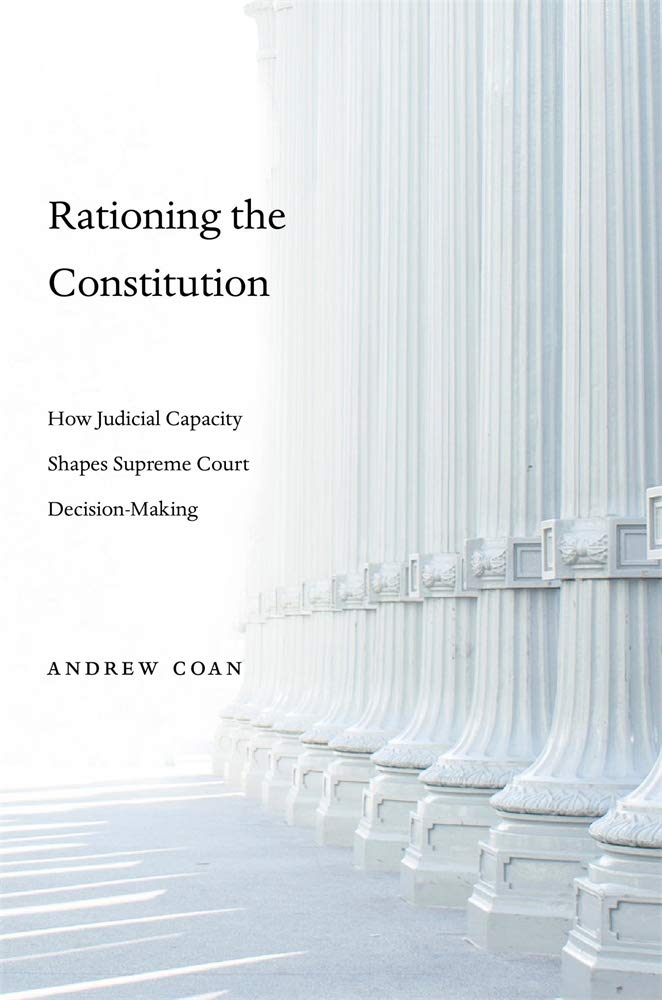
Title
Rationing the Constitution: How Judicial Capacity Shapes Supreme Court DecisionMaking,Used
Sold by Ergodebooks, an authorized reseller.
Returns accepted within 30 days | support@ergodebooks.com
Shipping Information
- Free Standard Shipping — United States only
- Processing Time: 3–5 business days
- Estimated Delivery: 6–10 business days after dispatch
- Double-boxed, fully insured & discreetly packaged
- Tracking number sent via email once dispatched
Returns & Refund
Returns accepted within 30 days of delivery.
Damaged or Defective Item
Free return shipping + replacement or full refund
Wrong Item Received
Free return shipping + replacement or full refund
Change of Mind
Return shipping at customer's expense · 25% restocking fee applies
Payment Option

In this groundbreaking analysis of Supreme Court decisionmaking, Andrew Coan explains how judicial caseload shapes the course of American constitutional law and the role of the Court in American society.Compared with the vast machinery surrounding Congress and the president, the Supreme Court is a tiny institution that can resolve only a small fraction of the constitutional issues that arise in any given year. Rationing the Constitution shows that this simple yet frequently ignored fact is essential to understanding how the Supreme Court makes constitutional law.Due to the structural organization of the judiciary and certain widely shared professional norms, the capacity of the Supreme Court to review lowercourt decisions is severely limited. From this fact, Andrew Coan develops a novel and arresting theory of Supreme Court decisionmaking. In deciding cases, the Court must not invite more litigation than it can handle. On many of the most important constitutional questionstouching on federalism, the separation of powers, and individual rightsthis constraint creates a strong pressure to adopt hardedged categorical rules, or defer to the political process, or both.The implications for U.S. constitutional law are profound. Lawyers, academics, and social activists pursuing social reform through the courts must consider whether their goals can be accomplished within the constraints of judicial capacity. Often the answer will be no. The limits of judicial capacity also substantially constrain the Courts much toutedand frequently lamentedpower to overrule democratic majorities. As Rationing the Constitution demonstrates, the Supreme Court is David, not Goliath.
⚠️ WARNING (California Proposition 65):
This product may contain chemicals known to the State of California to cause cancer, birth defects, or other reproductive harm.
For more information, please visit www.P65Warnings.ca.gov.