
Title
Reactive Distillation Design and Control,Used
Sold by Ergodebooks, an authorized reseller.
Returns accepted within 30 days | support@ergodebooks.com
Shipping Information
- Free Standard Shipping — United States only
- Processing Time: 3–5 business days
- Estimated Delivery: 6–10 business days after dispatch
- Double-boxed, fully insured & discreetly packaged
- Tracking number sent via email once dispatched
Returns & Refund
Returns accepted within 30 days of delivery.
Damaged or Defective Item
Free return shipping + replacement or full refund
Wrong Item Received
Free return shipping + replacement or full refund
Change of Mind
Return shipping at customer's expense · 25% restocking fee applies
Payment Option

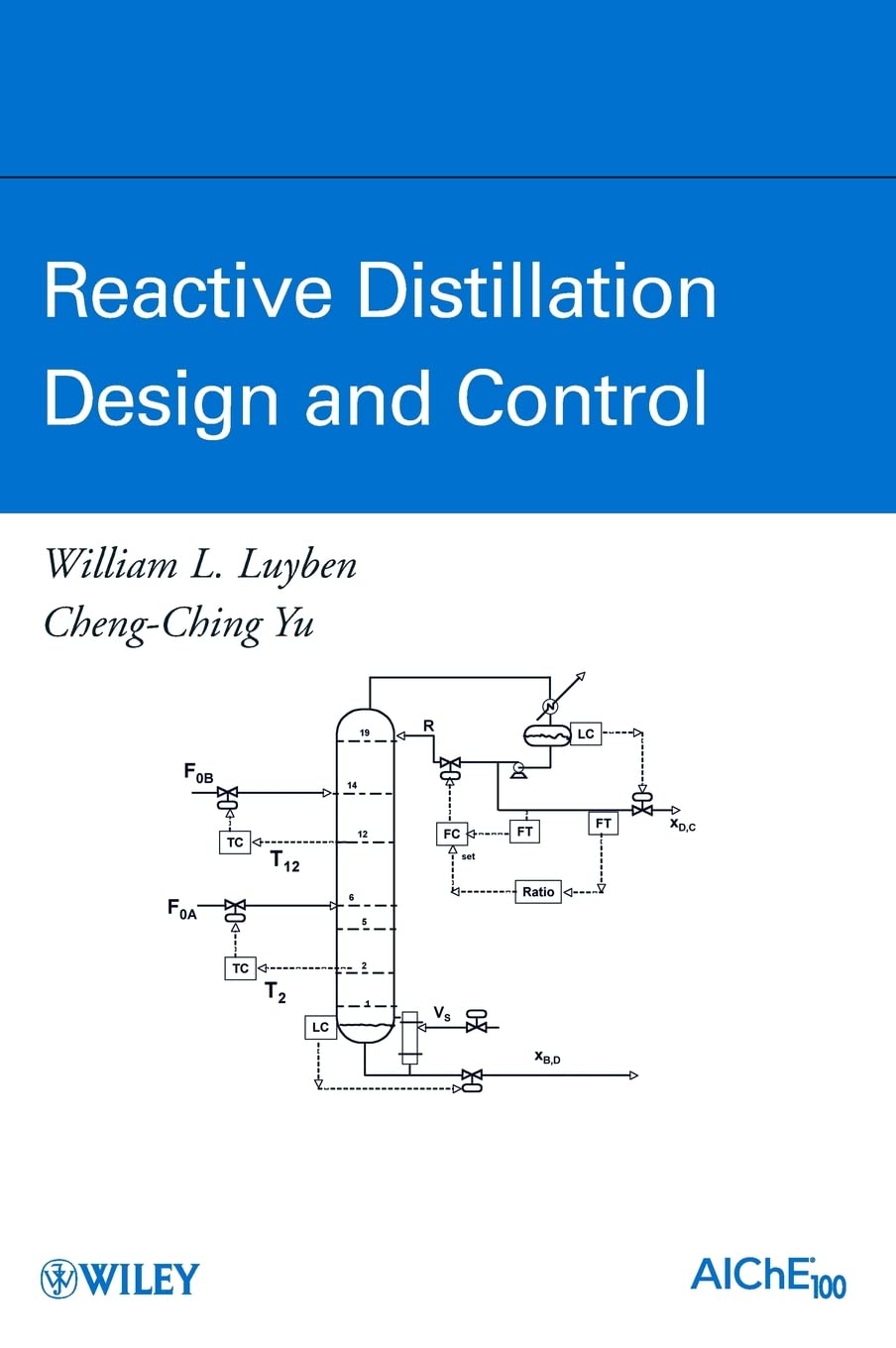
After an overview of the fundamentals, limitations, and scope of reactive distillation, this book uses rigorous models for steadystate design and dynamic analysis of different types of reactive distillation columns and quantitatively compares the economics of reactive distillation columns with conventional multiunit processes. It goes beyond traditional steadystate design that primarily considers the capital investment and energy costs when analyzing the control structure and the dynamic robustness of disturbances, and discusses how to maximize the economic and environmental benefits of reactive distillation technology.
⚠️ WARNING (California Proposition 65):
This product may contain chemicals known to the State of California to cause cancer, birth defects, or other reproductive harm.
For more information, please visit www.P65Warnings.ca.gov.
- Q: How many pages does this book have? A: This book has six hundred eight pages. It provides an in-depth exploration of reactive distillation design and control.
- Q: What are the dimensions of this book? A: The book measures seven point two inches in length, one point forty-two inches in width, and ten inches in height. These dimensions make it a standard hardcover size.
- Q: Who is the author of this book? A: The author is William Luyben. He is known for his expertise in chemical engineering and process design.
- Q: What type of binding does this book have? A: This book is bound in hardcover. This type of binding enhances durability and is suitable for frequent use.
- Q: What is the main topic of this book? A: The main topic is reactive distillation design and control. It covers both theoretical and practical aspects of the subject.
- Q: What is the target audience for this book? A: The book is aimed at chemical engineers and process designers. It is suitable for both students and professionals in the field.
- Q: How is this book useful for engineers? A: This book provides rigorous models for design and analysis. Engineers can use it to optimize reactive distillation processes.
- Q: Is this book suitable for beginners? A: Yes, the book includes an overview of fundamentals. It also discusses advanced topics for those with more experience.
- Q: Can this book help with economic analysis? A: Yes, it quantitatively compares the economics of reactive distillation with conventional processes. This analysis aids in decision-making.
- Q: What techniques does this book cover? A: The book covers steady-state design and dynamic analysis techniques. These are critical for effective control of distillation processes.
- Q: How should I store this book? A: Store the book in a cool, dry place. Keep it upright to prevent damage to the spine and pages.
- Q: Can this book be used as a reference for research? A: Yes, it serves as a valuable reference for research in chemical engineering. It provides detailed insights and models.
- Q: Is there a warranty for this book? A: Typically, books do not come with a warranty. However, check with the seller for return policies.
- Q: What if the book arrives damaged? A: If the book arrives damaged, contact the seller for a return or exchange. Most sellers have a policy for damaged items.
- Q: How can I maximize the benefits from this book? A: To maximize benefits, read it thoroughly and apply the concepts to real-world scenarios. Engage with the models presented.