
Title
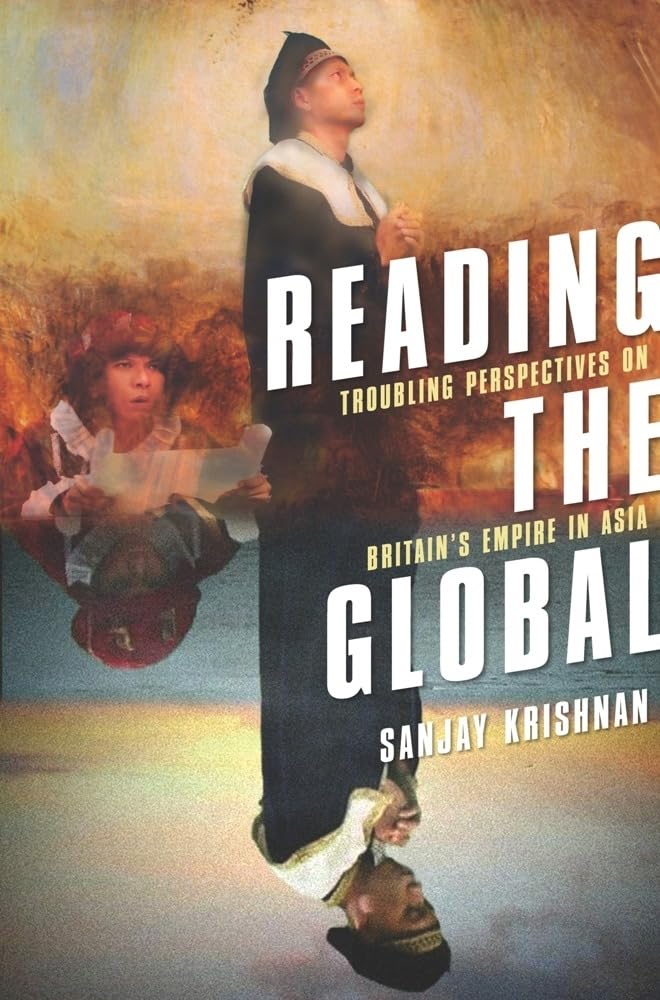
Reading the Global: Troubling Perspectives on Britain's Empire in Asia,Used
Sold by Ergodebooks, an authorized reseller.
Returns accepted within 30 days | support@ergodebooks.com
Shipping Information
- Free Standard Shipping — United States only
- Processing Time: 3–5 business days
- Estimated Delivery: 6–10 business days after dispatch
- Double-boxed, fully insured & discreetly packaged
- Tracking number sent via email once dispatched
Returns & Refund
Returns accepted within 30 days of delivery.
Damaged or Defective Item
Free return shipping + replacement or full refund
Wrong Item Received
Free return shipping + replacement or full refund
Change of Mind
Return shipping at customer's expense · 25% restocking fee applies
Payment Option

The global is an instituted perspective, not just an empirical process. Adopted initially by the British in order to make sense of their polyglot territorial empire, the global perspective served to make heterogeneous spaces and nonwhite subjects 'legible,' and in effect produced the regions it sought merely to describe. The global was the dominant perspective from which the world was produced for representation and control. It also set the terms within which subjectivity and history came to be imagined by colonizers and modern anticolonial nationalists.In this book, Sanjay Krishnan demonstrates how ideas of the global took root in eighteenth and nineteenthcentury descriptions of Southeast Asia. Krishnan turns to the works of Adam Smith, Thomas De Quincey, Abdullah bin Abdul Kadir, and Joseph Conrad, four authors who discuss the Malay Archipelago during the rise and consolidation of the British Empire. These works offer some of the most explicit and sophisticated discussions of the world as a single, interconnected entity, inducting their readers into comprehensive and objective descriptions of the world.The perspective organizing these authors' conception of the globalthe frame or code through which the world came into viewis indebted to the material and discursive possibilities set in motion by European conquest. The global, therefore, is not just a peculiar mode of thematization; it is aligned to a conception of historical development unique to European colonial capitalism. Krishnan troubles this dominant perspective. Drawing on the poststructuralist and postcolonial approaches of Jacques Derrida, Michel Foucault, and Gayatri Chakravorty Spivak, and challenging the recent historiography of empire and economic histories of globalization, he elaborates a bold new approach to the humanities in the age of globalization.
⚠️ WARNING (California Proposition 65):
This product may contain chemicals known to the State of California to cause cancer, birth defects, or other reproductive harm.
For more information, please visit www.P65Warnings.ca.gov.