
Title
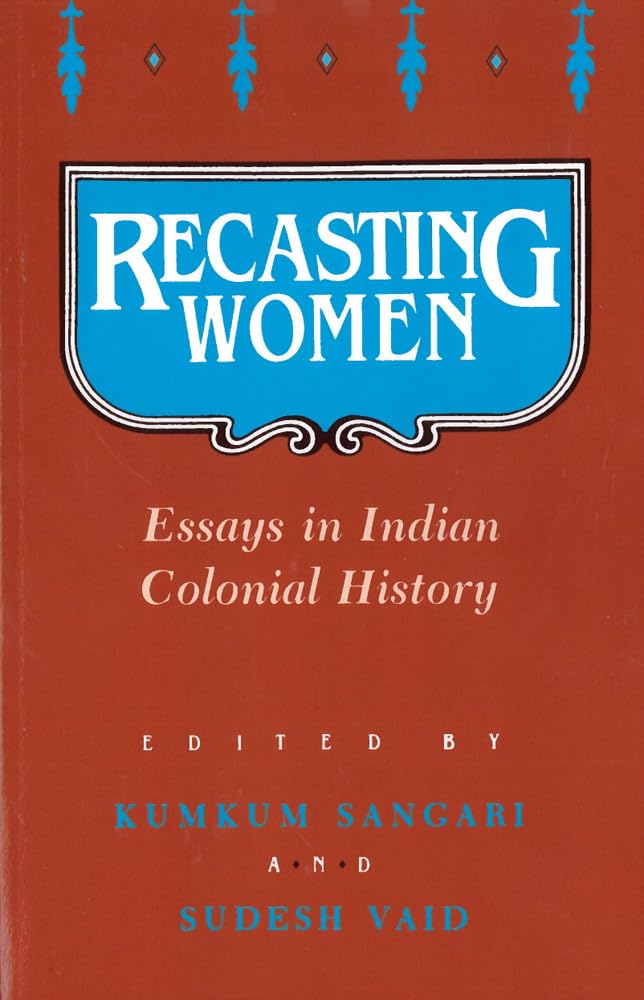
Recasting Women: Essays In Indian Colonial History,Used
Sold by Ergodebooks, an authorized reseller.
Returns accepted within 30 days | support@ergodebooks.com
Shipping Information
- Free Standard Shipping — United States only
- Processing Time: 3–5 business days
- Estimated Delivery: 6–10 business days after dispatch
- Double-boxed, fully insured & discreetly packaged
- Tracking number sent via email once dispatched
Returns & Refund
Returns accepted within 30 days of delivery.
Damaged or Defective Item
Free return shipping + replacement or full refund
Wrong Item Received
Free return shipping + replacement or full refund
Change of Mind
Return shipping at customer's expense · 25% restocking fee applies
Payment Option

This Collection Fills A Very Long Felt Need, A Fact Which Is Reinforced By The Generally Very High Quality Of The Contributions And The Fastgrowing Reputation In International Feminist Circles Of Many Of The Authors.'Arjun Appadurai, University Of Pennsylvaniathe Political And Social Life Of India In The Last Decade Has Given Rise To A Variety Of Questions Concerning The Nature And Resilience Of Patriarchal Systems In A Transitional And Postcolonial Society. The Contributors To This Interdisciplinary Volume Recognize That Every Aspect Of Reality Is Gendered, And That Such A Recognition Involves A Dismantling Of The Ideological Presuppositions Of The Socalled Gender Neutral Ideologies, As Well As The Boundaries Of Individual Disciplines.The First Set Of Essays Seeks To Analyze The Patriarchal Discourses Of A Colonial Society And Includes An Analysis Of The Shaping Of Hinduaryan Identity, The Parameters Of The Discourse On Widowimmolation, The 'Defeminization' Of Popular Culture In Nineteenthcentury Urban Calcutta, The Nature Of The Reforms Proposed By Early Women'S Journals In Hindi, And The Implications Of The Nationalist Movement And Of Indoanglian Leterature On Middleclass Patriarchal Norms.The Second Set Of Articles Relates To Women Of The Productive Classesthe Reconstitution Of Patriarchies In The Agrarian Transition In Haryana, In The Oudh Peasant Movement, In The Armed Peasant Struggle In Telangana, And Among The Working Class In Bengal. The Contributors Explore The Interrelation Of Patriarchies With Political Economy, Law, Religion, And Culture, And Suggest A Different History Of 'Reform' Movements, And Of Class And Gender Relations.
⚠️ WARNING (California Proposition 65):
This product may contain chemicals known to the State of California to cause cancer, birth defects, or other reproductive harm.
For more information, please visit www.P65Warnings.ca.gov.
- Q: What is the size of the book? A: The book measures five point five one inches in length, one inch in width, and eight point five inches in height.
- Q: How many pages does this book have? A: This book contains three hundred eighty-four pages.
- Q: What type of binding does the book have? A: The book is available in paperback binding.
- Q: Who is the author of 'Recasting Women'? A: The author of the book is Kumkum Sangari.
- Q: What is the main topic of the book? A: The book focuses on gender, history, and the impact of colonial systems on women in India.
- Q: Is this book suitable for academic study? A: Yes, this book is suitable for academic study, especially in gender studies and history.
- Q: What themes are explored in the essays? A: The essays explore themes such as patriarchal discourses, identity, and the intersection of gender with political economy.
- Q: Is this book appropriate for all ages? A: While it is not specifically an adult book, it is best suited for mature readers due to its academic nature.
- Q: How should I store this book? A: Store the book in a cool, dry place, upright to maintain its shape and prevent damage.
- Q: Can I clean the book if it gets dirty? A: Yes, gently wipe the cover with a dry cloth to remove any dust or dirt.
- Q: What if my book arrives damaged? A: If your book arrives damaged, please contact customer support for a replacement or return options.
- Q: Is there a warranty for this book? A: Books typically do not come with a warranty, but return policies may apply.
- Q: Can this book be used for group discussions? A: Yes, this book is excellent for group discussions on gender and colonial history topics.
- Q: How does this book compare to other gender studies books? A: This book offers a unique perspective on Indian colonial history, setting it apart from other gender studies literature.
- Q: Who published 'Recasting Women'? A: The book is published by Rutgers University Press.
- Q: Is this book considered a primary source? A: No, this book is a collection of essays and is considered a secondary source for research.