
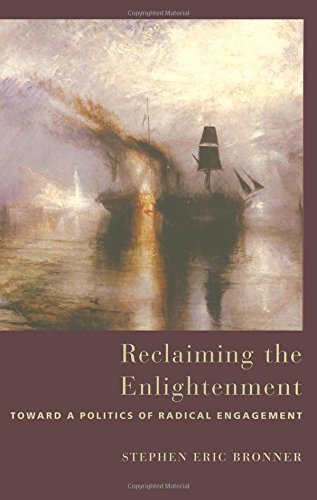
Title
Reclaiming the Enlightenment: Toward a Politics of Radical Engagement,Used
Sold by Ergodebooks, an authorized reseller.
Returns accepted within 30 days | support@ergodebooks.com
Shipping Information
- Free Standard Shipping — United States only
- Processing Time: 3–5 business days
- Estimated Delivery: 6–10 business days after dispatch
- Double-boxed, fully insured & discreetly packaged
- Tracking number sent via email once dispatched
Returns & Refund
Returns accepted within 30 days of delivery.
Damaged or Defective Item
Free return shipping + replacement or full refund
Wrong Item Received
Free return shipping + replacement or full refund
Change of Mind
Return shipping at customer's expense · 25% restocking fee applies
Payment Option

This book tackles an obvious yet profound problem of modern political life: the disorientation of intellectuals and activists on the left. As the study of political history and theory has been usurped by cultural criticism, a confusion over the origins and objectives of progressive politics has been the result. Specifically, it has become fashionable for intellectuals to attack the Enlightenment for its imperialism, eurocentrism, and scientism, and for the sexism and racism of some of its major representatives. Although the fact that individual thinkers harbored such prejudices is irrefutable, Stephen Bronner argues that reducing the Enlightenment ethos to these beliefs is wholly unsustainable.With its championing of democracy, equality, cosmopolitanism, and reasonand its vociferous attacks on popular prejudice, religious superstition, and arbitrary abuses of powerthe Enlightenment was once hailed as the foundation of all modern, progressive politics. But in 1947, this perspective was dramatically undermined when Max Horkheimer and Theodor Adorno published their classic work, Dialectic of Enlightenment, which claims that the Enlightenment was the source of totalitarianism and the worst excesses of modernity. Reclaiming the Enlightenment from purely philosophical and cultural interpretations, Bronner shows that its notion of political engagement keeps democracy fresh and alive by providing a practical foundation for fostering institutional accountability, opposing infringements on individual rights, instilling an enduring commitment to social reform, and building a cosmopolitan sensibility. This forceful and timely reinterpretation of the Enlightenment and its powerful influence on contemporary political life is a resounding wakeup call to critics on both the left and the right.
⚠️ WARNING (California Proposition 65):
This product may contain chemicals known to the State of California to cause cancer, birth defects, or other reproductive harm.
For more information, please visit www.P65Warnings.ca.gov.
- Q: What is the total page count of the book? A: The book contains two hundred twenty-four pages. This length makes it a manageable read for those interested in political theory.
- Q: What are the dimensions of the book? A: The book measures five point nine eight inches in length, eight point seven four inches in height, and zero point five one inches in thickness. These dimensions make it convenient for both reading and storage.
- Q: What type of binding does this book have? A: This book features paperback binding. This type of binding is lightweight and flexible, ideal for portability.
- Q: Who is the author of this book? A: The author is Stephen Eric Bronner. He is known for his work in political theory and cultural criticism.
- Q: What is the main theme of 'Reclaiming the Enlightenment'? A: The main theme revolves around reinterpreting the Enlightenment's impact on modern politics. It addresses the confusion among leftist intellectuals regarding their political foundations.
- Q: Is this book suitable for beginners in political theory? A: Yes, the book is suitable for beginners. It provides an accessible entry point into discussions of Enlightenment ideas and their relevance today.
- Q: How does 'Reclaiming the Enlightenment' approach political engagement? A: The book argues for a practical foundation of political engagement rooted in Enlightenment ideals. It emphasizes democracy, equality, and accountability.
- Q: What audience is this book intended for? A: This book is intended for intellectuals, activists, and anyone interested in political theory. It appeals to those seeking a deeper understanding of progressive politics.
- Q: What is the best way to read this book? A: The best way to read this book is to engage with it actively, taking notes on key arguments and concepts. This approach enhances comprehension of its complex themes.
- Q: How should I store this book to keep it in good condition? A: Store the book in a cool, dry place, away from direct sunlight. This will help prevent wear and tear on the paperback cover.
- Q: Is there any special care needed for this book? A: No special care is needed for this book. Regular care like avoiding spills and excessive bending will keep it in good condition.
- Q: What is the return policy for this book? A: The return policy typically allows returns within thirty days of purchase. Check with the retailer for specific conditions.
- Q: What if the book arrives damaged? A: If the book arrives damaged, contact the seller immediately for a replacement or refund. Most retailers have policies for such issues.
- Q: Can I gift this book to someone interested in philosophy? A: Yes, it makes an excellent gift for anyone interested in philosophy and political theory. Its engaging content is thought-provoking.
- Q: How does this book compare to other political theory books? A: This book differs by focusing on the Enlightenment's relevance today, unlike many that may only discuss historical context. It offers a contemporary reinterpretation.