
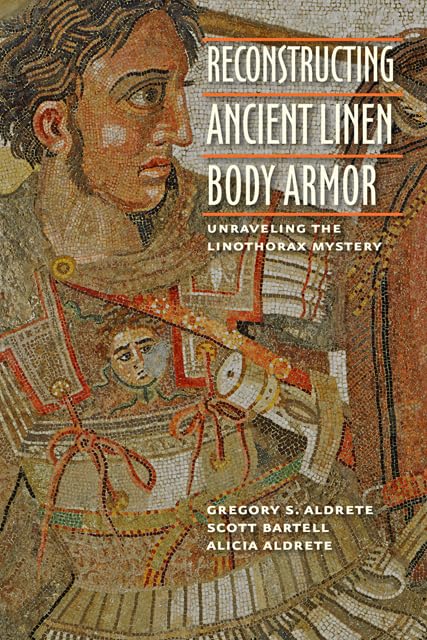
Title
Reconstructing Ancient Linen Body Armor: Unraveling The Linothorax Mystery
Sold by Ergodebooks, an authorized reseller.
Returns accepted within 30 days | support@ergodebooks.com
Shipping Information
- Free Standard Shipping — United States only
- Processing Time: 3–5 business days
- Estimated Delivery: 6–10 business days after dispatch
- Double-boxed, fully insured & discreetly packaged
- Tracking number sent via email once dispatched
Returns & Refund
Returns accepted within 30 days of delivery.
Damaged or Defective Item
Free return shipping + replacement or full refund
Wrong Item Received
Free return shipping + replacement or full refund
Change of Mind
Return shipping at customer's expense · 25% restocking fee applies
Payment Option

A Thorough And Original Study Of The Linothorax, The Linen Armor Worn By Alexander The Great.Alexander The Great Led One Of The Most Successful Armies In History And Conquered Nearly The Entirety Of The Known World While Wearing Armor Made Of Cloth. How Is That Possible? In Reconstructing Ancient Linen Body Armor, Gregory S. Aldrete, Scott Bartell, And Alicia Aldrete Provide The Answer.An Extensive Multiyear Project In Experimental Archaeology, This Pioneering Study Presents A Thorough Investigation Of The Linothorax, Linen Armor Worn By The Greeks, Macedonians, And Other Ancient Mediterranean Warriors. Because The Linothorax Was Made Of Cloth, No Examples Of It Have Survived. As A Result, Even Though There Are Dozens Of References To The Linothorax In Ancient Literature And Nearly A Thousand Images Of It In Ancient Art, This Linen Armor Remains Relatively Ignored And Misunderstood By Scholars.Combining Traditional Textual And Archaeological Analysis With Handson Reconstruction And Experimentation, The Authors Unravel The Mysteries Surrounding The Linothorax. They Have Collected And Examined All Of The Literary, Visual, Historical, And Archaeological Evidence For The Armor And Detail Their Efforts To Replicate The Armor Using Materials And Techniques That Are As Close As Possible To Those Employed In Antiquity. By Reconstructing Actual Examples Using Authentic Materials, The Authors Were Able To Scientifically Assess The True Qualities Of Linen Armor For The First Time In 1,500 Years. The Tests Reveal That The Linothorax Provided Surprisingly Effective Protection For Ancient Warriors, That It Had Several Advantages Over Bronze Armor, And That It Even Shared Qualities With Modernday Kevlar.Previously Featured In Documentaries On The Discovery Channel And The Canadian History Channel, As Well As In U.S. News And World Report, Msnbc Online, And Other International Venues, This Groundbreaking Work Will Be A Landmark In The Study Of Ancient Warfare.
⚠️ WARNING (California Proposition 65):
This product may contain chemicals known to the State of California to cause cancer, birth defects, or other reproductive harm.
For more information, please visit www.P65Warnings.ca.gov.
- Q: How many pages is the book? A: This book has three hundred four pages. It provides a comprehensive study of ancient linen body armor.
- Q: What is the binding type of this book? A: The book is a hardcover edition. This durable binding enhances its longevity and makes it suitable for repeated reading.
- Q: What are the dimensions of the book? A: The book measures six inches in length, zero point ninety-nine inches in width, and nine point zero two inches in height. These dimensions make it easy to handle and store.
- Q: Who are the authors of this book? A: The authors are Gregory S. Aldrete, Scott Bartell, and Alicia Aldrete. They are known for their expertise in ancient history and experimental archaeology.
- Q: What is the main topic of the book? A: The book focuses on the linothorax, a type of linen armor worn by ancient warriors. It explores its construction, historical significance, and effectiveness.
- Q: What is the target audience for this book? A: This book is suitable for historians, archaeology enthusiasts, and anyone interested in ancient warfare. It offers detailed insights into a lesser-known aspect of military history.
- Q: How should I care for this book? A: To keep this book in good condition, store it upright in a dry place. Avoid exposing it to direct sunlight to prevent fading.
- Q: Is this book suitable for children? A: Yes, this book is appropriate for older children and teens interested in history. However, parental guidance is recommended due to complex themes.
- Q: Are there any illustrations in the book? A: Yes, the book includes illustrations that complement the text. These visuals help in understanding the historical context and armor construction.
- Q: What is the significance of the linothorax discussed in the book? A: The linothorax is significant as it highlights the use of cloth armor in ancient warfare. The book demonstrates its advantages over traditional metal armor.
- Q: Can I find examples of linothorax in ancient literature? A: Yes, there are numerous references to linothorax in ancient literature and art. The book discusses these sources extensively.
- Q: What research methods are used in the book? A: The authors combine textual analysis with experimental archaeology. They reconstructed the armor to assess its effectiveness based on historical techniques.
- Q: Is there a glossary or reference section in the book? A: Yes, the book includes reference sections and a glossary. This aids readers in understanding specialized terms related to ancient armor.
- Q: What materials were used to reconstruct the linothorax? A: The authors used authentic materials similar to those in antiquity for reconstruction. This approach provides insights into the armor's properties.
- Q: Does the book discuss modern comparisons to the linothorax? A: Yes, the book compares linothorax to modern materials like Kevlar. It reveals surprising similarities in protective qualities.
- Q: What makes this book a landmark study? A: This book is considered groundbreaking due to its in-depth research and experimental approach to understanding ancient body armor. It sheds light on a previously overlooked topic.