
Title
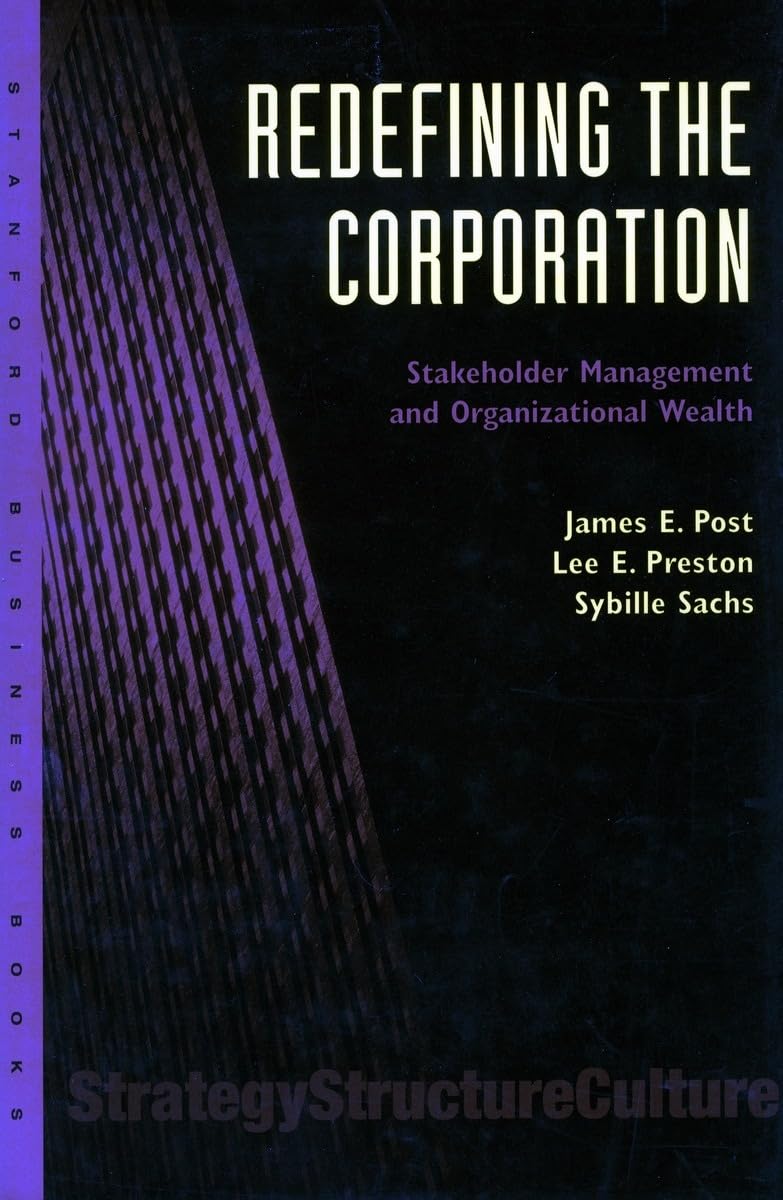
Redefining The Corporation: Stakeholder Management And Organizational Wealth,New
Sold by Ergodebooks, an authorized reseller.
Returns accepted within 30 days | support@ergodebooks.com
Shipping Information
- Free Standard Shipping — United States only
- Processing Time: 3–5 business days
- Estimated Delivery: 6–10 business days after dispatch
- Double-boxed, fully insured & discreetly packaged
- Tracking number sent via email once dispatched
Returns & Refund
Returns accepted within 30 days of delivery.
Damaged or Defective Item
Free return shipping + replacement or full refund
Wrong Item Received
Free return shipping + replacement or full refund
Change of Mind
Return shipping at customer's expense · 25% restocking fee applies
Payment Option

The modern corporation is an institution of enormous economic power and social impact. Corporations have grown in size and numbers all over the world because of their ability to mobilize productive resources and create new wealth. The evolution of the corporation has given rise to new opportunities and challenges that require a redefinition of the corporation and its objectives.The legitimacy of the corporation as an institution, its 'license to operate' within society, depends not only on its success in wealth creation but also on its ability to meet the expectations of diverse constituents who contribute to its existence and success. These constituencies and interests are the corporation's stakeholdersresource providers, customers, suppliers, alliance partners, and social and political actors. Consequently, the corporation must be seen as an institution engaged in mobilizing resources to create wealth and benefits for all its stakeholders.This book presents a stakeholder view of the corporation in both theoretical and practical terms. Its central proposition is that organizational wealth is created (or destroyed) through a corporation's interactions with its stakeholders. Effective stakeholder management develops and utilizes relationships between a corporation and its stakeholders for mutual benefit, thereby accomplishing the fundamental purpose of wealth creation.Following the empirical maxim that 'Corporations are what they do,' the authors examine the stakeholder management practices of three major corporations: Cummins Engine Company, Motorola, and the Royal Dutch/Shell Group. These companies are very different, and their current stakeholder management policies and practices have evolved in very different ways. However, they share a common commitment to humanistic values and to continuous learning. Their varied experiences illustrate some of the opportunities and challenges of stakeholder management, and confirm the appropriateness of the stakeholder view of the corporation as a basis for strategy and policy.
⚠️ WARNING (California Proposition 65):
This product may contain chemicals known to the State of California to cause cancer, birth defects, or other reproductive harm.
For more information, please visit www.P65Warnings.ca.gov.