
Title
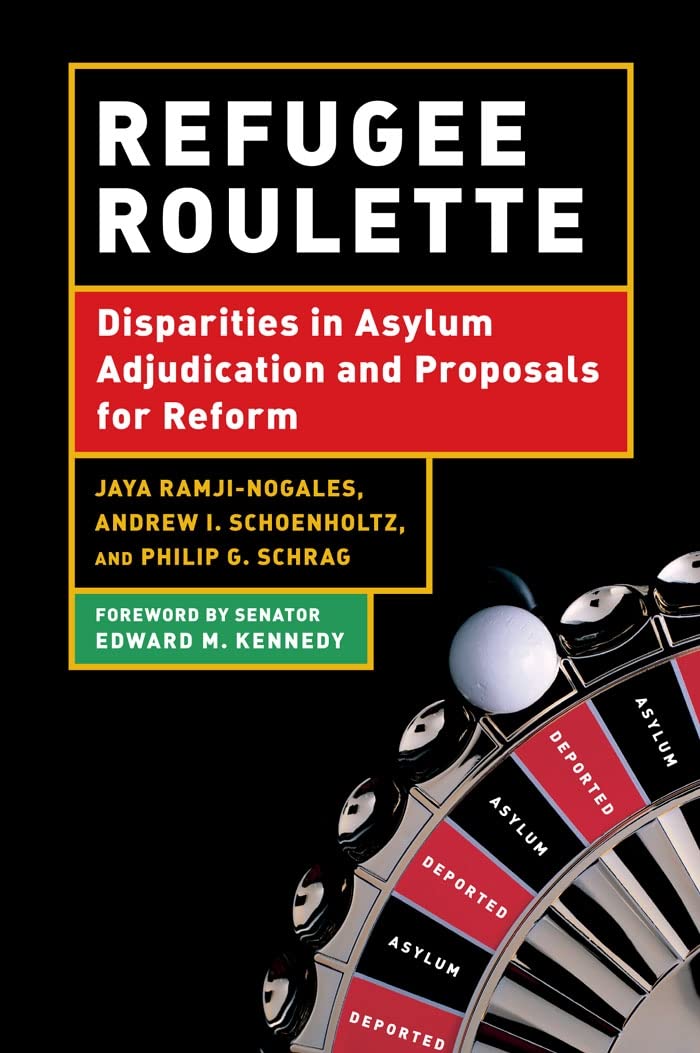
Refugee Roulette: Disparities In Asylum Adjudication And Proposals For Reform,Used
Sold by Ergodebooks, an authorized reseller.
Returns accepted within 30 days | support@ergodebooks.com
Shipping Information
- Free Standard Shipping — United States only
- Processing Time: 3–5 business days
- Estimated Delivery: 6–10 business days after dispatch
- Double-boxed, fully insured & discreetly packaged
- Tracking number sent via email once dispatched
Returns & Refund
Returns accepted within 30 days of delivery.
Damaged or Defective Item
Free return shipping + replacement or full refund
Wrong Item Received
Free return shipping + replacement or full refund
Change of Mind
Return shipping at customer's expense · 25% restocking fee applies
Payment Option

Through the Refugee Act of 1980, the United States offers the prospect of safety to people who flee to America to escape rape, torture, and even death in their native countries. In order to be granted asylum, however, an applicant must prove to an asylum officer or immigration judge that she has a wellfounded fear of persecution in her homeland. The chance of winning asylum should have little if anything to do with the personality of the official to whom a case is randomly assigned, but in a groundbreaking and shocking study, Jaya RamjiNogales, Andrew I. Schoenholtz, and Philip G. Schrag learned that lifeordeath asylum decisions are too frequently influenced by random factors relating to the decision makers. In many cases, the most important moment in an asylum case is the instant in which a clerk randomly assigns the application to an adjudicator. The system, in its current state, is like a game of chance.Refugee Roulette is the first analysis of decisions at all four levels of the asylum adjudication process: the Department of Homeland Security, the immigration courts, the Board of Immigration Appeals, and the United States Courts of Appeals. The data reveal tremendous disparities in asylum approval rates, even when different adjudicators in the same office each considered large numbers of applications from nationals of the same country. After providing a thorough empirical analysis, the authors make recommendations for future reform. Original essays by eight scholars and policy makers then discuss the authors research and recommendationsContributors: Bruce Einhorn, Steven Legomsky, Audrey Macklin, M. Margaret McKeown, Allegra McLeod, Carrie MenkelMeadow, Margaret Taylor, and Robert Thomas.
⚠️ WARNING (California Proposition 65):
This product may contain chemicals known to the State of California to cause cancer, birth defects, or other reproductive harm.
For more information, please visit www.P65Warnings.ca.gov.