
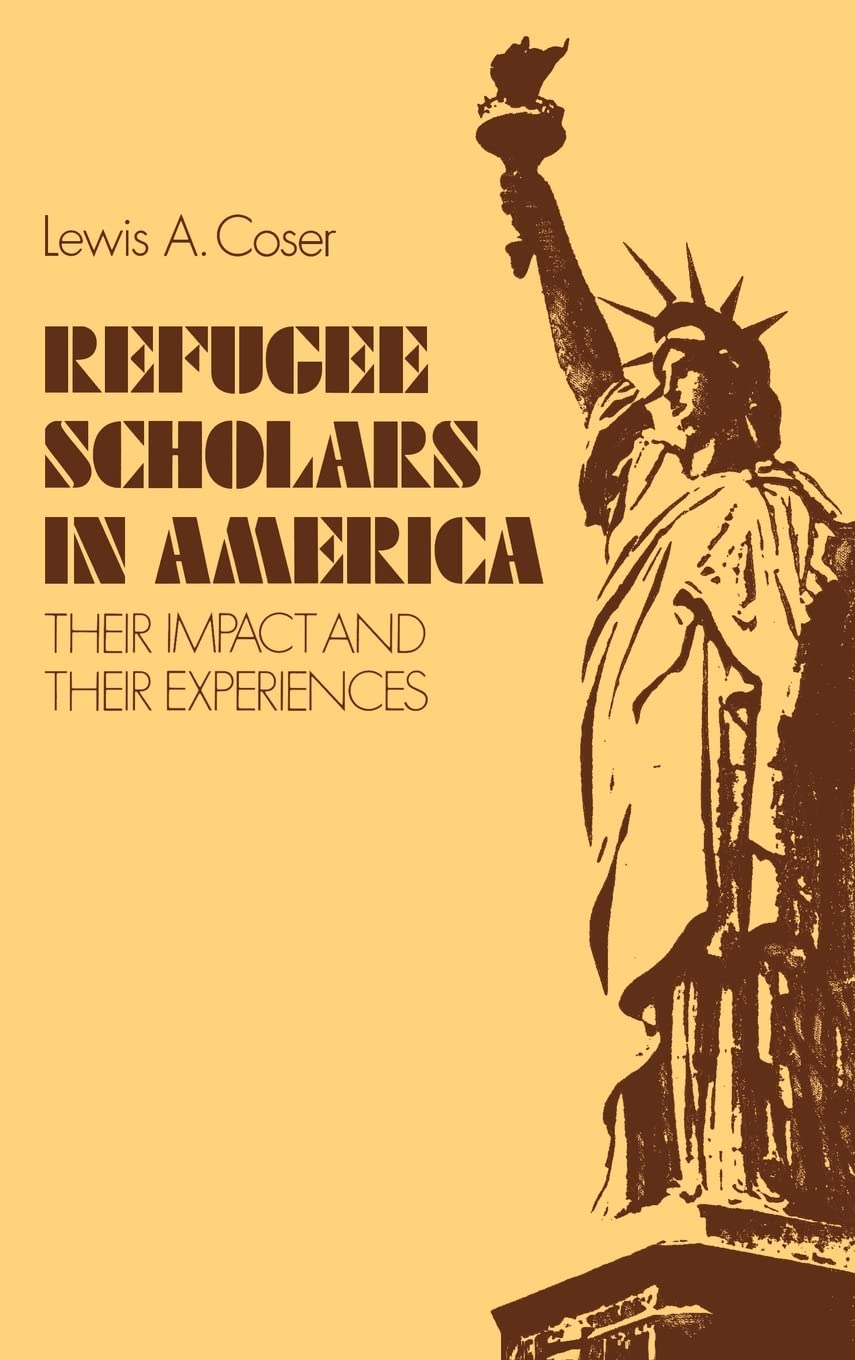
Title
Refugee Scholars in America: Their Impact and Their Experiences,Used
Sold by Ergodebooks, an authorized reseller.
Returns accepted within 30 days | support@ergodebooks.com
Shipping Information
- Free Standard Shipping — United States only
- Processing Time: 3–5 business days
- Estimated Delivery: 6–10 business days after dispatch
- Double-boxed, fully insured & discreetly packaged
- Tracking number sent via email once dispatched
Returns & Refund
Returns accepted within 30 days of delivery.
Damaged or Defective Item
Free return shipping + replacement or full refund
Wrong Item Received
Free return shipping + replacement or full refund
Change of Mind
Return shipping at customer's expense · 25% restocking fee applies
Payment Option

What were the contributions to American scholarship and culture made by European refugees from Nazi persecution? How did these migrs react to the experience of being strangers in the land of their refuge? In this engrossing book, Lewis Coser examines the impact of refugee intellectuals on the social sciences and the humanities in America, painting a collective portrait that sheds light not only on the accomplishments of the Europeans but also on the development of the several disciplines in America that either welcomed or rejected them.Coser explains, for example, why the migrs had more influence in the field of psychoanalysis than in psychology; why Austrian economists were more successful in America than were German economists; why only a few European sociologists made significant contributions in America. Discussing such luminaries as Bruno Bettelheim, Jacob Marshak, Hannah Arendt, Thomas Mann, Vladimir Nabokov, Roman Jacobson, Erwin Panofsky, and Paul Tillich, Coser describes their backgrounds, personalities, and careers in America, providing revealing anecdotes that help to bring these figures to life. His accounts of those who were famous in the country of their birth but never achieved eminence or a feeling of adjustment in America provide a poignant contrast.Coser concludes that the refugee intellectuals were most influential in areas of study where they filled a perceived need not previously met or in fields where they could build on already established traditions. His perceptive analysis of the Europeanborn men and women who altered American intellectual history is an absorbing and memorable story.
⚠️ WARNING (California Proposition 65):
This product may contain chemicals known to the State of California to cause cancer, birth defects, or other reproductive harm.
For more information, please visit www.P65Warnings.ca.gov.
- Q: What is the main theme of 'Refugee Scholars in America'? A: The book explores the contributions of European refugees from Nazi persecution to American scholarship and culture, examining their impact on social sciences and humanities.
- Q: Who is the author of this book? A: The author of 'Refugee Scholars in America' is Lewis Coser.
- Q: What kind of insights does Lewis Coser provide about refugee intellectuals? A: Coser provides insights into the backgrounds, personalities, and careers of refugee intellectuals, highlighting their influence in various academic fields and sharing anecdotes that illuminate their experiences.
- Q: What is the publication date of this book? A: The book was published on October 1, 1984.
- Q: How many pages does 'Refugee Scholars in America' have? A: The book contains 380 pages.
- Q: What type of binding does this book have? A: This book is available in hardcover binding.
- Q: What is the condition of the book? A: The item condition is listed as 'Good'.
- Q: Is there a specific edition of this book? A: Yes, this book is a First Edition.
- Q: What subjects does the book cover related to refugee scholars? A: The book covers topics such as the influence of refugee scholars in psychoanalysis, economics, and sociology, and their roles in shaping American intellectual history.
- Q: Can you provide examples of notable figures discussed in the book? A: Notable figures discussed include Bruno Bettelheim, Hannah Arendt, Thomas Mann, and Vladimir Nabokov, among others.