If you have any questions, you are always welcome to contact us. We'll get back to you as soon as possible, withing 24 hours on weekdays.
Customer service
All questions about your order, return and delivery must be sent to our customer service team by e-mail at yourstore@yourdomain.com
Sale & Press
If you are interested in selling our products, need more information about our brand or wish to make a collaboration, please contact us at press@yourdomain.com
Help
If you have any questions, you are always welcome to contact us. We'll get back to you as soon as possible, withing 24 hours on weekdays.
Customer service
All questions about your order, return and delivery must be sent to our customer service team by e-mail at yourstore@yourdomain.com
Sale & Press
If you are interested in selling our products, need more information about our brand or wish to make a collaboration, please contact us at press@yourdomain.com
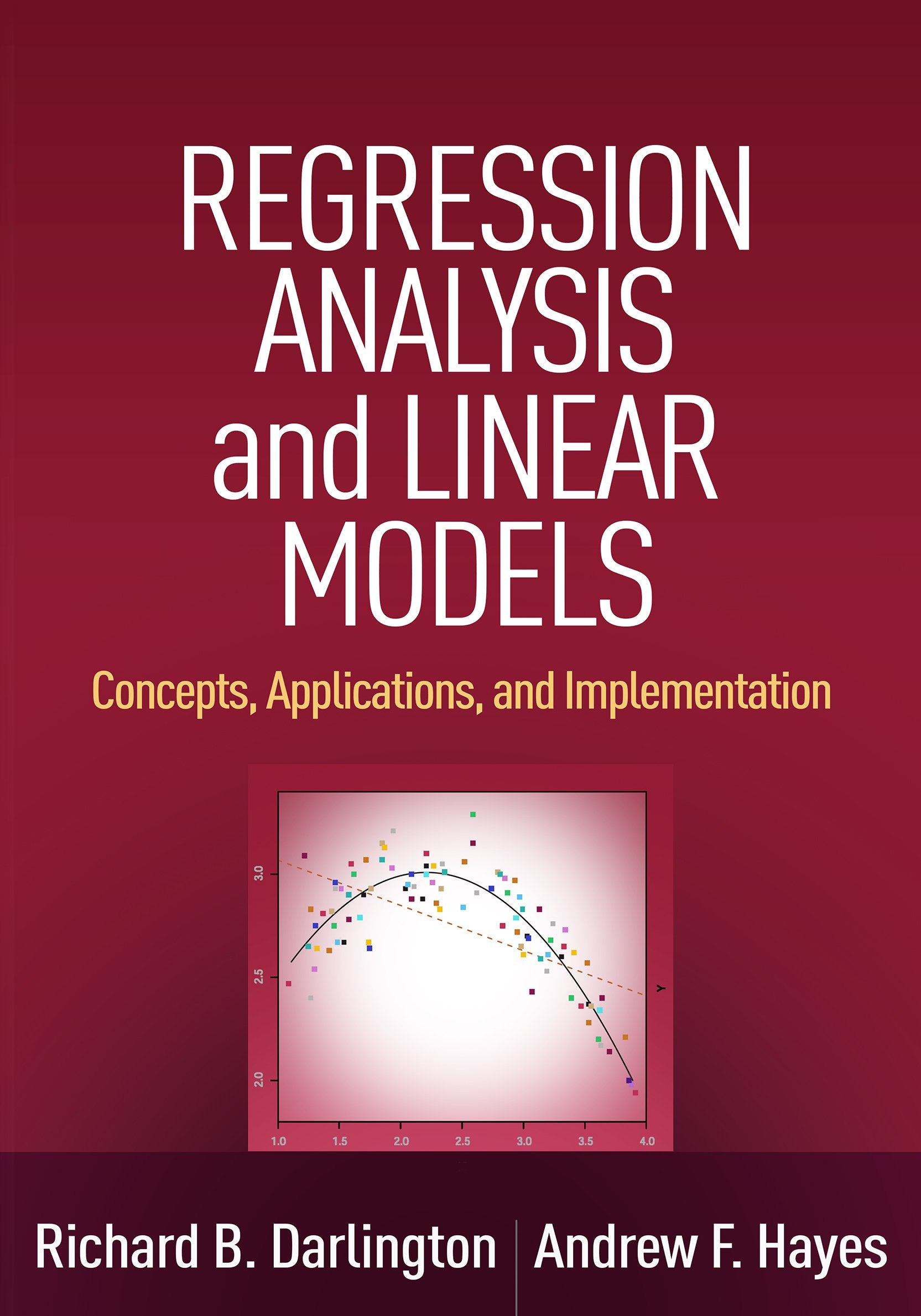
Emphasizing conceptual understanding over mathematics, this userfriendly text introduces linear regression analysis to students and researchers across the social, behavioral, consumer, and health sciences. Coverage includes model construction and estimation, quantification and measurement of multivariate and partial associations, statistical control, group comparisons, moderation analysis, mediation and path analysis, and regression diagnostics, among other important topics. Engaging workedthrough examples demonstrate each technique, accompanied by helpful advice and cautions. The use of SPSS, SAS, and STATA is emphasized, with an appendix on regression analysis using R. The companion website (www.afhayes.com) provides datasets for the book's examples as well as the RLM macro for SPSS and SAS.Pedagogical Features:*Chapters include SPSS, SAS, or STATA code pertinent to the analyses described, with each distinctively formatted for easy identification.*An appendix documents the RLM macro, which facilitates computations for estimating and probing interactions, dominance analysis, heteroscedasticityconsistent standard errors, and linear spline regression, among other analyses.*Students are guided to practice what they learn in each chapter using datasets provided online.*Addresses topics not usually covered, such as ways to measure a variables importance, coding systems for representing categorical variables, causation, and myths about testing interaction.
⚠️ WARNING (California Proposition 65):
This product may contain chemicals known to the State of California to cause cancer,
birth defects, or other reproductive harm.
For MAP (Minimum Advertised Price) violations and Intellectual Property (IP) or Trademark concerns, please contact:
support@ergodebooks.com
⚠️ California Proposition 65 Warning: Some products sold on this website may expose you to chemicals known to the State of California to cause cancer, birth defects, or other reproductive harm. For more information, visit www.P65Warnings.ca.gov.