
Title
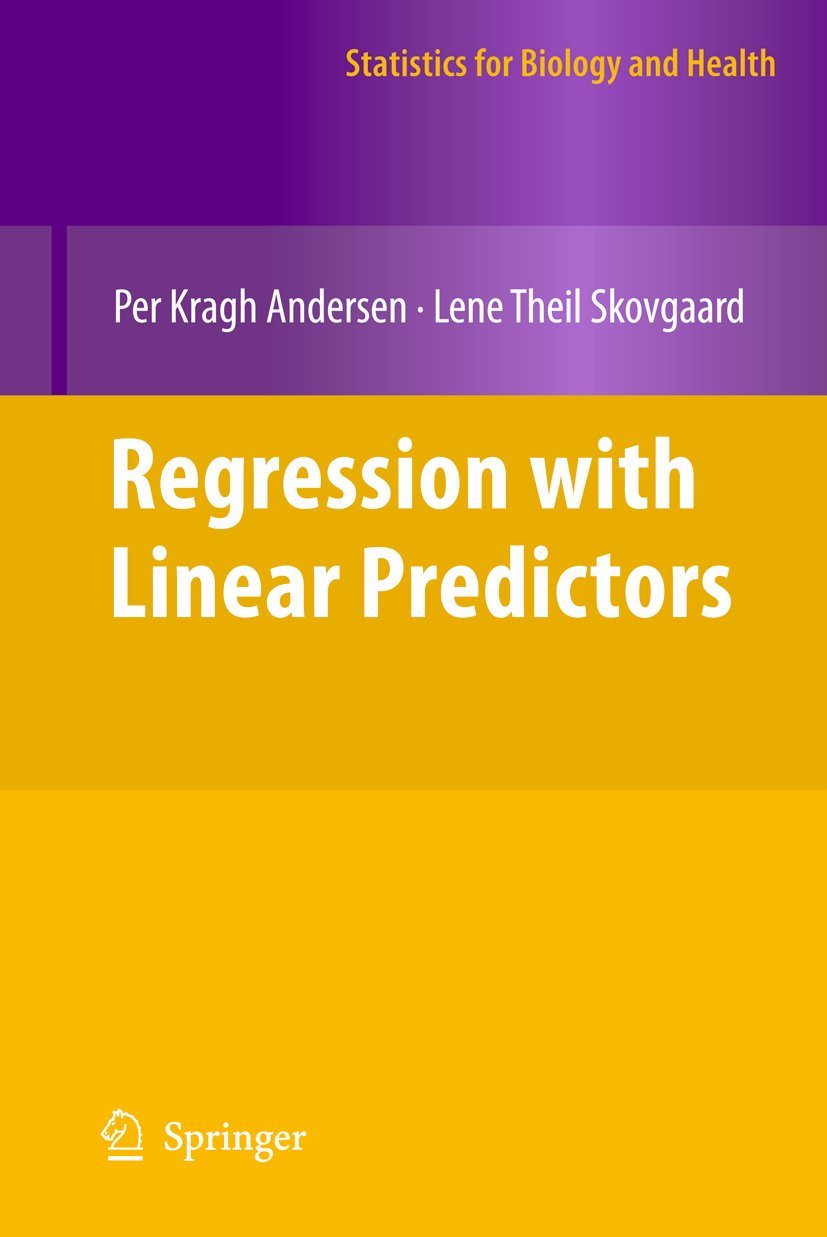
Regression With Linear Predictors (Statistics For Biology And Health),Used
Sold by Ergodebooks, an authorized reseller.
Returns accepted within 30 days | support@ergodebooks.com
Shipping Information
- Free Standard Shipping — United States only
- Processing Time: 3–5 business days
- Estimated Delivery: 6–10 business days after dispatch
- Double-boxed, fully insured & discreetly packaged
- Tracking number sent via email once dispatched
Returns & Refund
Returns accepted within 30 days of delivery.
Damaged or Defective Item
Free return shipping + replacement or full refund
Wrong Item Received
Free return shipping + replacement or full refund
Change of Mind
Return shipping at customer's expense · 25% restocking fee applies
Payment Option

This is a book about regression analysis, that is, the situation in statistics where the distribution of a response (or outcome) variable is related to planatory variables (or covariates). This is an extremely common situation in the application of statistical methods in many ?elds, andlinear regression, gistic regression, and Cox proportional hazards regression are frequently used for quantitative, binary, and survival time outcome variables, respectively. Several books on these topics have appeared and for that reason one may well ask why we embark on writing still another book on regression. We have two main reasons for doing this: 1. First, we want to highlightsimilaritiesamonglinear,logistic,proportional hazards,andotherregressionmodelsthatincludealinearpredictor. These modelsareoftentreatedentirelyseparatelyintextsinspiteofthefactthat alloperationsonthemodelsdealingwiththelinearpredictorareprecisely the same, including handling of categorical and quantitative covariates, testing for linearity and studying interactions. 2. Second, we want to emphasize that, for any type of outcome variable, multiple regression models are composed of simple building blocks that areaddedtogetherinthelinearpredictor:thatis,ttests,onewayanalyses of variance and simple linear regressions for quantitative outcomes, 22, 2(k+1) tables and simple logistic regressions for binary outcomes, and 2and (k+1)sample logrank testsand simple Cox regressionsfor survival data. Thishastwoconsequences. Allthesesimpleandwellknownmethods can be considered as special cases of the regression models. On the other hand, the e?ect of a single explanatory variable in a multiple regression model can be interpreted in a way similar to that obtained in the simple analysis, however, now valid only for the other explanatory variables in the model held ?xed.
⚠️ WARNING (California Proposition 65):
This product may contain chemicals known to the State of California to cause cancer, birth defects, or other reproductive harm.
For more information, please visit www.P65Warnings.ca.gov.