
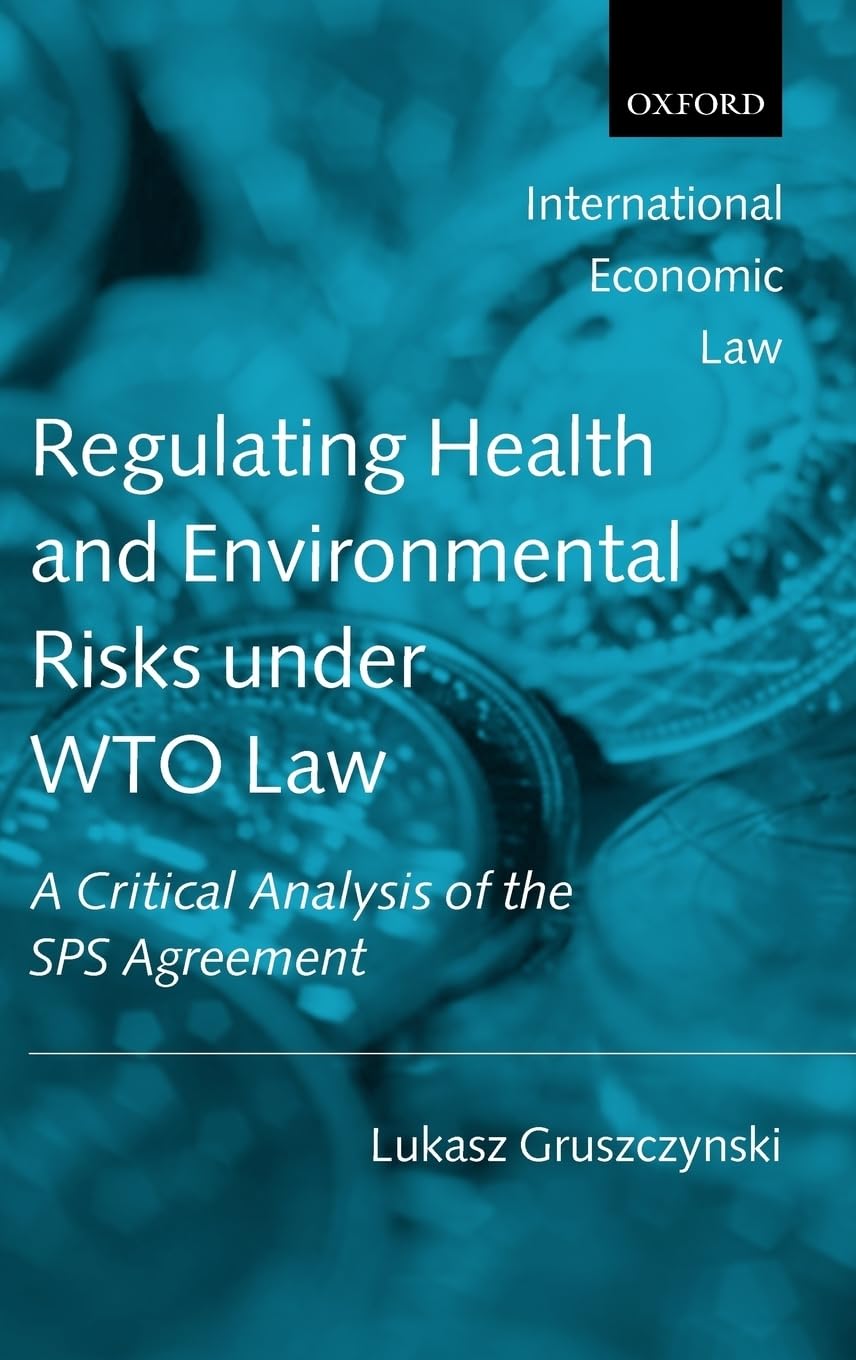
Title
Regulating Health And Environmental Risks Under Wto Law: A Critical Analysis Of The Sps Agreement (International Economic Law Se
Sold by Ergodebooks, an authorized reseller.
Returns accepted within 30 days | support@ergodebooks.com
Shipping Information
- Free Standard Shipping — United States only
- Processing Time: 3–5 business days
- Estimated Delivery: 6–10 business days after dispatch
- Double-boxed, fully insured & discreetly packaged
- Tracking number sent via email once dispatched
Returns & Refund
Returns accepted within 30 days of delivery.
Damaged or Defective Item
Free return shipping + replacement or full refund
Wrong Item Received
Free return shipping + replacement or full refund
Change of Mind
Return shipping at customer's expense · 25% restocking fee applies
Payment Option

The last sixty years witnessed an unprecedented expansion of international trade. The system created by the General Agreement on Tariffs and Trade and later by the World Trade Organization (WTO) has proved to be an efficient instrument for the elimination of trade and tariff barriers. This process coincided with increased national regulatory controls, which were particularly visible in the area of risk regulation. Governments, responding to the demands of their domestic constituencies, have adopted a wide range of regulatory measures aimed at protecting the environment and human health. Although, for the most part, the new regulatory initiatives served legitimate objectives, it has also turned out that internal measures might become an attractive vehicle for protectionism, taking the place that was traditionally occupied by tariff barriers. Regulating Health and Environmental Risks under the WTO Law examinesthe WTO Agreement on the Application of Sanitary and Phytosanitary Measures (SPS Agreement). In which it is an attempt by the international community to limit possible abuses while assuring WTO Members of an extensive margin of regulatory discretion.The central problem that the book tackles is whether the system established by the SPS Agreement can address the existing and potential challenges of a new interdependent world. In answering this question, the author provides a comprehensive and critical examination of the substantive provisions of the Agreement and corresponding case law. In this context, the book particularly focuses on two issues: the consistency in the interpretation of the SPS Agreement and the appropriateness of its various requirements. This analysis leads the author to conclude that despite some interpretative failures of SPS case law, the system established by the SPS Agreement seems to provide an effective solution for the supervision of domestic SPS measures.
⚠️ WARNING (California Proposition 65):
This product may contain chemicals known to the State of California to cause cancer, birth defects, or other reproductive harm.
For more information, please visit www.P65Warnings.ca.gov.