
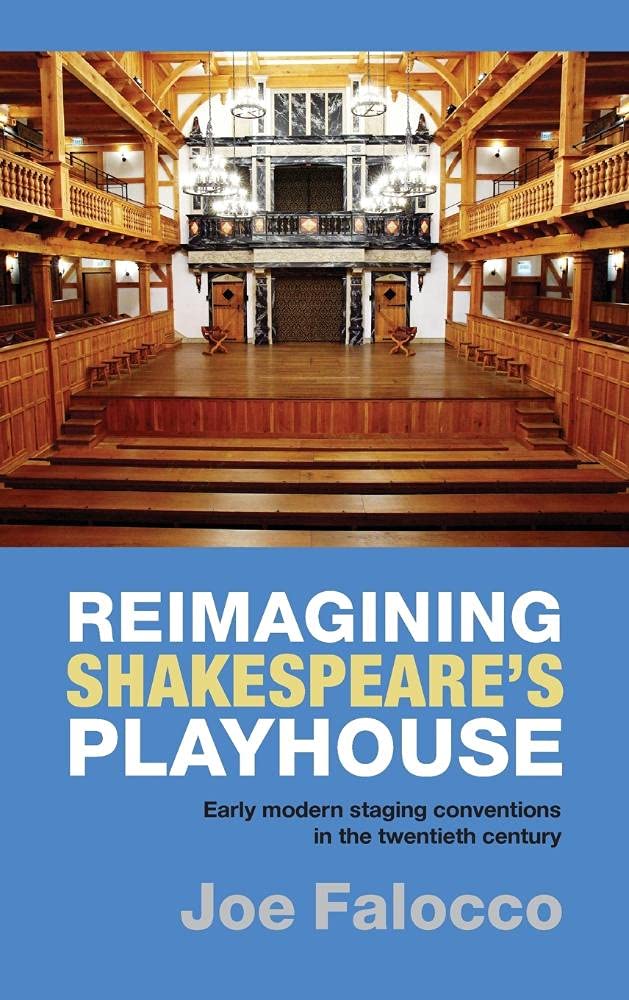
Title
Reimagining Shakespeare's Playhouse: Early Modern Staging Conventions in the Twentieth Century,Used
Sold by Ergodebooks, an authorized reseller.
Returns accepted within 30 days | support@ergodebooks.com
Shipping Information
- Free Standard Shipping — United States only
- Processing Time: 3–5 business days
- Estimated Delivery: 6–10 business days after dispatch
- Double-boxed, fully insured & discreetly packaged
- Tracking number sent via email once dispatched
Returns & Refund
Returns accepted within 30 days of delivery.
Damaged or Defective Item
Free return shipping + replacement or full refund
Wrong Item Received
Free return shipping + replacement or full refund
Change of Mind
Return shipping at customer's expense · 25% restocking fee applies
Payment Option

An examination of the recreation of Renaissance staging traditions in modern performances.Provocative, very readable, and extremely widely researched; it will be an important intervention in many ongoing debates.' LUCY MUNRO, Senior Lecturer in English, Keele UniversityNumerous attempts have been made in the modern and postmodern era to recreate the staging conventions of Shakespeare's theatre, from William Poel to the founders of the New Globe. This volume examines the work of these directors, analysing their practical successes and failures; it also engages with the ideological critiques of early modern staging advanced by scholars such as W.B. Worthen and Ric Knowles. The author argues that rather than indulging in archaism for its own sake, the movementlooked backward in a progressive attempt to address the challenges of the twentieth century.The book begins with a reexamination of the conventional view of Poel as an antiquarian crank. Subsequent chapters are devoted toHarley Granville Barker and Nugent Monck; the author argues that while Barker's major contribution was the dubious achievement of establishing the movement's reputation as an essentially literary phenomenon, Monck took the first tentative steps toward an architectural reimagining of modern performance spaces, an advance which led to later triumphs in early modern staging. The book then traces the sporadic and irregular development of Tyrone Guthrie's commitment to early modern practices. The final chapter looks at how competing historical theories of playhouse design influenced the construction of the Globe, while the conclusion discusses the ongoing potential of early modern staging in the new millennium.Dr JOE FALOCCO is Lecturer in English, Texas State University.
⚠️ WARNING (California Proposition 65):
This product may contain chemicals known to the State of California to cause cancer, birth defects, or other reproductive harm.
For more information, please visit www.P65Warnings.ca.gov.