If you have any questions, you are always welcome to contact us. We'll get back to you as soon as possible, withing 24 hours on weekdays.
Customer service
All questions about your order, return and delivery must be sent to our customer service team by e-mail at yourstore@yourdomain.com
Sale & Press
If you are interested in selling our products, need more information about our brand or wish to make a collaboration, please contact us at press@yourdomain.com
Help
If you have any questions, you are always welcome to contact us. We'll get back to you as soon as possible, withing 24 hours on weekdays.
Customer service
All questions about your order, return and delivery must be sent to our customer service team by e-mail at yourstore@yourdomain.com
Sale & Press
If you are interested in selling our products, need more information about our brand or wish to make a collaboration, please contact us at press@yourdomain.com
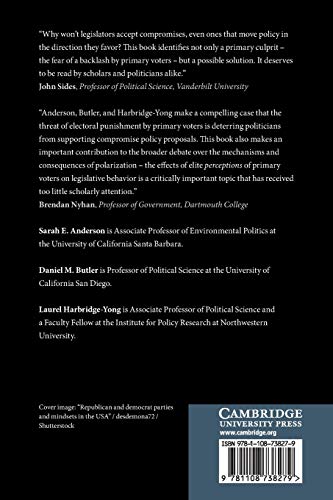
Legislative solutions to pressing problems like balancing the budget, climate change, and poverty usually require compromise. Yet national, state, and local legislators often reject compromise proposals that would move policy in their preferred direction. Why do legislators reject such agreements? This engaging and relevant investigation into how politicians think reveals that legislators refuse compromise and exacerbate gridlock because they fear punishment from voters in primary elections. Prioritizing these electoral interests can lead lawmakers to act in ways that hurt their policy interests and also overlook the broader electorate's preferences by representing only a subset of voters with rigid positions. With their solutionoriented approach, Anderson, Butler, and HarbridgeYong demonstrate that improving the likelihood of legislative compromise may require moving negotiations outside of the public spotlight. Highlighting key electoral motives underlying polarization, this book is an excellent resource for scholars and students studying Congress, American politics, public policy, and political behavior.
⚠️ WARNING (California Proposition 65):
This product may contain chemicals known to the State of California to cause cancer,
birth defects, or other reproductive harm.
For MAP (Minimum Advertised Price) violations and Intellectual Property (IP) or Trademark concerns, please contact:
support@ergodebooks.com
⚠️ California Proposition 65 Warning: Some products sold on this website may expose you to chemicals known to the State of California to cause cancer, birth defects, or other reproductive harm. For more information, visit www.P65Warnings.ca.gov.