
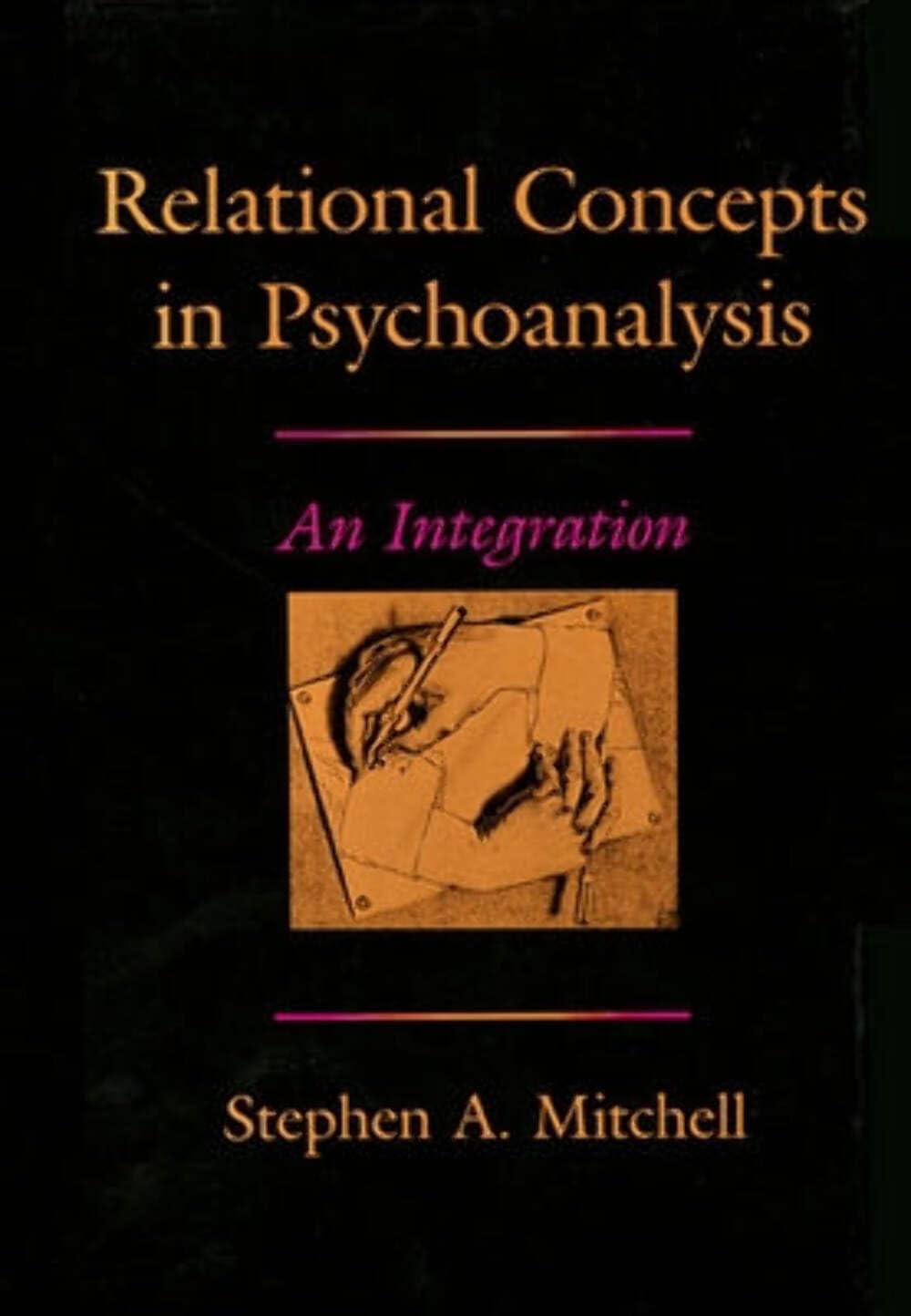
Title
Relational Concepts in Psychoanalysis: An Integration,Used
Sold by Ergodebooks, an authorized reseller.
Returns accepted within 30 days | support@ergodebooks.com
Shipping Information
- Free Standard Shipping — United States only
- Processing Time: 3–5 business days
- Estimated Delivery: 6–10 business days after dispatch
- Double-boxed, fully insured & discreetly packaged
- Tracking number sent via email once dispatched
Returns & Refund
Returns accepted within 30 days of delivery.
Damaged or Defective Item
Free return shipping + replacement or full refund
Wrong Item Received
Free return shipping + replacement or full refund
Change of Mind
Return shipping at customer's expense · 25% restocking fee applies
Payment Option

There are more psychoanalytic theories today than anyone knows what to do with, and the heterogeneity and complexity of the entire body of psychoanalytic though have become staggering. In Relational Concepts in Psychoanalysis, Stephen A. Mitchell weaves strands from the principal relationalmodel traditions (interpersonal psychoanalysis, British school objectrelations theories, self psychology, and existential psychoanalysis) into a comprehensive approach to many of the knottiest problems and controversies in theoretical and clinical psychoanalysis.Mitchells earlier book, Object Relations in Psychoanalytic Theory, coauthored with Jay Greenberg, set the stage for this current integration by providing a broad comparative analysis of important thinking on the nature of human relationships. In that classic study Greenberg and Mitchell distinguished between two basic paradigms: the drive model, in which relations with others are generated and shaped by the need for drive gratifications, and various relational models, in which relations themselves are taken as primary and irreducible. In Relational Concepts in Psychoanalysis, Mitchell argues that the drive model has since outlived its usefulness. The relational model, on the other hand, has been developed piecemeal by different authors who rarely acknowledge and explore the commonality of their assumptions or the rich complementarity of their perspectives.In this bold effort at integrative theorizing, Mitchell draws together major lines of relationalmodel traditions into a unified framework for psychoanalytic thought, more economical than the anachronistic drive model and more inclusive than any of the singular relational approaches to the core significance of sexuality, the impact of early experience, the relation of the past to the present, the interpenetration of illusion and actuality, the centrality of the will, the repetition of painful experience, the nature of analytic situation, and the process of analytic change. As such, his book will be required reading for psychoanalytic scholars, practitioners, candidates in psychoanalysis, and students in the field.
⚠️ WARNING (California Proposition 65):
This product may contain chemicals known to the State of California to cause cancer, birth defects, or other reproductive harm.
For more information, please visit www.P65Warnings.ca.gov.
- Q: What is the main focus of 'Relational Concepts in Psychoanalysis'? A: The book focuses on integrating various relational-model traditions in psychoanalysis, addressing complex issues within the field.
- Q: Who is the author of this book? A: The author is Stephen A. Mitchell, a prominent figure in psychoanalytic theory.
- Q: What is the condition of the book being sold? A: The book is listed as a 'Used Book in Good Condition'.
- Q: How many pages does 'Relational Concepts in Psychoanalysis' have? A: The book contains 326 pages.
- Q: What type of binding does this book have? A: This edition is a hardcover.
- Q: When was 'Relational Concepts in Psychoanalysis' published? A: It was published on November 15, 1988.
- Q: What edition is this book? A: This is the First Edition of the book.
- Q: Is this book suitable for beginners in psychoanalysis? A: While it is comprehensive, it may be more suitable for scholars and practitioners rather than complete beginners.
- Q: What are the key themes discussed in the book? A: Key themes include the nature of human relationships, the impact of early experiences, and the process of analytic change.
- Q: Can this book be useful for psychoanalytic students? A: Yes, it is considered required reading for students in the field of psychoanalysis.