
Title
Relevant Linguistics: An Introduction to the Structure and Use of English for Teachers,Used
Sold by Ergodebooks, an authorized reseller.
Returns accepted within 30 days | support@ergodebooks.com
Shipping Information
- Free Standard Shipping — United States only
- Processing Time: 3–5 business days
- Estimated Delivery: 6–10 business days after dispatch
- Double-boxed, fully insured & discreetly packaged
- Tracking number sent via email once dispatched
Returns & Refund
Returns accepted within 30 days of delivery.
Damaged or Defective Item
Free return shipping + replacement or full refund
Wrong Item Received
Free return shipping + replacement or full refund
Change of Mind
Return shipping at customer's expense · 25% restocking fee applies
Payment Option

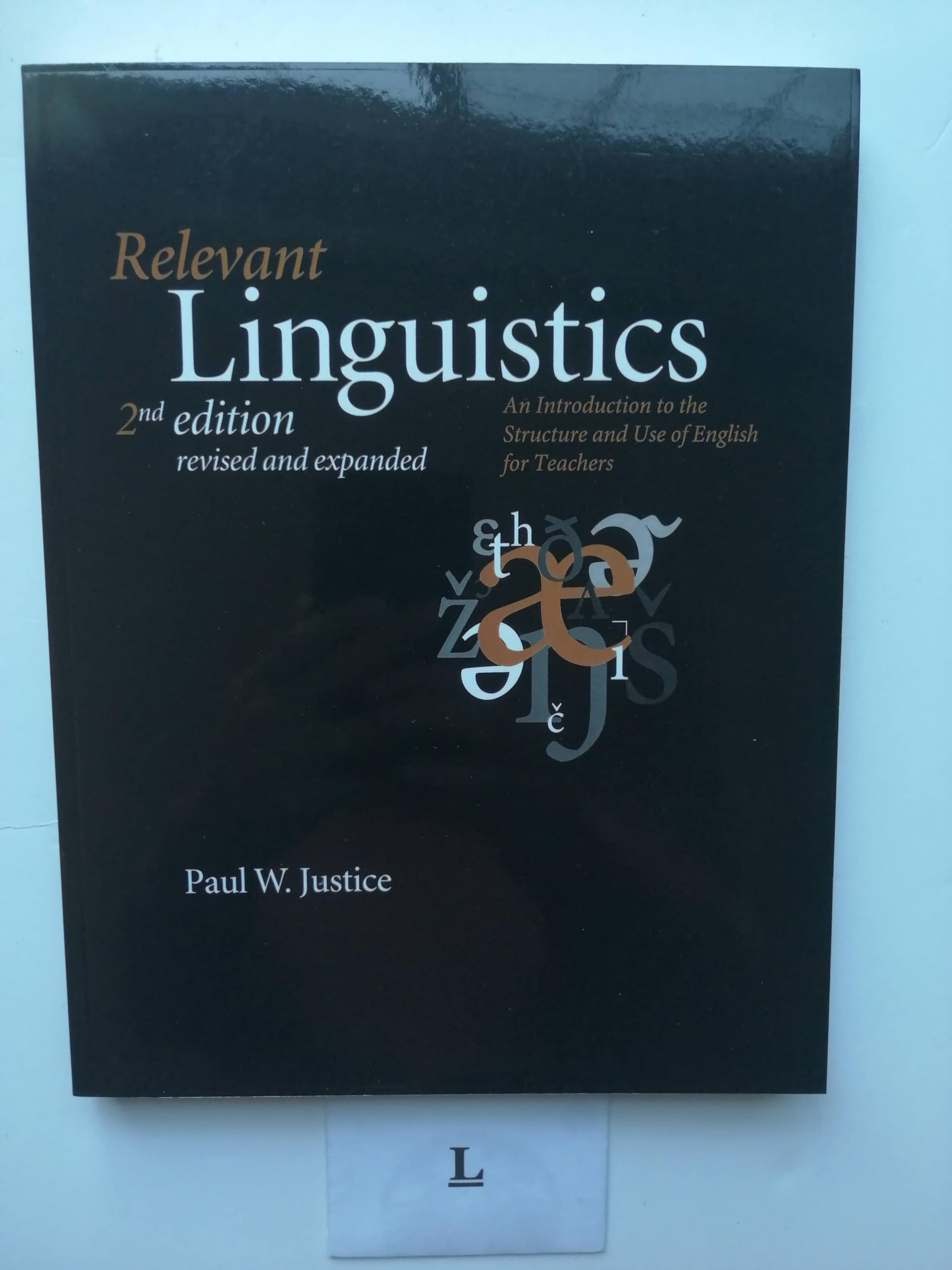
This revised and expanded edition of Paul W. Justice's popular text provides a straightforward, accessible introduction to the basics of linguistics for education students and all nonlinguistics majors, covering the essentials of phonetics, phonology, morphology, morphophonology, and syntax. While this overview is accessible to any student, Justice's text will be of particular use in teacher training programs, many of which now expose trainees to these topics in order to cope with rising linguistic diversity in classrooms.Each chapter of Relevant Linguistics leads students through descriptive analysis, helps them grasp linguistic concepts, and provides them with the reference materials necessary for their own teaching. This second edition contains more exercises as well as expanded and clarified explanations of the issues discussed in the first edition. Also included are more references to areas such as the history of English and semantics.
⚠️ WARNING (California Proposition 65):
This product may contain chemicals known to the State of California to cause cancer, birth defects, or other reproductive harm.
For more information, please visit www.P65Warnings.ca.gov.
- Q: What topics are covered in 'Relevant Linguistics'? A: 'Relevant Linguistics' covers essential topics such as phonetics, phonology, morphology, morpho-phonology, and syntax, providing a comprehensive introduction to linguistics for education students.
- Q: Who is the author of the book? A: The book is authored by Paul W. Justice, who has revised and expanded the original text for better accessibility and understanding.
- Q: Is this book suitable for non-linguistics majors? A: Yes, this book is designed to be accessible for all non-linguistics majors, making it suitable for a wide range of education students.
- Q: How many pages does this book contain? A: 'Relevant Linguistics' contains a total of 311 pages, providing thorough coverage of the subject matter.
- Q: What is the binding type of this book? A: The book is available in paperback binding, making it easy to handle and read.
- Q: When was the second edition of 'Relevant Linguistics' published? A: The second edition was published on January 1, 2004.
- Q: Are there additional exercises in the second edition? A: Yes, the second edition includes more exercises and expanded explanations compared to the first edition, enhancing the learning experience.
- Q: Can this book help in teacher training programs? A: Absolutely, this book is particularly useful in teacher training programs as it equips trainees with essential linguistic knowledge to handle diverse classrooms.
- Q: Does the book include references to historical aspects of English? A: Yes, the second edition includes references to the history of English and semantics, providing a broader context for students.
- Q: Is this book suitable for self-study? A: Yes, 'Relevant Linguistics' is suitable for self-study, as it provides descriptive analysis and reference materials necessary for understanding linguistic concepts.