
Title
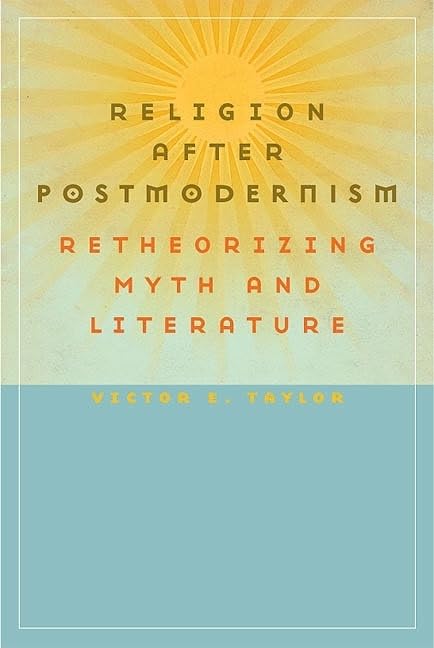
Religion After Postmodernism: Retheorizing Myth And Literature (Studies In Religion And Culture),Used
Sold by Ergodebooks, an authorized reseller.
Returns accepted within 30 days | support@ergodebooks.com
Shipping Information
- Free Standard Shipping — United States only
- Processing Time: 3–5 business days
- Estimated Delivery: 6–10 business days after dispatch
- Double-boxed, fully insured & discreetly packaged
- Tracking number sent via email once dispatched
Returns & Refund
Returns accepted within 30 days of delivery.
Damaged or Defective Item
Free return shipping + replacement or full refund
Wrong Item Received
Free return shipping + replacement or full refund
Change of Mind
Return shipping at customer's expense · 25% restocking fee applies
Payment Option

ReviewThis is a brilliant and original book. I am impressed with the depth and seriousness of Taylor's work and the clarity by which he accomplishes it. Taylor has moved into the first rank of 'theological' readers of the literary text and the creative process. (Sander L. GilmanEmory University, author of Multiculturalism and the Jews)Taylor's ParaInquiry was groundbreaking in its own right, but this new work is far more encompassing, sensitive to cuttingedge themes and developments in Continental philosophy and cultural studies, and prepared to take these trajectories to a new level. The marriage of postmodernist 'theory' and religious theory has not been seriously proposed, and Taylor is the first to do so in a significant as well as serious way. (Carl RaschkeUniversity of Denver, author of The Next Reformation)Theologians are in great debt for Taylors work. (Tom Beaudoin Theology Today)Product DescriptionIn this critical examination of the role of the imagination in the modern and postmodern periods, Victor E. Taylor looks at the 'fable' as a narrative form that addresses the ultimate questions of how to live and why. He assesses various literary theories and styles in the wake of postmodernism to reveal the ways in which fablestyle narrative can be a meaningful genre for addressing traditional and posttraditional religious, ethical, and epistemological concerns. In the process, Taylor draws on key figures across the humanitiesfrom Mircea Eliade and Claude LviStrauss, Paul Ricoeur and Slavoj Zizek, to Leo Tolstoy and Franz Kafka.Placing an emphasis on rethinking the importance of critical theory in religious studies, the author argues that a new, more demanding formulation of the concept of possibility allows for a realignment of the philosophical, mythological, and literary imaginations. By returning to the history of philosophy, myth studies, and modern literature, Taylor makes a renewed case for the significance of a distinctive formulation of religious theory as a desire for thinking. Religion after Postmodernism calls for a reconsideration of 'theory as thinking' for the future of philosophy, religious studies, and literature.ReviewThis is a brilliant and original book. I am impressed with the depth and seriousness of Taylor's work and the clarity by which he accomplishes it. Taylor has moved into the first rank of 'theological' readers of the literary text and the creative process.Taylor's ParaInquiry was groundbreaking in its own right, but this new work is far more encompassing, sensitive to cuttingedge themes and developments in Continental philosophy and cultural studies, and prepared to take these trajectories to a new level. The marriage of postmodernist 'theory' and religious theory has not been seriously proposed, and Taylor is the first to do so in a significant as well as serious way.Theologians are in great debt for Taylors work.Review'This is a brilliant and original book. I am impressed with the depth and seriousness of Taylor's work and the clarity by which he accomplishes it. Taylor has moved into the first rank of 'theological' readers of the literary text and the creative process. 'Sander L. GilmanEmory University, author of Multiculturalism and the Jews'Taylor's ParaInquiry was groundbreaking in its own right, but this new work is far more encompassing, sensitive to cuttingedge themes and developments in Continental philosophy and cultural studies, and prepared to take these trajectories to a new level. The marriage of postmodernist 'theory' and religious theory has not been seriously proposed, and Taylor is the first to do so in a significant as well as serious way. 'Carl RaschkeUniversity of Denver, author of The Next Reformation'Theologians are in great debt for Taylors work. 'Tom Beaudoin, author of Theology TodayAbout the AuthorVictor E. Taylor is Associate Professor at York College of Pennsylvania. His previous works include Para/Inquiry: Postmo
⚠️ WARNING (California Proposition 65):
This product may contain chemicals known to the State of California to cause cancer, birth defects, or other reproductive harm.
For more information, please visit www.P65Warnings.ca.gov.