
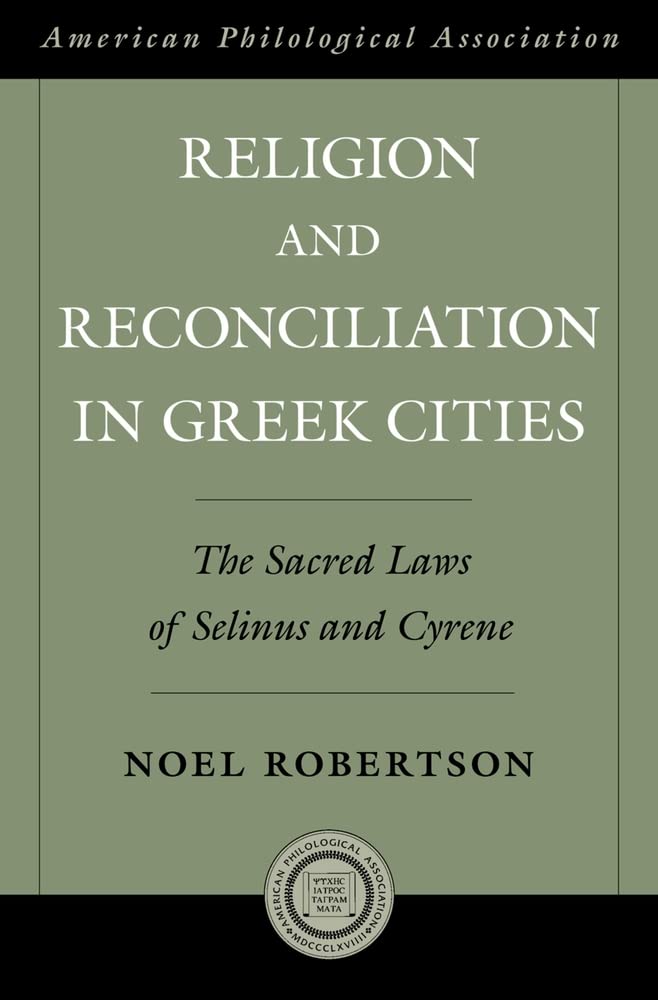
Title
Religion and Reconciliation in Greek Cities: The Sacred Laws of Selinus and Cyrene (Society for Classical Studies American Class,Used
Sold by Ergodebooks, an authorized reseller.
Returns accepted within 30 days | support@ergodebooks.com
Shipping Information
- Free Standard Shipping — United States only
- Processing Time: 3–5 business days
- Estimated Delivery: 6–10 business days after dispatch
- Double-boxed, fully insured & discreetly packaged
- Tracking number sent via email once dispatched
Returns & Refund
Returns accepted within 30 days of delivery.
Damaged or Defective Item
Free return shipping + replacement or full refund
Wrong Item Received
Free return shipping + replacement or full refund
Change of Mind
Return shipping at customer's expense · 25% restocking fee applies
Payment Option

Two Greek cities which in their time were leading states in the Mediterranean world, Selinus in Sicily and Cyrene in Libya, set up inscriptions of the kind called sacred laws, but regulating worship on a larger scale than elsewhere Selinus in the mid fifth century B.C., Cyrene in the late fourth. In different ways, the content and the format of both inscriptions are so unusual that they have baffled understanding.At Selinus, a large lead tablet with two columns of writing upside down to each other is thought to be a remedy for homicide pollution arising from civil strife, but most of it remains obscure and intractable. The gods who are named and the ritual that is prescribed have been misinterpreted in the light of literary works that dwell on the sensational. Instead, they belong to agrarian religion and follow a regular sequence of devotions, the upsidedown columns being reversed midway through the year with magical effect. Gods and ritual were selected because of their appeal to ordinary persons. Selinus was governed by a long enduring oligarchy which made an effort, appearing also in the economic details of sacrifice, to reconcile rich and poor.At Cyrene, a long series of rules were displayed on a marble block in the premier shrine of Apollo. They are extremely diverse both costly and trivial, customary and novel and eighty years of disputation have brought no agreement as to the individual meaning or general significance. In fact this mixture of things is carefully arranged to suit a variety of needs, of rich and poor, of citizens of long standing and of newcomers probably of Libyan origin. In one instance the same agrarian deities appear as at Selinus. It is the work once more of a moderate oligarchy, which on other evidence proved its worth during the turbulent events of this period.Religion and Reconciliation in Greek Cities provides a revised text and a secure meaning for both documents, and interprets the gods, the ritual, and the social background in the light of much comparative material from other Greek cities. Noel Robertson's approach rejects the usual assumptions based on moralizing literary works and in doing so restores to us an ancient nature religion which Greek communities adapted to their own practical purposes.
⚠️ WARNING (California Proposition 65):
This product may contain chemicals known to the State of California to cause cancer, birth defects, or other reproductive harm.
For more information, please visit www.P65Warnings.ca.gov.
- Q: What is the main focus of 'Religion and Reconciliation in Greek Cities'? A: The book examines the sacred laws of the ancient Greek cities Selinus and Cyrene, focusing on their unique inscriptions regulating worship and their social implications.
- Q: Who is the author of this book? A: The author of 'Religion and Reconciliation in Greek Cities' is Noel Robertson.
- Q: How many pages does the book contain? A: The book has a total of 432 pages.
- Q: What is the binding type of this book? A: This book is available in hardcover binding.
- Q: When was 'Religion and Reconciliation in Greek Cities' published? A: The book was published on December 1, 2009.
- Q: What are the key themes discussed in the book? A: Key themes include the interpretation of ancient ritual practices, social structures in Greek cities, and the reconciliation efforts between different societal groups.
- Q: Is this book suitable for academic study? A: Yes, this book is suitable for academic study, particularly for those interested in ancient Greek religion, archaeology, and social history.
- Q: What type of readers might benefit from this book? A: Students, scholars, and anyone interested in ancient Greek culture and religion will find valuable insights in this book.
- Q: Does the book provide a comparative analysis with other Greek cities? A: Yes, the book interprets the inscriptions in the context of comparative material from other Greek cities.
- Q: What makes the inscriptions from Selinus and Cyrene unique? A: The inscriptions are notable for their unusual content and format, including the use of upside-down columns and a diverse range of rules catering to various social classes.