
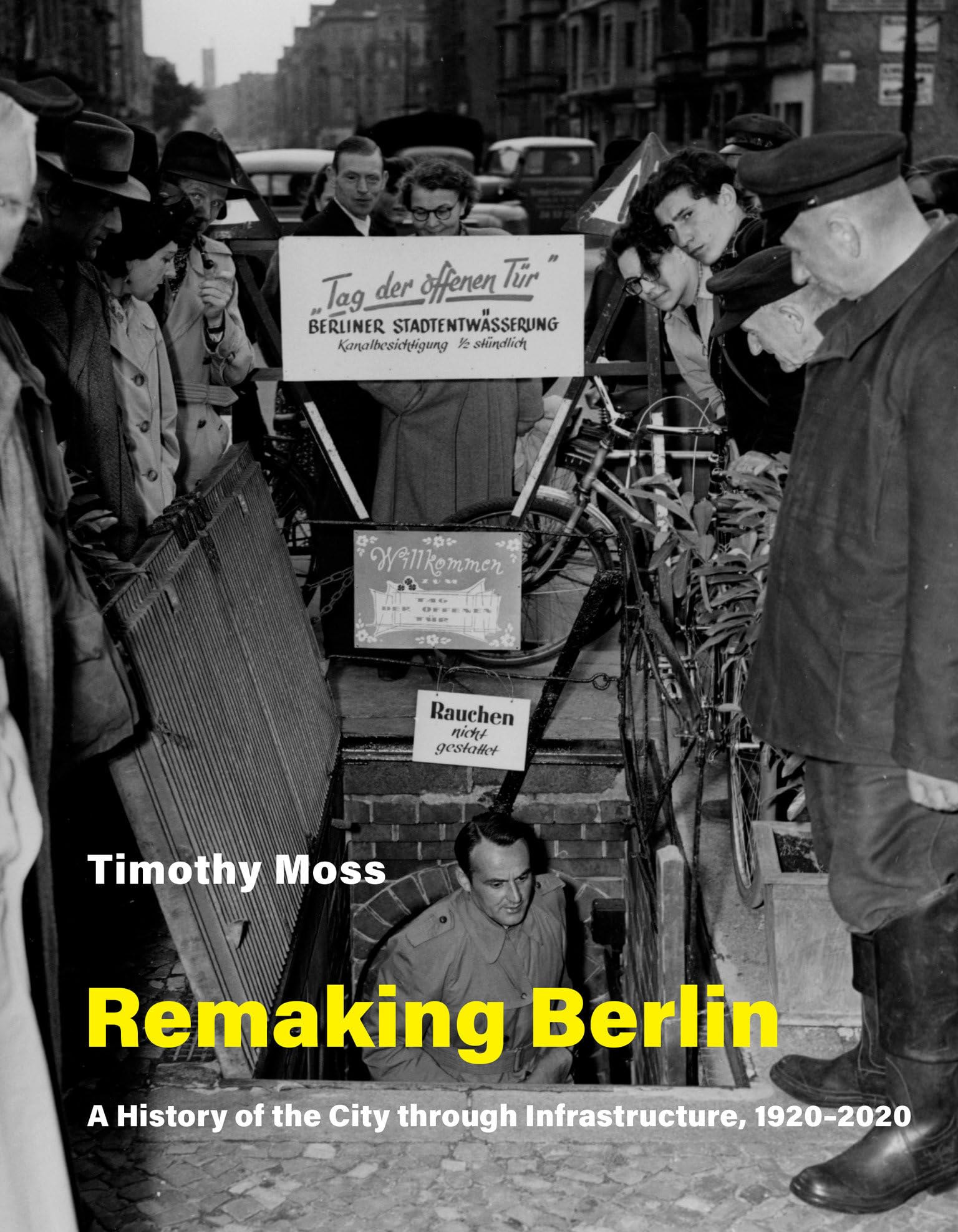
Title
Remaking Berlin: A History of the City through Infrastructure, 19202020 (Infrastructures),Used
Sold by Ergodebooks, an authorized reseller.
Returns accepted within 30 days | support@ergodebooks.com
Shipping Information
- Free Standard Shipping — United States only
- Processing Time: 3–5 business days
- Estimated Delivery: 6–10 business days after dispatch
- Double-boxed, fully insured & discreetly packaged
- Tracking number sent via email once dispatched
Returns & Refund
Returns accepted within 30 days of delivery.
Damaged or Defective Item
Free return shipping + replacement or full refund
Wrong Item Received
Free return shipping + replacement or full refund
Change of Mind
Return shipping at customer's expense · 25% restocking fee applies
Payment Option

An examination of Berlin's turbulent history through the lens of its water and energy infrastructures.In Remaking Berlin, Timothy Moss takes a novel perspective on Berlin's turbulent twentiethcentury history, examining it through the lens of its water and energy infrastructures. He shows that, through a century of changing regimes, geopolitical interventions, and socioeconomic volatility, Berlin's networked urban infrastructures have acted as medium and manifestation of municipal, national, and international politics and policies. Moss traces the coevolution of Berlin and its infrastructure systems from the creation of Greater Berlin in 1920 to remunicipalization of services in 2020, encompassing democratic, fascist, and socialist regimes. Throughout, he explores the tension between obduracy and change in Berlin's infrastructures. Examining the choices made by utility managers, politicians, and government officials, Moss makes visible systems that we often take for granted.Moss describes the reorganization of infrastructure systems to meet the needs of a new unitary city after Berlin's incorporation in 1920, and how utilities delivered on political promises; the insidious embedding of repression, racism, autarky, and militarization within the networked city under the Nazis; and the resilience of Berlin's infrastructures during wartime and political division. He examines East Berlin's socialist infrastructural ideal (and its underresourced systems), West Berlin's insular existence (and its aspirations of system autarky), and reunified Berlin's privatization of utilities (subsequently challenged by social movements). Taking Berlin as an exemplar, Moss's account will inspire researchers to take a fresh look at urban infrastructure histories, offering new ways of conceptualizing the multiple temporalities and spatialities of the networked city.
⚠️ WARNING (California Proposition 65):
This product may contain chemicals known to the State of California to cause cancer, birth defects, or other reproductive harm.
For more information, please visit www.P65Warnings.ca.gov.
- Q: How many pages does 'Remaking Berlin' have? A: This book has four hundred forty-eight pages. It provides an in-depth analysis of Berlin's infrastructure over a century.
- Q: What is the binding type of 'Remaking Berlin'? A: The book is available in paperback binding. This makes it both lightweight and easy to handle.
- Q: What are the dimensions of 'Remaking Berlin'? A: The dimensions are seven point zero one inches in length, one inch in width, and nine point zero two inches in height. These measurements make it a convenient size for reading.
- Q: Who is the author of 'Remaking Berlin'? A: The author is Timothy Moss. He is known for his scholarly work on urban infrastructure and planning.
- Q: What category does 'Remaking Berlin' fall under? A: This book falls under the category of Urban & Land Use Planning. It examines the historical context of urban infrastructure in Berlin.
- Q: What themes are explored in 'Remaking Berlin'? A: The book explores themes of infrastructure, politics, and social change. It examines how these elements have shaped Berlin from 1920 to 2020.
- Q: How do I read 'Remaking Berlin'? A: You can read this book like any novel or academic text. It is suitable for those interested in urban studies or history.
- Q: Is 'Remaking Berlin' suitable for academic research? A: Yes, it is suitable for academic research. The book provides extensive references and insights into urban infrastructure histories.
- Q: Who would benefit from reading 'Remaking Berlin'? A: Researchers, urban planners, and history enthusiasts would benefit from this book. It offers valuable perspectives on Berlin's infrastructure.
- Q: How should I store 'Remaking Berlin'? A: Store the book in a cool, dry place away from direct sunlight. This will help preserve its condition over time.
- Q: Can I clean the cover of 'Remaking Berlin'? A: Yes, you can clean the cover gently with a soft cloth. Avoid using water or cleaning solutions to prevent damage.
- Q: What if 'Remaking Berlin' arrives damaged? A: If the book arrives damaged, you should contact the retailer for a return or exchange. Most retailers have policies for damaged items.
- Q: Does 'Remaking Berlin' contain any illustrations or maps? A: The book primarily focuses on text and analysis, with limited illustrations. It emphasizes the discussion of infrastructures in a historical context.
- Q: Is 'Remaking Berlin' relevant for current urban planning discussions? A: Yes, it is relevant for current urban planning discussions. The insights into historical infrastructure can inform contemporary practices.
- Q: Are there any additional resources linked to 'Remaking Berlin'? A: The book may reference additional resources in its bibliography. Readers can explore these for further research on urban infrastructure.