
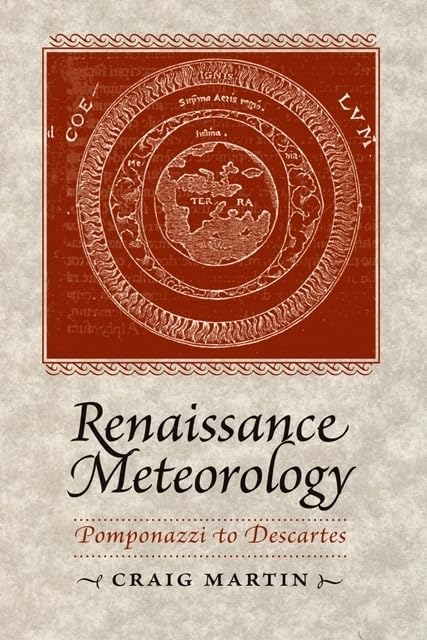
Title
Renaissance Meteorology: Pomponazzi To Descartes
Sold by Ergodebooks, an authorized reseller.
Returns accepted within 30 days | support@ergodebooks.com
Shipping Information
- Free Standard Shipping — United States only
- Processing Time: 3–5 business days
- Estimated Delivery: 6–10 business days after dispatch
- Double-boxed, fully insured & discreetly packaged
- Tracking number sent via email once dispatched
Returns & Refund
Returns accepted within 30 days of delivery.
Damaged or Defective Item
Free return shipping + replacement or full refund
Wrong Item Received
Free return shipping + replacement or full refund
Change of Mind
Return shipping at customer's expense · 25% restocking fee applies
Payment Option

Craig Martin Takes A Careful Look At How Renaissance Scientists Analyzed And Interpreted Rain, Wind, And Other Natural Phenomena Like Meteors And Earthquakes And Their Impact On The Great Thinkers Of The Scientific Revolution.Martin Argues That Meteorology Was Crucial To The Transformation That Took Place In Science During The Early Modern Period. By Examining The Conceptual Foundations Of The Subject, Martin Links Aristotelian Meteorology With The New Natural Philosophies Of The Seventeenth Century. He Argues That Because Meteorology Involved Conjecture And Observation And Forced Attention To Material And Efficient Causation, It Paralleled Developments In The Natural Philosophies Of Descartes And Other Key Figures Of The Scientific Revolution.Although An Inherently Uncertain Endeavor, Forecasting The Weather Was An Extremely Useful Component Not Just Of Scientific Study, But Also Of Politics, Courtly Life, And Religious Doctrine. Martin Explores How Natural Philosophers Of The Time Participated In Political And Religious Controversies By Debating The Meanings, Causes, And Purposes Of Natural Disasters And Other Weather Phenomena.Through Careful Readings Of An Impressive Range Of Texts, Martin Situates The History Of Meteorology Within The Larger Context Of Renaissance And Early Modern Science. The First Study On Renaissance Theories Of Weather In Five Decades, Renaissance Meteorology Offers A Novel Understanding Of Traditional Natural Philosophy And Its Impact On The Development Of Modern Science.
⚠️ WARNING (California Proposition 65):
This product may contain chemicals known to the State of California to cause cancer, birth defects, or other reproductive harm.
For more information, please visit www.P65Warnings.ca.gov.
- Q: What is 'Renaissance Meteorology: Pomponazzi to Descartes' about? A: This book examines how Renaissance scientists analyzed natural phenomena like rain, wind, and earthquakes, and their influence on scientific thought during the early modern period.
- Q: Who is the author of this book? A: The author is Craig Martin, who provides insights into the historical context of meteorology and its impact on the scientific revolution.
- Q: What is the publication date of 'Renaissance Meteorology'? A: The book was published on November 1, 2011.
- Q: How many pages does the book have? A: The book contains 224 pages.
- Q: What type of binding does this book have? A: This edition is bound in hardcover.
- Q: Is this book suitable for academic use? A: Yes, it offers a scholarly examination of Renaissance theories of weather and would be suitable for academic study in history and philosophy of science.
- Q: Does the book include illustrations? A: Yes, this is an illustrated edition, which may help in understanding the concepts discussed.
- Q: What category does this book fall under? A: The book is categorized under Europe, focusing on the history of science in that region.
- Q: Is this book a first edition? A: Yes, it is an illustrated edition, representing the first comprehensive study of Renaissance meteorology in five decades.
- Q: What themes are explored in 'Renaissance Meteorology'? A: The book explores themes of conjecture, observation, and the interplay between meteorology and political and religious thought during the Renaissance.