If you have any questions, you are always welcome to contact us. We'll get back to you as soon as possible, withing 24 hours on weekdays.
Customer service
All questions about your order, return and delivery must be sent to our customer service team by e-mail at yourstore@yourdomain.com
Sale & Press
If you are interested in selling our products, need more information about our brand or wish to make a collaboration, please contact us at press@yourdomain.com
Help
If you have any questions, you are always welcome to contact us. We'll get back to you as soon as possible, withing 24 hours on weekdays.
Customer service
All questions about your order, return and delivery must be sent to our customer service team by e-mail at yourstore@yourdomain.com
Sale & Press
If you are interested in selling our products, need more information about our brand or wish to make a collaboration, please contact us at press@yourdomain.com
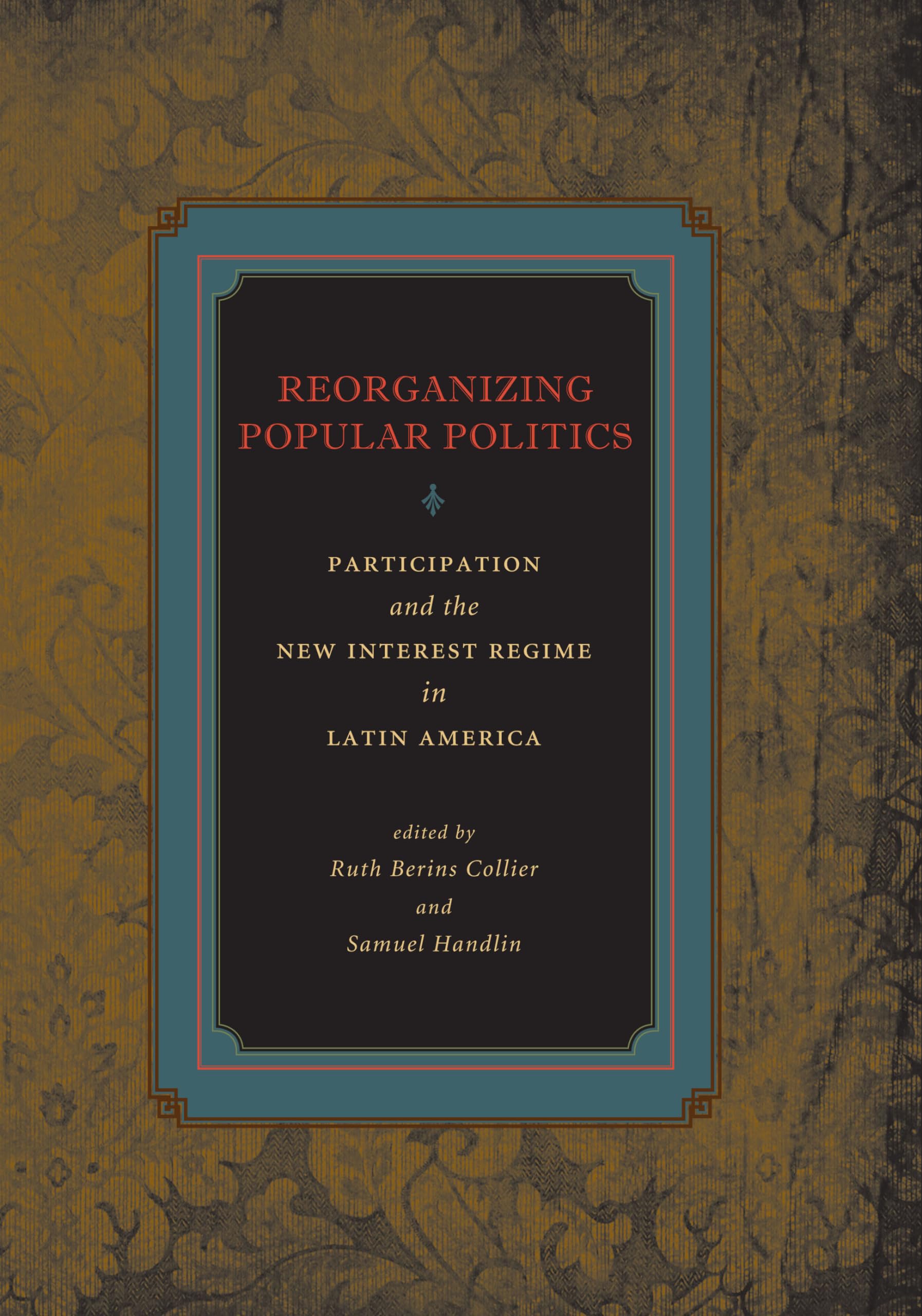
A historic shift has occurred in the organizational structures through which the lower classes in Latin America express voice and find political representation. With the political and economic reforms of the 1980s and 1990s, networks of communitybased associations and nongovernmental organizations replaced partyaffiliated labor unions as the predominant organizations to which the lower classes turned. This volume examines the new interest regime in Argentina, Chile, Peru, and Venezuela through two extensive surveysone of individuals and one of associationsundertaken in those nations capital cities.Contrary to common perceptions, the new interest regime is neither a vibrant, autonomous civil society nor a set of weak, atomized organizations. Participation in associations is generally high, compared to direct action as a strategy for pursuing collective interests, and associations more frequently coordinate and engage the state than has sometimes been assumed. However, various forms of interaction with the state pose a classic tradeoff between representation and state control, and the new interest regime is marked by representational distortion, in that the lower classes are less likely to use the new structures than the middle classes. Within these general patterns, distinct national models are emerging.This volume represents the most ambitious and systematic effort to date to examine individual participation and associational life in Latin America and to carry out a crossnational analysis of new forms of political representation.
⚠️ WARNING (California Proposition 65):
This product may contain chemicals known to the State of California to cause cancer,
birth defects, or other reproductive harm.
For MAP (Minimum Advertised Price) violations and Intellectual Property (IP) or Trademark concerns, please contact:
support@ergodebooks.com
⚠️ California Proposition 65 Warning: Some products sold on this website may expose you to chemicals known to the State of California to cause cancer, birth defects, or other reproductive harm. For more information, visit www.P65Warnings.ca.gov.