
Title
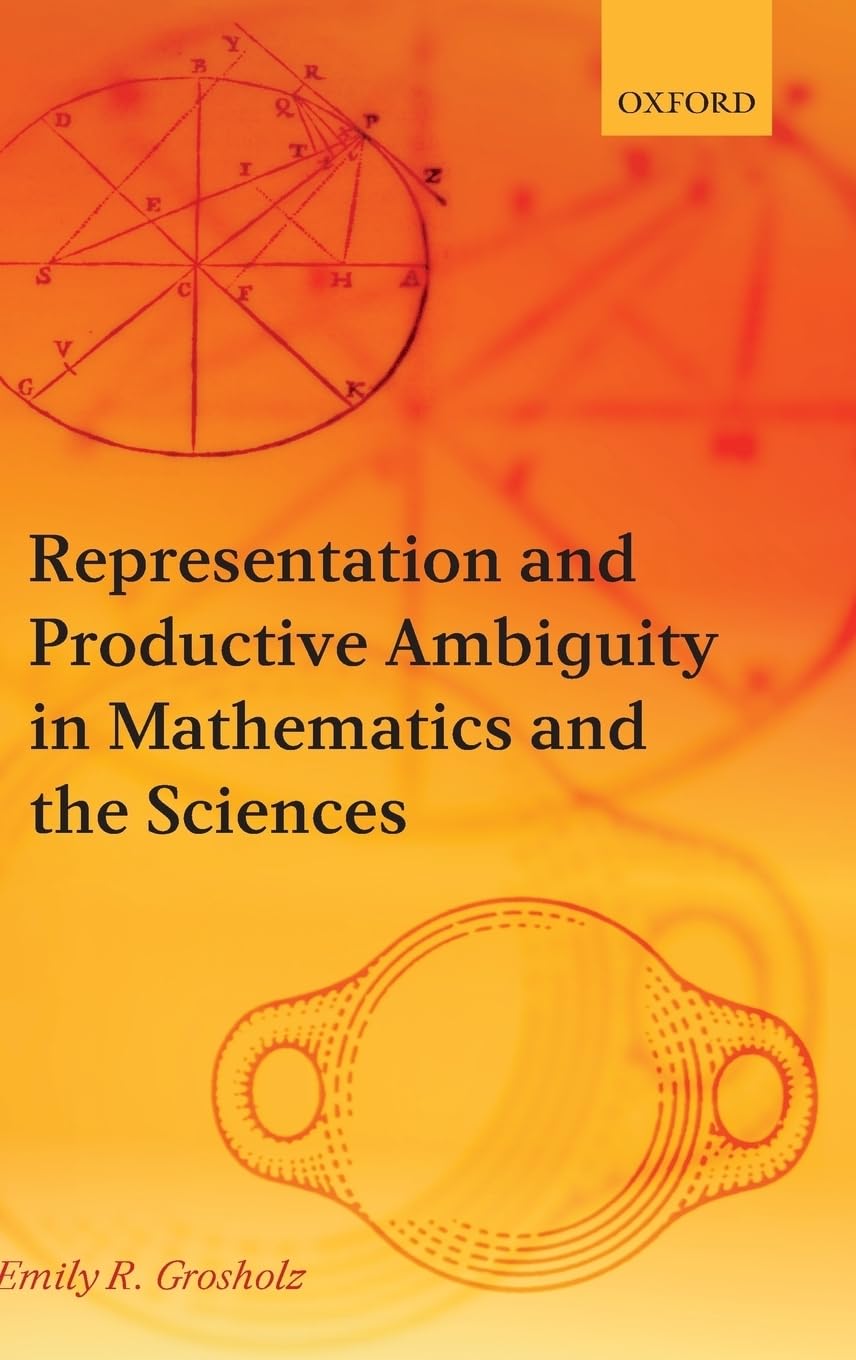
Representation and Productive Ambiguity in Mathematics and the Sciences,Used
Sold by Ergodebooks, an authorized reseller.
Returns accepted within 30 days | support@ergodebooks.com
Shipping Information
- Free Standard Shipping — United States only
- Processing Time: 3–5 business days
- Estimated Delivery: 6–10 business days after dispatch
- Double-boxed, fully insured & discreetly packaged
- Tracking number sent via email once dispatched
Returns & Refund
Returns accepted within 30 days of delivery.
Damaged or Defective Item
Free return shipping + replacement or full refund
Wrong Item Received
Free return shipping + replacement or full refund
Change of Mind
Return shipping at customer's expense · 25% restocking fee applies
Payment Option

Emily Grosholz offers an original investigation of demonstration in mathematics and science, examining how it works and why it is persuasive. Focusing on geometrical demonstration, she shows the roles that representation and ambiguity play in mathematical discovery. She presents a wide range of case studies in mechanics, topology, algebra, logic, and chemistry, from ancient Greece to the present day, but focusing particularly on the seventeenth and twentieth centuries. She argues that reductive methods are effective not because they diminish but because they multiply and juxtapose modes of representation. Such problemsolving is, she argues, best understood in terms of Leibnizian "analysis"the search for conditions of intelligibility. Discovery and justification are then two aspects of one rational way of proceeding, which produces the mathematician's formal experience.Grosholz defends the importance of iconic, as well as symbolic and indexical, signs in mathematical representation, and argues that pragmatic, as well as syntactic and semantic, considerations are indispensable fore mathematical reasoning. By taking a close look at the way results are presented on the page in mathematical (and biological, chemical, and mechanical) texts, she shows that when two or more traditions combine in the service of problem solving, notations and diagrams are subtly altered, multiplied, and juxtaposed, and surrounded by prose in natural language which explains the novel combination. Viewed this way, the texts yield striking examples of language and notation that are irreducibly ambiguous and productive because they are ambiguous. Grosholtz's arguments, which invoke Descartes, Locke, Hume, and Kant, will be of considerable interest to philosophers and historians of mathematics and science, and also have farreaching consequences for epistemology and philosophy of language.
⚠️ WARNING (California Proposition 65):
This product may contain chemicals known to the State of California to cause cancer, birth defects, or other reproductive harm.
For more information, please visit www.P65Warnings.ca.gov.