
Title
Representing And Intervening: Introductory Topics In The Philosophy Of Natural Science
Sold by Ergodebooks, an authorized reseller.
Returns accepted within 30 days | support@ergodebooks.com
Shipping Information
- Free Standard Shipping — United States only
- Processing Time: 3–5 business days
- Estimated Delivery: 6–10 business days after dispatch
- Double-boxed, fully insured & discreetly packaged
- Tracking number sent via email once dispatched
Returns & Refund
Returns accepted within 30 days of delivery.
Damaged or Defective Item
Free return shipping + replacement or full refund
Wrong Item Received
Free return shipping + replacement or full refund
Change of Mind
Return shipping at customer's expense · 25% restocking fee applies
Payment Option

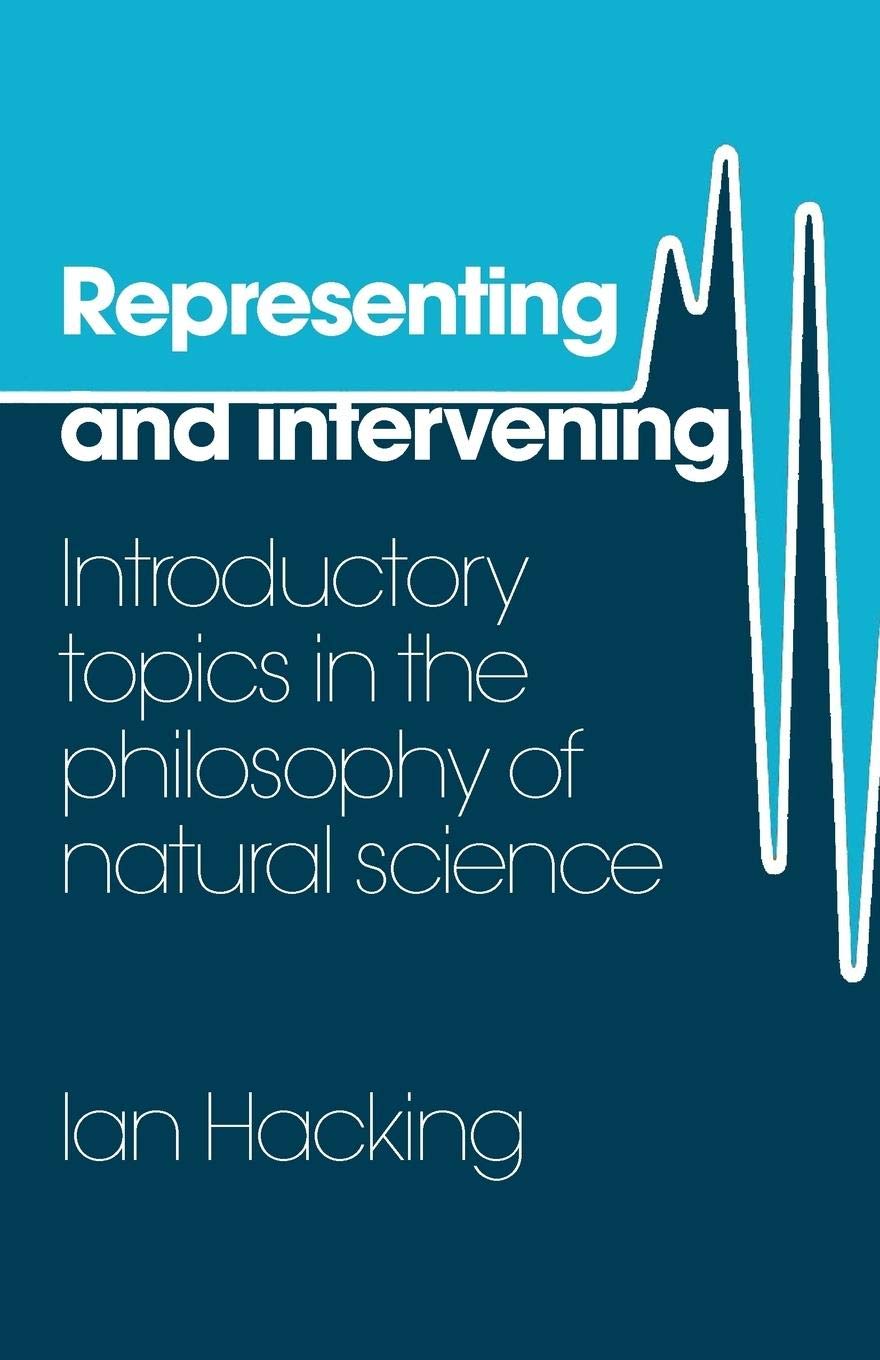
This 1983 Book Is A Lively And Clearly Written Introduction To The Philosophy Of Natural Science, Organized Around The Central Theme Of Scientific Realism. It Has Two Parts. 'Representing' Deals With The Different Philosophical Accounts Of Scientific Objectivity And The Reality Of Scientific Entities. The Views Of Kuhn, Feyerabend, Lakatos, Putnam, Van Fraassen, And Others, Are All Considered. 'Intervening' Presents The First Sustained Treatment Of Experimental Science For Many Years And Uses It To Give A New Direction To Debates About Realism. Hacking Illustrates How Experimentation Often Has A Life Independent Of Theory. He Argues That Although The Philosophical Problems Of Scientific Realism Can Not Be Resolved When Put In Terms Of Theory Alone, A Sound Philosophy Of Experiment Provides Compelling Grounds For A Realistic Attitude. A Great Many Scientific Examples Are Described In Both Parts Of The Book, Which Also Includes Lucid Expositions Of Recent High Energy Physics And A Remarkable Chapter On The Microscope In Cell Biology.
⚠️ WARNING (California Proposition 65):
This product may contain chemicals known to the State of California to cause cancer, birth defects, or other reproductive harm.
For more information, please visit www.P65Warnings.ca.gov.
- Q: What is the page count of the book? A: This book has three hundred four pages. It provides a comprehensive introduction to the philosophy of natural science.
- Q: What is the binding type of this book? A: The book is paperback. This makes it lightweight and portable for reading on the go.
- Q: Who is the author of this book? A: The author is Ian Hacking. He is well-known for his contributions to the philosophy of science.
- Q: What are the dimensions of the book? A: The book measures five point five one inches in length, zero point seven six inches in width, and eight point five inches in height. These measurements make it easy to handle.
- Q: What is the main subject of this book? A: The book focuses on the philosophy of natural science. It discusses themes like scientific realism and experimental science.
- Q: How do I use this book for study? A: You can use this book as a foundational text for understanding the philosophy of natural science. It's suitable for both beginners and advanced readers.
- Q: Is this book suitable for students? A: Yes, this book is suitable for students studying philosophy or natural science. It presents complex ideas in an accessible manner.
- Q: Is this book appropriate for beginners? A: Yes, beginners can easily grasp the concepts presented in this book. It is designed to introduce key topics in philosophy.
- Q: How should I store this book? A: Store this book in a dry, cool place. Keeping it on a shelf away from direct sunlight will help maintain its condition.
- Q: Can I clean this book? A: Yes, you can clean the book by gently dusting it with a soft cloth. Avoid using liquids that could damage the pages.
- Q: What if the book arrives damaged? A: If the book arrives damaged, you can return it for a replacement or refund. Check the return policy of the seller for details.
- Q: Does this book include illustrations? A: Yes, the book includes illustrations relevant to the concepts discussed. They enhance understanding of complex scientific ideas.
- Q: Is this book a good reference for advanced studies? A: Yes, this book is a valuable reference for advanced studies in philosophy of science. It provides deep insights into scientific realism.
- Q: Are there any notable philosophers discussed in the book? A: Yes, the book discusses philosophers like Kuhn, Feyerabend, and Lakatos. Their views contribute significantly to the themes explored.
- Q: What is the publication year of this book? A: This book was published in nineteen eighty-three. It has remained relevant in discussions of scientific realism.