
Title
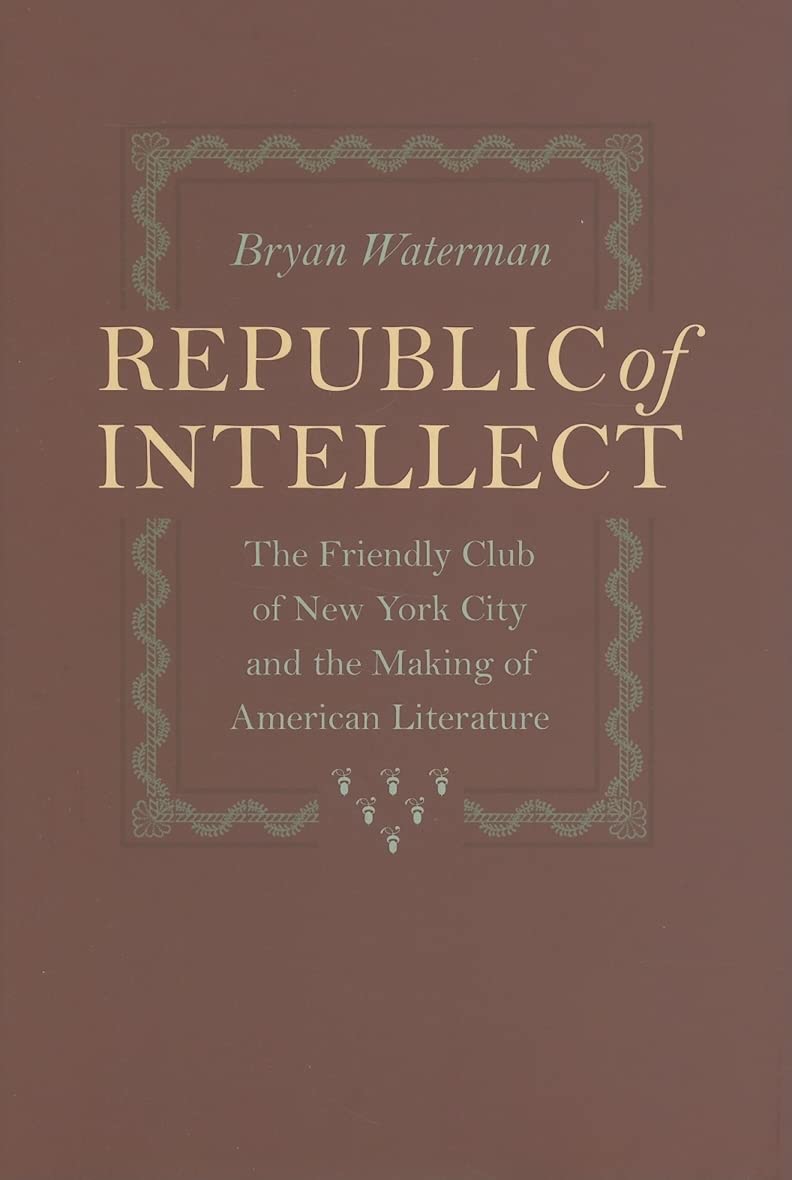
Republic of Intellect: The Friendly Club of New York City and the Making of American Literature (New Studies in American Intelle,Used
Sold by Ergodebooks, an authorized reseller.
Returns accepted within 30 days | support@ergodebooks.com
Shipping Information
- Free Standard Shipping — United States only
- Processing Time: 3–5 business days
- Estimated Delivery: 6–10 business days after dispatch
- Double-boxed, fully insured & discreetly packaged
- Tracking number sent via email once dispatched
Returns & Refund
Returns accepted within 30 days of delivery.
Damaged or Defective Item
Free return shipping + replacement or full refund
Wrong Item Received
Free return shipping + replacement or full refund
Change of Mind
Return shipping at customer's expense · 25% restocking fee applies
Payment Option

In the 1790s, a single conversational circlethe Friendly Clubunited New York City's most ambitious young writers, and in Republic of Intellect, Bryan Waterman uses an innovative blend of literary criticism and historical narrative to recreate the club's intellectual culture. The story of the Friendly Club reveals the mutually informing conditions of authorship, literary association, print culture, and production of knowledge in a specific time and placethe tumultuous, tenuous world of postrevolutionary New York City. More than any similar group in the early American republic, the Friendly Club occupied a crossroadsgeographical, professional, and otherwiseof American literary and intellectual culture.Waterman argues that the relationships among club members' novels, plays, poetry, diaries, legal writing, and medical essays lead to important first examples of a distinctively American literature and also illuminate the local, national, and transatlantic circuits of influence and information that club members called 'the republic of intellect.' He addresses topics ranging from political conspiracy in the gothic novels of Charles Brockden Brown to the opening of William Dunlap's Park Theatre, from early American debates on gendered conversation to the publication of the first American medical journal. Voluntary association and print culture helped these young New Yorkers, Waterman concludes, to produce a broader and more diverse postrevolutionary public sphere than scholars have yet recognized.
⚠️ WARNING (California Proposition 65):
This product may contain chemicals known to the State of California to cause cancer, birth defects, or other reproductive harm.
For more information, please visit www.P65Warnings.ca.gov.
- Q: What is the main focus of 'Republic of Intellect'? A: The book focuses on the Friendly Club, a conversational circle in 1790s New York City that brought together ambitious young writers, exploring its impact on American literature and intellectual culture.
- Q: Who is the author of 'Republic of Intellect'? A: The author is Bryan Waterman, who combines literary criticism with historical narrative in this work.
- Q: What is the publication date of this book? A: The book was published on May 15, 2007.
- Q: What is the format of the book? A: The book is available in hardcover format.
- Q: How many pages does 'Republic of Intellect' have? A: The book contains 344 pages.
- Q: What condition is the book in? A: The book is classified as 'New'.
- Q: What themes are explored in 'Republic of Intellect'? A: The book explores themes such as authorship, literary association, print culture, and the production of knowledge in post-revolutionary America.
- Q: Is there an edition of this book that includes annotations? A: Yes, this book is an annotated edition.
- Q: What type of readers would benefit from this book? A: Readers interested in American literature, intellectual history, and cultural studies will find this book particularly valuable.
- Q: Does 'Republic of Intellect' include discussions on specific authors or works? A: Yes, it discusses various authors and topics, including Charles Brockden Brown's gothic novels and William Dunlap's Park Theatre.