
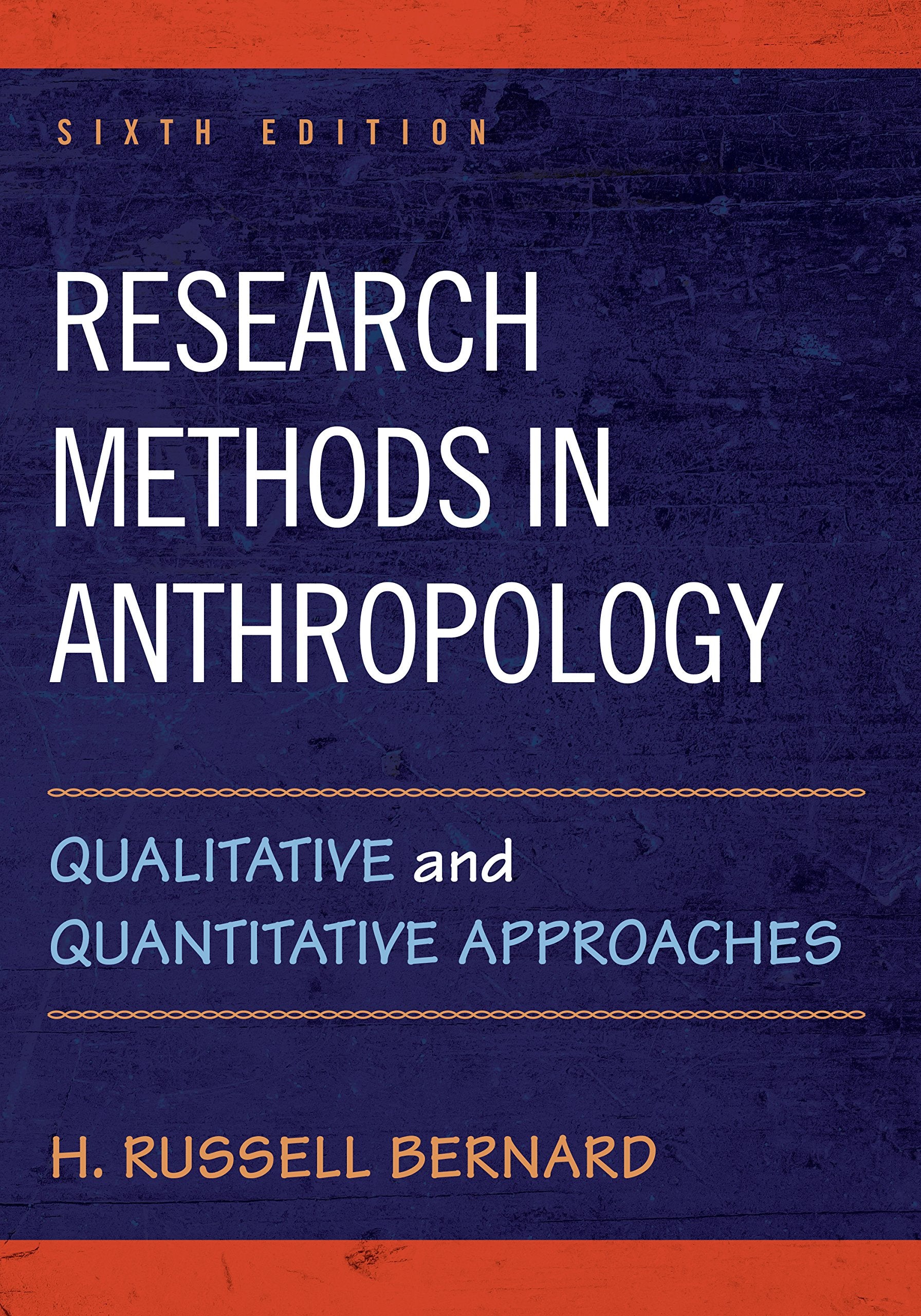
Title
Research Methods in Anthropology: Qualitative and Quantitative Approaches,Used
Sold by Ergodebooks, an authorized reseller.
Returns accepted within 30 days | support@ergodebooks.com
Shipping Information
- Free Standard Shipping — United States only
- Processing Time: 3–5 business days
- Estimated Delivery: 6–10 business days after dispatch
- Double-boxed, fully insured & discreetly packaged
- Tracking number sent via email once dispatched
Returns & Refund
Returns accepted within 30 days of delivery.
Damaged or Defective Item
Free return shipping + replacement or full refund
Wrong Item Received
Free return shipping + replacement or full refund
Change of Mind
Return shipping at customer's expense · 25% restocking fee applies
Payment Option

H. Russell Bernard's Research Methods in Anthropology, Sixth Edition, is the standard for learning about the range of methods for collecting and analyzing qualitative and quantitative data about human thought and human behavior.In the first section of the book, students learn the elements of research design, including how to choose a research topic, how to develop research questions and hypotheses, and how to choose an appropriate sample for their research.In the next section, students learn the methods of data collection, including: openended interviewing, questionnaire design, participant observation, direct and indirect observation, building scales in the field, and taking and managing field notes. This section also introduces the methods for cultural domain analysis and network analysis.The last section of the book covers methods for analyzing all these kinds of data, including: finding and analyzing themes in text, conversation and narrative analysis, and decision modeling, as well as descriptive and inferential statistics, multidimensional scaling. and cluster analysis. There is no separate chapter on ethics. That topic is important in every phase of research, even in the beginning phase of choosing a problem to study, and is covered throughout the book.A comprehensive research methods text for cultural anthropologists Covers research design, data collection and data analysis Full coverage of both qualitative and quantitative approaches Written in plain language. Turns research methods into fun reading A real howto, handson text Extensive bibliography on all topics covered in the book
⚠️ WARNING (California Proposition 65):
This product may contain chemicals known to the State of California to cause cancer, birth defects, or other reproductive harm.
For more information, please visit www.P65Warnings.ca.gov.
- Q: What are the main topics covered in 'Research Methods in Anthropology'? A: The book covers research design, data collection methods, and data analysis techniques for both qualitative and quantitative approaches in anthropology.
- Q: Who is the author of this book? A: The author is H. Russell Bernard, a professor at the University of Florida.
- Q: Is this book suitable for beginners in anthropology? A: Yes, the book is written in plain language, making it accessible for beginners while also comprehensive for advanced readers.
- Q: What is the publication date of the sixth edition? A: The sixth edition was published on November 17, 2017.
- Q: How many pages does the book have? A: The book contains 728 pages.
- Q: What type of binding does this book have? A: This book is available in paperback binding.
- Q: Does the book include information on ethics in research? A: While there is no separate chapter on ethics, the topic is integrated throughout the book in relation to all phases of research.
- Q: What methods of data collection are discussed in the book? A: The book discusses methods such as open-ended interviewing, questionnaire design, participant observation, and direct and indirect observation.
- Q: Is there a bibliography included in the book? A: Yes, the book includes an extensive bibliography covering all topics discussed.
- Q: What makes this book different from other research methods texts? A: This book combines both qualitative and quantitative approaches and aims to make research methods engaging and practical for students.